Introduction to Exokernel Architecture
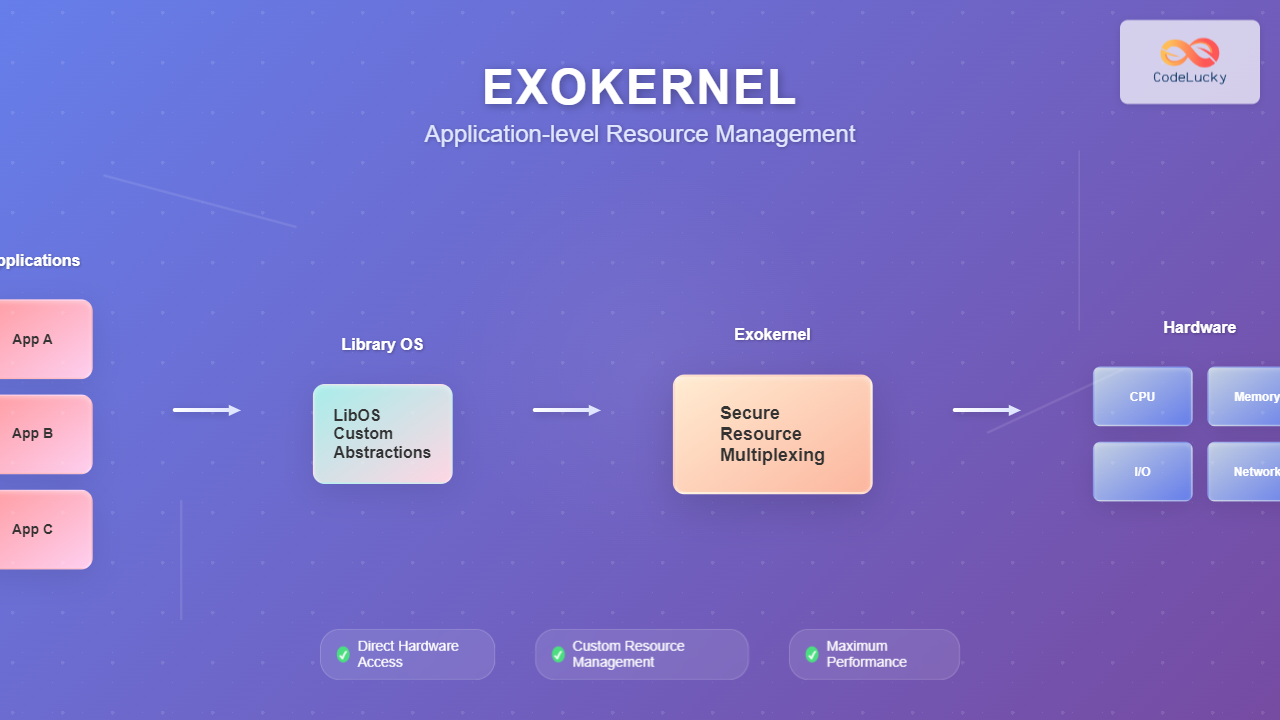
The exokernel represents a revolutionary approach to operating system design that fundamentally challenges traditional kernel architectures. Unlike monolithic kernels or microkernels, exokernels provide application-level resource management by securely multiplexing hardware resources while allowing applications to implement their own abstractions through library operating systems.
Developed at MIT in the 1990s by Dawson Engler and M. Frans Kaashoek, the exokernel architecture addresses the performance and flexibility limitations of conventional operating systems by eliminating unnecessary abstractions and providing direct, protected access to hardware resources.

Core Principles of Exokernel Design
Secure Multiplexing
The primary responsibility of an exokernel is secure multiplexing of hardware resources. This involves three fundamental mechanisms:
- Track ownership of resources
- Ensure protection during resource access
- Revoke access when necessary
The exokernel maintains minimal abstractions, focusing solely on safely sharing physical resources among applications rather than providing high-level services or policies.
Separation of Protection and Management
Traditional operating systems combine resource protection with resource management policies. Exokernels separate these concerns:
- Exokernel: Handles protection and secure access
- Library OS: Implements management policies and abstractions
This separation enables applications to implement custom resource management strategies optimized for their specific requirements.
Library Operating Systems (LibOS)
Library operating systems are application-level libraries that provide traditional OS abstractions like file systems, virtual memory, and process management. They run in user space and communicate with the exokernel through well-defined interfaces.

LibOS Characteristics
Library operating systems in exokernel architecture exhibit several key characteristics:
- Application-specific: Tailored to specific application requirements
- Untrusted: Run in user mode without kernel privileges
- Replaceable: Can be swapped or customized without kernel changes
- Efficient: Direct access to hardware reduces overhead
Resource Management in Exokernels
Memory Management
Exokernel memory management differs significantly from traditional virtual memory systems. Instead of providing virtual memory abstractions, the exokernel:
- Tracks physical page ownership
- Validates memory access rights
- Allows applications to manage their own page tables
Example: Physical Memory Allocation
// LibOS requests physical pages from exokernel
physical_page_t* pages = exokernel_alloc_pages(num_pages, READABLE | WRITABLE);

// LibOS creates custom page table entries
for (int i = 0; i < num_pages; i++) {
    page_table_entry_t pte;
    pte.physical_addr = pages[i].addr;
    pte.virtual_addr = virtual_base + (i * PAGE_SIZE);
    pte.permissions = READABLE | WRITABLE | USER_MODE;

    // Install PTE through exokernel
    exokernel_install_pte(&pte);
}
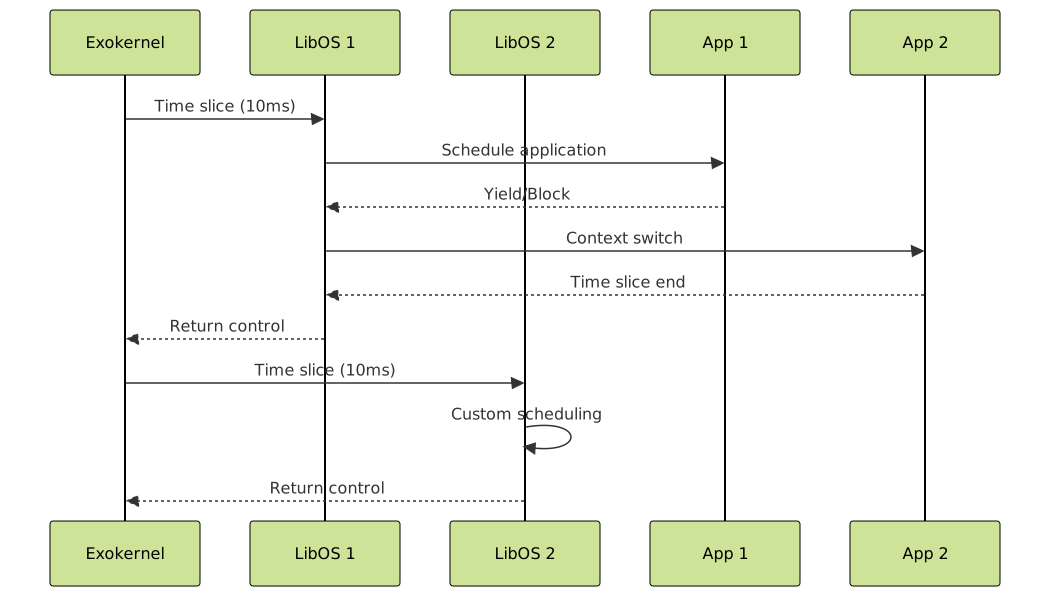
CPU Scheduling
CPU scheduling in exokernels operates at two levels:
- Exokernel level: Time-slice allocation to LibOS instances
- LibOS level: Application-specific scheduling within time slices
I/O Resource Management
Exokernels provide secure access to I/O devices through secure bindings – cryptographically protected capabilities that allow applications to access specific hardware resources.
Example: Network I/O Binding
// Create secure binding for network interface
secure_binding_t* net_binding = exokernel_bind_network_interface(
    ETHERNET_DEV_0,           // Device identifier
    application_id,           // Application ID
    SEND_RECEIVE_PACKETS      // Permission flags
);

// Use binding to access network directly
packet_t packet;
populate_packet(&packet, data, length);
exokernel_send_packet(net_binding, &packet);
Advantages of Exokernel Architecture
Performance Benefits
Exokernels offer significant performance advantages:
- Reduced overhead: Elimination of unnecessary abstraction layers
- Direct hardware access: Applications can optimize hardware usage
- Custom optimizations: Application-specific resource management
- Minimal kernel crossings: Fewer system calls and context switches
Flexibility and Customization
The architecture provides unprecedented flexibility:
- Multiple abstractions: Different applications can use different OS interfaces
- Experimental systems: Easy prototyping of new OS concepts
- Legacy compatibility: LibOS can emulate existing OS interfaces
- Specialized applications: Custom optimizations for specific workloads
Implementation Challenges
Complexity Management
Implementing exokernels presents several challenges:
- Security verification: Ensuring secure resource multiplexing
- LibOS development: Creating reliable library operating systems
- Hardware abstraction: Managing diverse hardware interfaces
- Resource revocation: Safely reclaiming resources from applications

Development Overhead
While exokernels provide flexibility, they require significant development effort:
- LibOS implementation: Applications need sophisticated library OS
- Hardware knowledge: Developers must understand low-level hardware details
- Security considerations: Careful design to prevent security vulnerabilities
- Testing complexity: Validating custom resource management policies
Real-world Exokernel Systems
Aegis and ExOS
The first practical exokernel system, developed at MIT:
- Aegis: The exokernel providing secure resource multiplexing
- ExOS: A library operating system running on Aegis
- Performance: Demonstrated significant improvements in application performance
XOK
A more recent exokernel implementation featuring:
- Web server optimization: Custom LibOS for high-performance web serving
- Application-level networking: Direct network stack implementation
- Zero-copy I/O: Efficient data movement between network and storage
Comparison with Other Kernel Architectures

| Aspect | Monolithic | Microkernel | Exokernel |
|---|---|---|---|
| Abstraction Level | High-level | Moderate | Minimal |
| Performance | Good | Moderate | Excellent |
| Flexibility | Limited | Good | Excellent |
| Complexity | Kernel | Services | LibOS |
| Security | Kernel-enforced | IPC-based | Capability-based |
Future Directions and Research
Modern Applications
Current research explores exokernel concepts in:
- Cloud computing: Container and virtualization optimization
- IoT devices: Minimal kernel footprint for embedded systems
- Real-time systems: Predictable resource allocation
- High-performance computing: Custom optimizations for scientific applications
Hybrid Approaches
Modern systems incorporate exokernel principles:
- User-space networking: DPDK and similar frameworks
- User-space file systems: FUSE and application-specific storage
- Container runtimes: Minimal kernel interfaces for containerized applications
- Unikernels: Single-address-space operating systems
Practical Considerations for Implementation
Security Model
Implementing secure resource multiplexing requires:
- Capability-based access control: Cryptographically secure resource bindings
- Resource quotas: Preventing resource exhaustion attacks
- Secure boot: Establishing trust in LibOS components
- Memory protection: Hardware-enforced isolation between applications
Performance Optimization
Key optimization strategies include:
- Zero-copy operations: Direct data movement between hardware and applications
- Batch operations: Amortizing system call overhead
- Application-specific caching: Custom cache management policies
- Hardware specialization: Leveraging specific hardware features
Conclusion
Exokernel architecture represents a fundamental shift in operating system design philosophy, prioritizing performance and flexibility over traditional abstractions. By providing secure, low-level access to hardware resources and delegating high-level policies to library operating systems, exokernels enable unprecedented customization and optimization opportunities.
While the complexity of implementing robust library operating systems presents challenges, the benefits of exokernel architecture—including improved performance, application-specific optimizations, and system flexibility—make it an attractive approach for specialized systems and research environments. As modern computing demands increasingly diverse and performance-critical applications, exokernel concepts continue to influence contemporary system design, from container technologies to high-performance networking frameworks.
The exokernel’s core insight—that operating systems should provide mechanism rather than policy—remains relevant in today’s computing landscape, where applications have increasingly diverse requirements that traditional one-size-fits-all operating systems struggle to accommodate efficiently.
Related Posts
Operating System Architecture: Monolithic vs Microkernel Design Patterns
Introduction to Operating System Architecture Operating system architecture defines how the core components of an OS are organized and interact...
Microkernel Operating System: Modular Architecture for Enhanced System Reliability
What is a Microkernel Operating System? A microkernel operating system represents a minimalist approach to kernel design where only the...
Kernel in Operating System: Core Functions and Memory Management
The kernel stands as the fundamental cornerstone of any operating system, serving as the critical bridge between hardware components and...
Monolithic Kernel: Complete Guide to Traditional Kernel Architecture
What is a Monolithic Kernel? A monolithic kernel is a traditional kernel architecture where the entire operating system runs in...
System Calls in Operating System: Complete Guide to User-Kernel Interface
System calls serve as the fundamental bridge between user applications and the operating system kernel, enabling programs to request services...
Hybrid Kernel: Complete Guide to Combining Micro and Monolithic Kernel Architectures
A hybrid kernel represents an evolutionary approach in operating system design that strategically combines elements from both microkernel and monolithic...
Embedded Operating System: Complete Guide to Resource-Constrained Environments
Embedded operating systems form the backbone of countless devices we interact with daily, from smart home appliances to automotive control...
Windows NT Kernel: Complete Guide to Design, Architecture and Implementation
Introduction to Windows NT Kernel The Windows NT Kernel forms the foundation of all modern Windows operating systems, from Windows...
Multithreading in Operating Systems: Benefits, Challenges, and Implementation Guide
What is Multithreading in Operating Systems? Multithreading is a fundamental concept in modern operating systems that allows a single process...
Container Virtualization: Complete Guide to OS-level Virtualization Technology
Container virtualization represents a revolutionary approach to application deployment and resource management through OS-level virtualization. Unlike traditional hardware virtualization, containers...
Container Operating Systems: Complete Guide to Docker and Kubernetes Platforms
Container operating systems have revolutionized how we deploy, manage, and scale applications in modern computing environments. Unlike traditional operating systems...
Garbage Collection in Operating System: Complete Guide to Automatic Memory Management
What is Garbage Collection in Operating Systems? Garbage collection is an automatic memory management technique used by operating systems and...