What is the Excel FACT Function?
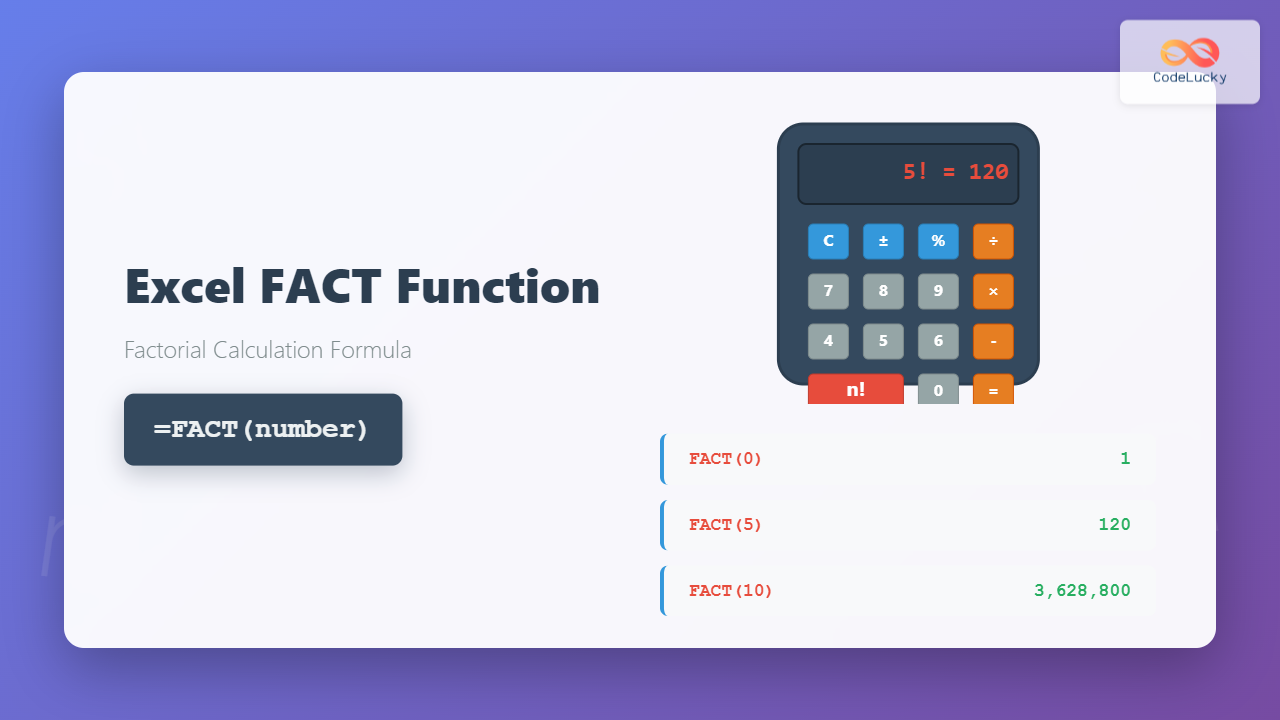
The Excel FACT function is a powerful mathematical function that calculates the factorial of a given number. A factorial, denoted by the exclamation mark (!), represents the product of all positive integers from 1 up to that number. For example, 5! equals 5 × 4 × 3 × 2 × 1 = 120.
This function is particularly useful in statistical analysis, probability calculations, combinatorics, and various mathematical modeling scenarios where factorial computations are required.
FACT Function Syntax and Parameters
The syntax for the Excel FACT function is straightforward:
=FACT(number)Parameters:
- number (required): The non-negative integer for which you want to calculate the factorial. This value must be greater than or equal to 0 and less than or equal to 170.
Important Constraints
The FACT function has specific limitations you should be aware of:
- The input must be a non-negative integer (0 or positive whole number)
- The maximum value is 170, as 171! exceeds Excel’s numerical precision limits
- Decimal numbers are automatically truncated to integers
- Negative numbers will result in a #NUM! error
Basic FACT Function Examples
Simple Factorial Calculations
Here are fundamental examples of using the FACT function:
=FACT(0)    // Returns 1 (0! = 1 by definition)
=FACT(1)    // Returns 1 (1! = 1)
=FACT(5)    // Returns 120 (5! = 5×4×3×2×1)
=FACT(10)   // Returns 3,628,800
Using Cell References
You can reference cells containing numbers instead of typing values directly:
=FACT(A1)   // Calculates factorial of value in cell A1
=FACT(B2+1) // Calculates factorial of (B2 value + 1)
Advanced FACT Function Applications
Probability and Combinatorics
The FACT function is essential for probability calculations and combinatorial analysis. Here’s how to calculate combinations using factorials:
// Calculate combinations C(n,r) = n! / (r! × (n-r)!)
=FACT(A1)/(FACT(B1)*FACT(A1-B1))
This formula calculates “n choose r” combinations, useful in probability theory and statistical analysis.
Permutation Calculations
For permutations, you can use FACT with this formula:
// Calculate permutations P(n,r) = n! / (n-r)!
=FACT(A1)/FACT(A1-B1)
Statistical Applications
Factorials are crucial in various statistical distributions, particularly the Poisson distribution:
// Poisson probability formula component
=EXP(-A1)*POWER(A1,B1)/FACT(B1)
Error Handling and Troubleshooting
Common FACT Function Errors
#NUM! Error: This occurs when:
- The input number is negative
- The input number exceeds 170
- The result is too large for Excel to handle
#VALUE! Error: This happens when:
- The input is not a number
- The input is text that cannot be converted to a number
Error Prevention Techniques
Use data validation and error-checking formulas to prevent common issues:
=IF(A1<0,"Invalid: Negative number",IF(A1>170,"Invalid: Too large",FACT(A1)))This formula checks for valid input before calculating the factorial.
FACT Function with Other Excel Functions
Combining with COMBIN Function
Excel also provides the COMBIN function for direct combination calculations, which internally uses factorial logic:
=COMBIN(10,3) // Equivalent to FACT(10)/(FACT(3)*FACT(7))Using FACT in Array Formulas
You can apply FACT to ranges of cells using array formulas:
=FACT(A1:A5) // Calculates factorial for each cell in the rangePerformance Considerations and Best Practices
Optimization Tips
When working with large datasets or complex formulas involving FACT:
- Cache factorial results in separate cells if used multiple times
- Use absolute cell references ($A$1) when copying formulas
- Consider using Excel’s built-in statistical functions when available
Alternative Approaches
For very large factorial calculations or when working beyond Excel’s limits, consider:
- Using logarithmic approaches: =EXP(GAMMALN(n+1))
- Breaking down calculations into smaller components
- Using specialized statistical software for extreme values
Real-World Use Cases
Quality Control and Six Sigma
In quality control processes, factorials help calculate process capability indices and defect probabilities.
Financial Modeling
Factorial calculations appear in option pricing models and risk assessment formulas, particularly in Monte Carlo simulations.
Scientific Research
Researchers use factorials in experimental design, calculating the number of possible arrangements in factorial experiments.
Comparison with Other Spreadsheet Applications
The FACT function is available in most major spreadsheet applications:
- Google Sheets: Identical syntax and functionality
- LibreOffice Calc: Same implementation with identical constraints
- Apple Numbers: Supports FACT function with similar limitations
Troubleshooting Common Issues
Large Number Handling
When working with factorials near the 170 limit, results may display in scientific notation. Use number formatting to control display:
Format Cells > Number > Decimal places: 0Precision Considerations
Excel uses double-precision floating-point arithmetic, which can introduce minor rounding errors in very large factorial calculations. For critical applications requiring exact precision, consider alternative calculation methods.
Integration with Excel’s Mathematical Functions
The FACT function works seamlessly with Excel’s extensive mathematical function library:
- GAMMA function: FACT(n) equals GAMMA(n+1) for positive integers
- LN function: Use LN(FACT(n)) for logarithmic factorial calculations
- POWER function: Combine with FACT for advanced probability distributions
Conclusion
The Excel FACT function is an essential tool for anyone working with mathematical calculations, statistical analysis, or probability theory in spreadsheets. Understanding its syntax, limitations, and practical applications enables you to leverage its power effectively in various professional scenarios.
Whether you’re calculating combinations for market research, analyzing experimental designs, or working with probability distributions, the FACT function provides the computational foundation for accurate factorial calculations within Excel’s versatile environment.
Remember to validate your inputs, understand the function’s constraints, and consider alternative approaches when working with values approaching the function’s limits. With proper implementation, the FACT function becomes a valuable addition to your Excel formula toolkit.
Related Posts

Excel SIGN Function: Master Number Sign Detection with Practical Examples
The Excel SIGN function is a powerful mathematical tool that determines whether a number is positive, negative, or zero. This...

C++ How To: Calculate Factorial
In the world of mathematics and programming, the factorial of a non-negative integer is a fundamental concept. It's denoted by...

Excel ABS Function: Complete Guide to Absolute Value Calculations
The ABS function in Microsoft Excel is one of the most fundamental mathematical functions that converts any number to its...

Excel POWER Function: Complete Guide to Exponentiation Formula with Examples
What is the Excel POWER Function? The Excel POWER function is a built-in mathematical function that calculates the result of...

Excel ISNUMBER Function: Complete Guide to Numeric Value Detection and Validation
What is the Excel ISNUMBER Function? The ISNUMBER function in Microsoft Excel is a logical function that tests whether a...

Excel EXP Function: Complete Guide to Exponential Calculations
What is the Excel EXP Function? The Excel EXP function is a powerful mathematical function that calculates the exponential value...

Excel MOD Function: Master Remainder Calculations with Formula Examples
The Excel MOD function is a powerful mathematical tool that calculates the remainder after dividing one number by another. Whether...

Excel NOT Function: Complete Guide to Reverse Logic Formulas
What is the Excel NOT Function? The Excel NOT function is a powerful logical function that reverses the logical value...

Excel INT Function: Complete Guide to Integer Extraction and Rounding
The Excel INT function is a fundamental mathematical function that extracts the integer portion of a number by rounding it...
Excel AGGREGATE Function: Complete Guide to Advanced Statistical Calculations
Excel's AGGREGATE function is one of the most powerful and versatile statistical functions available in Microsoft Excel. Unlike traditional statistical...

Excel CEILING Function: Complete Guide to Rounding Up Numbers
The Excel CEILING function is a powerful mathematical tool that rounds numbers up to the nearest specified multiple. Whether you're...

Excel PERMUT Function: Complete Guide to Permutation Calculations
What is the Excel PERMUT Function? The PERMUT function in Microsoft Excel calculates the number of permutations for a given...