Exchange-Traded Funds (ETFs) are one of the easiest and most popular ways for beginners to start investing in the stock market. They offer instant diversification, lower costs, and simplicity compared to picking individual stocks. In this guide by CodeLucky.com, we’ll break down what ETFs are, how they work, and which ETFs are best for new investors.
What Are ETFs?
An ETF (Exchange-Traded Fund) is an investment fund that holds a collection of securities—such as stocks, bonds, or commodities—and trades on stock exchanges, just like a regular stock. Each ETF aims to track the performance of a specific index or sector, such as the S&P 500 or Nasdaq 100.
Think of an ETF as a “basket” that contains many different investments. By buying one ETF share, you own a small portion of all the underlying assets.

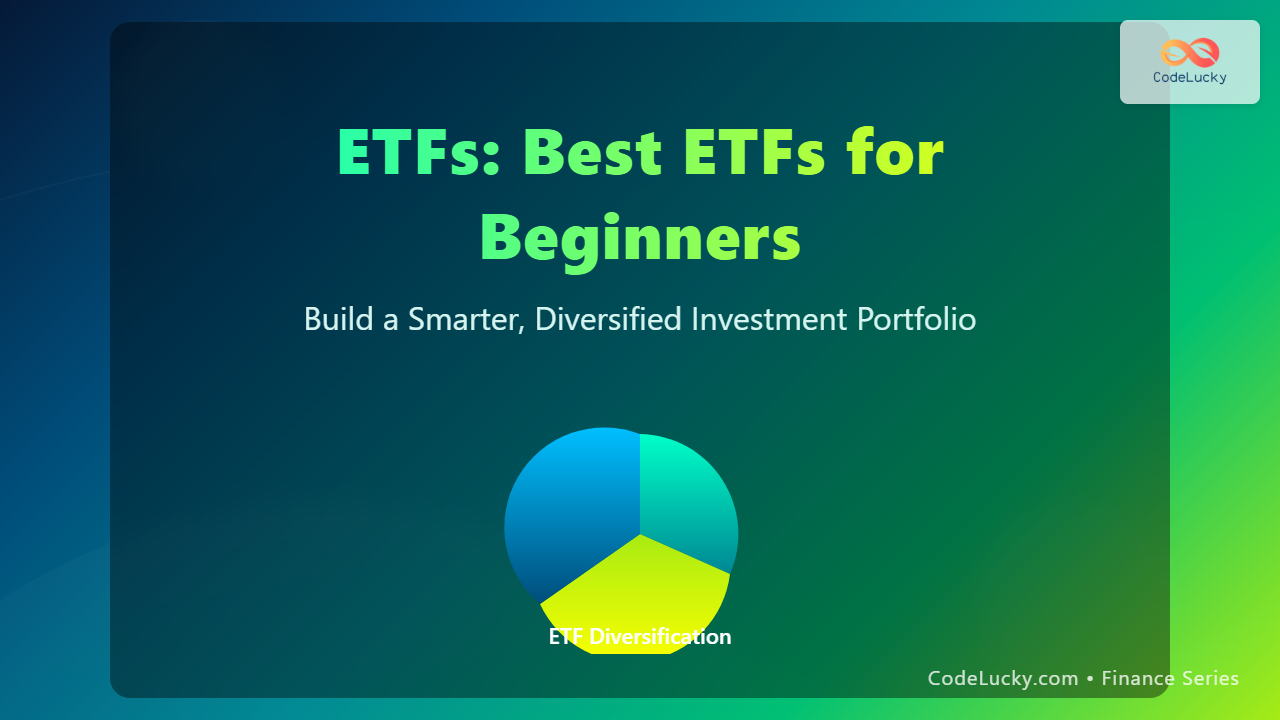
This diagram shows how an ETF combines different asset types, offering built-in diversification.
How ETFs Work
ETFs trade on stock exchanges throughout the day, allowing investors to buy and sell them at real-time prices. This flexibility is a major advantage over mutual funds, which only trade at the end of the day.

ETFs combine the best of both worlds: the diversification of mutual funds and the liquidity of stocks.
Types of ETFs
Before choosing an ETF, it’s helpful to understand the main types available:
- Stock ETFs: Track major stock indices like the S&P 500 or Nasdaq 100.
- Bond ETFs: Focus on government or corporate bonds, ideal for conservative investors.
- Commodity ETFs: Include gold, silver, or oil ETFs to hedge against inflation.
- Sector ETFs: Focus on specific industries like technology, healthcare, or energy.
- International ETFs: Provide access to global markets and emerging economies.

This visual example shows a diversified ETF portfolio suitable for risk-balanced growth.
Advantages of ETFs for Beginners
- Diversification: Own hundreds of assets through one simple investment.
- Low Fees: ETFs typically have lower expense ratios than mutual funds.
- Liquidity: Buy and sell like regular stocks throughout the day.
- Transparency: ETF holdings are usually disclosed daily.
- Accessibility: Start investing with small amounts—many brokers offer fractional shares.

This flow shows a simple ETF investing process that even a first-time investor can follow easily.
Best ETFs for Beginners (2025)
Here are some well-known ETFs ideal for beginners looking for a mix of growth and safety. These examples are for educational purposes only, not financial advice.
| ETF Name | Tracks | Expense Ratio | Why It’s Good for Beginners |
|---|---|---|---|
| Vanguard S&P 500 ETF (VOO) | S&P 500 Index | 0.03% | Provides exposure to 500 largest U.S. companies; highly diversified. |
| Schwab U.S. Broad Market ETF (SCHB) | Total U.S. Market | 0.03% | Includes large, mid, and small-cap U.S. stocks. |
| iShares Core MSCI EAFE ETF (IEFA) | Developed International Markets | 0.07% | Offers global diversification outside the U.S. |
| Vanguard Total Bond Market ETF (BND) | U.S. Bond Market | 0.03% | Ideal for stable income and risk balancing. |
| SPDR Gold Shares (GLD) | Gold Price | 0.40% | Acts as hedge against inflation and market volatility. |
Interactive ETF Calculator Example
Here’s a simple interactive example (HTML + JavaScript) to estimate potential ETF returns:
<label>Investment Amount: </label>
<input type="number" id="amount" value="10000"><br>
<label>Average Annual Return (%): </label>
<input type="number" id="rate" value="8"><br>
<label>Years: </label>
<input type="number" id="years" value="10"><br>
<button onclick="calculateETF()">Calculate</button>
<p id="result"></p>
<script>
function calculateETF(){
  let A = parseFloat(document.getElementById('amount').value);
  let r = parseFloat(document.getElementById('rate').value)/100;
  let y = parseInt(document.getElementById('years').value);
  let final = A * Math.pow(1 + r, y);
  document.getElementById('result').innerText =
      'Estimated Value: $' + final.toFixed(2);
}
</script>
This simple interactive snippet lets readers input their own values to visualize possible ETF growth over time.

Pro Tips for ETF Investing
- Start with broad-market ETFs for simplicity and lower risk.
- Use SIP (Systematic Investment Plan) to invest small amounts monthly.
- Consider tax-efficient ETFs that reduce capital gains impact.
- Avoid chasing performance; focus on long-term growth.
- Rebalance your portfolio annually to maintain ideal allocation.
Key Takeaways
ETFs are an excellent choice for beginners—simple, affordable, and transparent. By choosing the right mix of ETFs, new investors can build a diversified portfolio suited for steady, long-term growth. The best approach is to start small, stay consistent, and keep learning about how your ETFs perform over time.
Disclaimer: The information provided in this article is for educational purposes only and does not constitute financial advice. Always consult a licensed financial advisor before making investment decisions.