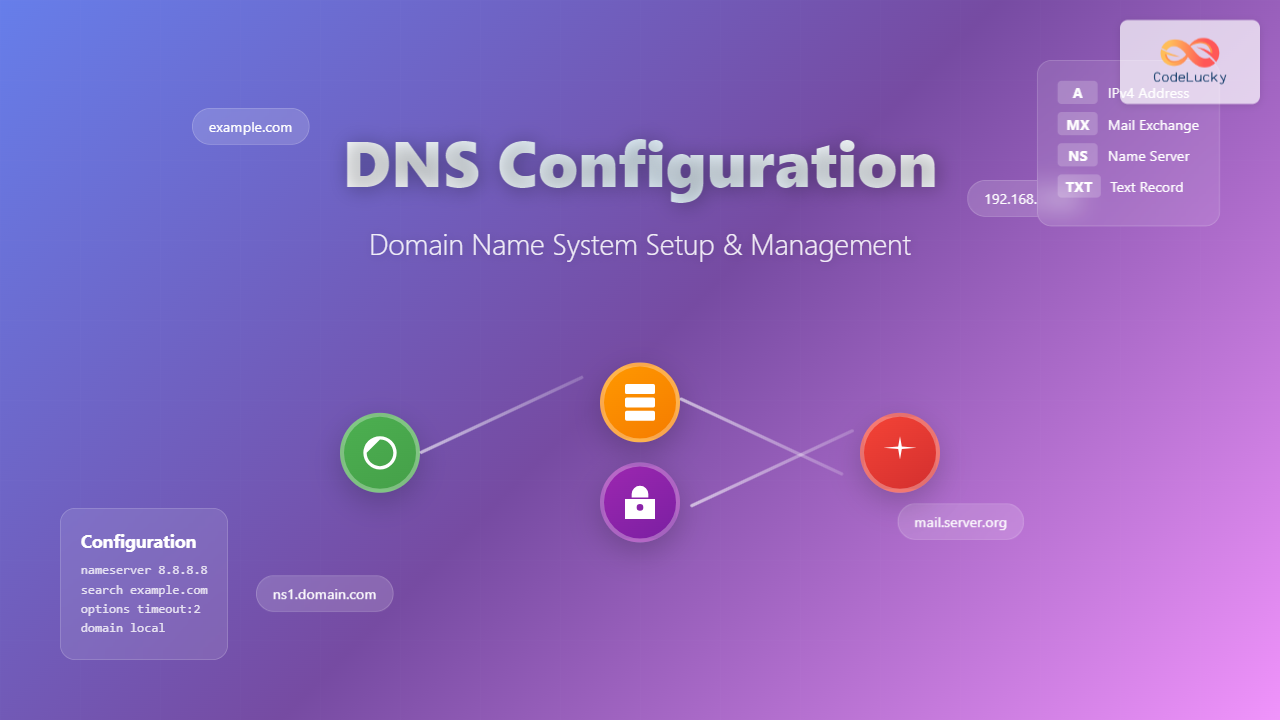
Understanding DNS Configuration in Operating Systems
The Domain Name System (DNS) is a critical component of modern computing infrastructure that translates human-readable domain names into IP addresses. Proper DNS configuration is essential for network connectivity, web browsing, email services, and virtually all internet-based applications. This comprehensive guide explores DNS configuration across different operating systems, providing practical examples and advanced troubleshooting techniques.

DNS Resolution Process and Components
DNS resolution involves multiple components working together to resolve domain names. Understanding these components is crucial for effective DNS configuration:
Key DNS Components
- DNS Resolver: Client-side component that initiates DNS queries
- Recursive DNS Server: Performs the full resolution process on behalf of clients
- Root DNS Servers: Top-level servers in the DNS hierarchy
- TLD DNS Servers: Manage top-level domains (.com, .org, .net)
- Authoritative DNS Servers: Hold the actual DNS records for specific domains
- DNS Cache: Temporary storage for resolved DNS queries
DNS Configuration Files and Locations
Different operating systems store DNS configuration in various locations. Understanding these file locations is essential for manual configuration and troubleshooting.
Linux DNS Configuration
Linux systems primarily use several configuration files for DNS settings:
# Primary DNS resolver configuration
/etc/resolv.conf

# Static hostname to IP mappings
/etc/hosts

# Service resolution order
/etc/nsswitch.conf

# SystemD resolved configuration (modern systems)
/etc/systemd/resolved.conf
Example /etc/resolv.conf Configuration
# DNS servers in order of preference
nameserver 8.8.8.8
nameserver 8.8.4.4
nameserver 1.1.1.1

# Default domain for hostname resolution
domain example.com

# Search domains for short hostname lookups
search example.com internal.local

# Query timeout in seconds
options timeout:2

# Number of retry attempts
options attempts:3

# Use TCP for DNS queries instead of UDP
options use-vc
Windows DNS Configuration
Windows systems store DNS configuration in the registry and provide both GUI and command-line configuration options:
# View current DNS configuration
ipconfig /all

# Flush DNS cache
ipconfig /flushdns

# Register DNS records
ipconfig /registerdns

# Set DNS servers via netsh
netsh interface ip set dns "Local Area Connection" static 8.8.8.8
netsh interface ip add dns "Local Area Connection" 8.8.4.4 index=2
Advanced DNS Configuration Techniques

DNS Record Types and Configuration
Understanding DNS record types is crucial for proper DNS configuration:
| Record Type | Purpose | Example | TTL (Typical) |
|---|---|---|---|
| A | Maps domain to IPv4 address | example.com → 192.0.2.1 | 300-3600s |
| AAAA | Maps domain to IPv6 address | example.com → 2001:db8::1 | 300-3600s |
| CNAME | Creates domain alias | www.example.com → example.com | 300-1800s |
| MX | Specifies mail servers | example.com → mail.example.com (Priority: 10) | 3600-86400s |
| TXT | Stores text information | SPF, DKIM, verification records | 300-3600s |
| SRV | Service location records | _http._tcp.example.com | 300-3600s |
Setting Up Local DNS Server with BIND
BIND (Berkeley Internet Name Domain) is the most widely used DNS server software. Here’s a complete configuration example:
# Install BIND on Ubuntu/Debian
sudo apt update
sudo apt install bind9 bind9utils bind9-doc

# Main configuration file: /etc/bind/named.conf.local
zone "example.local" {
    type master;
    file "/etc/bind/db.example.local";
    allow-update { none; };
};

zone "1.168.192.in-addr.arpa" {
    type master;
    file "/etc/bind/db.192.168.1";
    allow-update { none; };
};
Forward Zone Configuration
# /etc/bind/db.example.local
$TTL    604800
@       IN      SOA     ns1.example.local. admin.example.local. (
                        2023082801      ; Serial
                        604800          ; Refresh
                        86400           ; Retry
                        2419200         ; Expire
                        604800 )        ; Negative Cache TTL

; Name servers
@       IN      NS      ns1.example.local.
@       IN      NS      ns2.example.local.

; A records
@       IN      A       192.168.1.10
ns1     IN      A       192.168.1.10
ns2     IN      A       192.168.1.11
www     IN      A       192.168.1.20
mail    IN      A       192.168.1.30
ftp     IN      A       192.168.1.40

; CNAME records
webmail IN      CNAME   www.example.local.
blog    IN      CNAME   www.example.local.

; MX records
@       IN      MX      10      mail.example.local.
Reverse Zone Configuration
# /etc/bind/db.192.168.1
$TTL    604800
@       IN      SOA     ns1.example.local. admin.example.local. (
                        2023082801      ; Serial
                        604800          ; Refresh
                        86400           ; Retry
                        2419200         ; Expire
                        604800 )        ; Negative Cache TTL

; Name servers
@       IN      NS      ns1.example.local.
@       IN      NS      ns2.example.local.

; PTR records
10      IN      PTR     example.local.
10      IN      PTR     ns1.example.local.
11      IN      PTR     ns2.example.local.
20      IN      PTR     www.example.local.
30      IN      PTR     mail.example.local.
40      IN      PTR     ftp.example.local.
DNS Security and Best Practices

Implementing DNS Security (DNSSEC)
DNS Security Extensions (DNSSEC) provide authentication and integrity for DNS responses. Here’s how to enable DNSSEC:
# Generate zone keys
cd /etc/bind/keys
dnssec-keygen -a RSASHA256 -b 2048 -n ZONE example.local
dnssec-keygen -a RSASHA256 -b 4096 -f KSK -n ZONE example.local

# Sign the zone
dnssec-signzone -A -3 $(head -c 1000 /dev/random | sha1sum | cut -b 1-16) \
    -N INCREMENT -o example.local -t /etc/bind/db.example.local

# Update named.conf.local
zone "example.local" {
    type master;
    file "/etc/bind/db.example.local.signed";
    key-directory "/etc/bind/keys";
    auto-dnssec maintain;
    inline-signing yes;
};
DNS Security Best Practices
- Enable DNSSEC: Implement DNS Security Extensions for authentication
- Use Secure Resolvers: Configure DNS over HTTPS (DoH) or DNS over TLS (DoT)
- Implement Access Controls: Restrict zone transfers and recursive queries
- Regular Updates: Keep DNS software updated with security patches
- Monitor DNS Traffic: Log and analyze DNS queries for anomalies
- Redundancy: Configure multiple DNS servers for high availability
DNS Troubleshooting and Diagnostic Tools

Essential DNS Diagnostic Commands
Effective DNS troubleshooting requires mastering various diagnostic tools:
# Basic domain resolution test
dig example.com

# Query specific record type
dig example.com MX
dig example.com AAAA
dig example.com TXT

# Reverse DNS lookup
dig -x 192.0.2.1

# Trace DNS resolution path
dig +trace example.com

# Query specific DNS server
dig @8.8.8.8 example.com

# Show all available records
dig example.com ANY

# Disable recursion
dig +norecurs example.com
Advanced dig Options
# Show query time and server response
dig +stats example.com

# Display only answer section
dig +noall +answer example.com

# Use TCP instead of UDP
dig +tcp example.com

# Set custom timeout
dig +time=10 example.com

# Enable debugging output
dig +debug example.com

# Show DNSSEC validation
dig +dnssec example.com
Windows DNS Troubleshooting
# Basic nslookup commands
nslookup example.com

# Set specific DNS server
nslookup example.com 8.8.8.8

# Query specific record type
nslookup -type=MX example.com

# Interactive mode
nslookup
> set type=A
> example.com
> exit

# PowerShell DNS commands
Resolve-DnsName example.com
Resolve-DnsName example.com -Type MX
Clear-DnsClientCache
Get-DnsClientCache
Performance Optimization and Caching
DNS performance directly impacts user experience. Proper caching and optimization strategies are essential for optimal performance:
DNS Cache Configuration
# Configure systemd-resolved cache
# /etc/systemd/resolved.conf
[Resolve]
DNS=8.8.8.8 1.1.1.1
#FallbackDNS=8.8.4.4 1.0.0.1
Domains=local
DNSSEC=yes
DNSOverTLS=yes
Cache=yes
CacheFromLocalhost=no

# Restart service
sudo systemctl restart systemd-resolved

# Check status
systemctl status systemd-resolved
resolvectl status
Local DNS Caching with Unbound
# Install Unbound
sudo apt install unbound

# Basic configuration: /etc/unbound/unbound.conf.d/local.conf
server:
    interface: 127.0.0.1
    port: 53
    do-ip4: yes
    do-ip6: yes
    do-udp: yes
    do-tcp: yes

    # Cache settings
    cache-min-ttl: 300
    cache-max-ttl: 86400
    msg-cache-size: 50m
    rrset-cache-size: 100m

    # Security settings
    hide-identity: yes
    hide-version: yes
    harden-glue: yes
    harden-dnssec-stripped: yes

    # Performance tuning
    num-threads: 4
    msg-cache-slabs: 4
    rrset-cache-slabs: 4
    infra-cache-slabs: 4
    key-cache-slabs: 4

forward-zone:
    name: "."
    forward-addr: 8.8.8.8
    forward-addr: 8.8.4.4
    forward-addr: 1.1.1.1
    forward-addr: 1.0.0.1
Monitoring and Logging DNS Activity

BIND Logging Configuration
# /etc/bind/named.conf.local logging configuration
logging {
    channel default_log {
        file "/var/log/bind/default.log" versions 3 size 5m;
        severity info;
        print-time yes;
        print-severity yes;
        print-category yes;
    };

    channel query_log {
        file "/var/log/bind/query.log" versions 3 size 10m;
        severity info;
        print-time yes;
    };

    channel security_log {
        file "/var/log/bind/security.log" versions 3 size 5m;
        severity warning;
        print-time yes;
        print-severity yes;
    };

    category default { default_log; };
    category queries { query_log; };
    category security { security_log; };
    category lame-servers { null; };
};

# Enable query logging
options {
    querylog yes;
};
DNS Performance Monitoring Script
#!/bin/bash
# DNS performance monitoring script

DOMAINS=("google.com" "cloudflare.com" "github.com")
DNS_SERVERS=("8.8.8.8" "1.1.1.1" "208.67.222.222")
LOG_FILE="/var/log/dns-performance.log"

for domain in "${DOMAINS[@]}"; do
    for dns in "${DNS_SERVERS[@]}"; do
        start_time=$(date +%s.%N)
        result=$(dig +short @$dns $domain)
        end_time=$(date +%s.%N)

        if [ -n "$result" ]; then
            response_time=$(echo "$end_time - $start_time" | bc)
            echo "$(date): $dns -> $domain: ${response_time}s SUCCESS" >> $LOG_FILE
        else
            echo "$(date): $dns -> $domain: FAILED" >> $LOG_FILE
        fi

        sleep 1
    done
done
Common DNS Configuration Issues and Solutions
Understanding common DNS problems and their solutions is crucial for maintaining reliable DNS services:
Troubleshooting Common Issues
| Issue | Symptoms | Common Causes | Solutions |
|---|---|---|---|
| Slow Resolution | High DNS query latency | Distant DNS servers, network congestion | Use local DNS servers, implement caching |
| Resolution Failures | Domain not found errors | Incorrect DNS settings, server downtime | Check resolver configuration, test alternative servers |
| Cache Poisoning | Incorrect IP addresses returned | Security vulnerabilities, malicious attacks | Enable DNSSEC, use secure resolvers |
| Zone Transfer Issues | Secondary servers not updating | Access control restrictions, network issues | Check ACLs, verify network connectivity |
DNS Configuration Validation
# Validate BIND configuration
named-checkconf /etc/bind/named.conf

# Validate zone files
named-checkzone example.com /etc/bind/db.example.com

# Test DNS server functionality
dig @localhost example.com
dig @localhost -x 192.168.1.10

# Check DNS propagation
dig +trace example.com

# Verify DNSSEC
dig +dnssec example.com
delv example.com
Conclusion
Proper DNS configuration is fundamental to network operations and internet connectivity. This comprehensive guide has covered essential aspects of DNS setup, from basic resolver configuration to advanced security implementations. Key takeaways include understanding DNS resolution processes, implementing appropriate caching strategies, securing DNS infrastructure with DNSSEC, and maintaining robust monitoring and troubleshooting procedures.
Success with DNS configuration requires continuous monitoring, regular updates, and proactive security measures. By following the practices outlined in this guide, system administrators can ensure reliable, secure, and high-performance DNS services that form the backbone of modern network infrastructure.