The stock market offers two primary types of equity investments that often spark discussion among investors — dividend stocks and growth stocks. Understanding the distinction between the two is crucial for crafting a long-term investment strategy that suits your financial goals, risk tolerance, and cash flow needs.
What Are Dividend Stocks?
Dividend stocks are shares of companies that regularly distribute a part of their profits to shareholders as dividends. These companies are typically well-established, financially stable, and generate consistent revenue streams. They focus more on returning capital to shareholders rather than reinvesting aggressively into growth or expansion.
Examples of dividend stocks: Johnson & Johnson (JNJ), Coca-Cola (KO), and Procter & Gamble (PG).
Dividend stocks are attractive to investors seeking regular income, such as retirees or conservative investors targeting steady returns.
Benefits of Dividend Stocks
- Steady income through regular dividends.
- Lower volatility compared to growth stocks.
- Potential for compounding returns if dividends are reinvested.
- Indication of company stability and profitability.
Drawbacks of Dividend Stocks
- Slower price appreciation compared to growth stocks.
- Dividends can be cut during financial downturns.
- Less reinvestment in innovation and expansion.
What Are Growth Stocks?
Growth stocks belong to companies that reinvest most or all of their earnings back into the business for expansion, product development, or market penetration. These stocks often trade at high price-to-earnings (P/E) ratios because investors expect strong future growth.
Examples of growth stocks: Amazon (AMZN), Tesla (TSLA), and Alphabet (GOOGL).
Growth stocks appeal to investors who are seeking capital appreciation and are comfortable with higher volatility.
Benefits of Growth Stocks
- High potential for capital gains.
- Exposure to innovation and emerging sectors.
- Better suited for long-term wealth creation.
Drawbacks of Growth Stocks
- High volatility and risk during market downturns.
- No regular income — all returns depend on the sale price.
- Valuations can become overinflated, leading to corrections.
Core Comparison: Dividend vs Growth Stocks

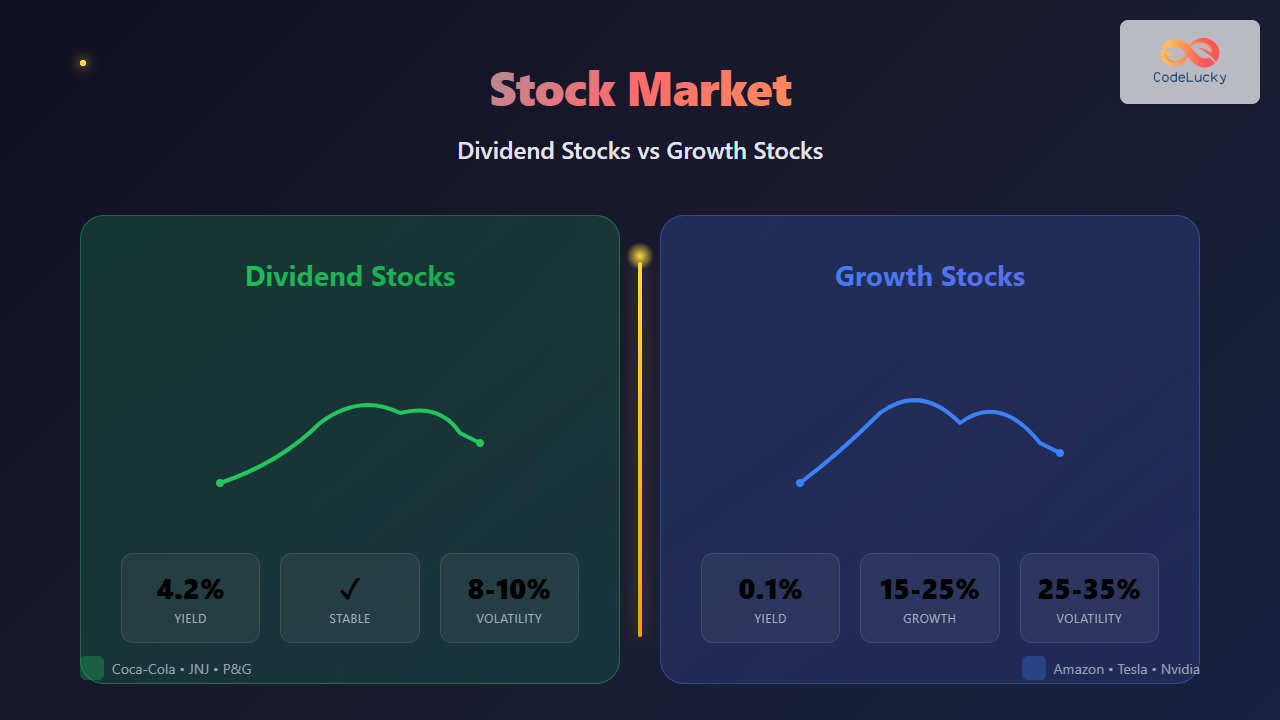
The diagram above visually compares dividend and growth stocks at a conceptual level — one focuses on consistent cash flow, while the other targets rapid market value appreciation.
Detailed Comparison Table
| Factor | Dividend Stocks | Growth Stocks |
|---|---|---|
| Primary Goal | Income through dividends | Price appreciation |
| Risk Level | Low to moderate | Moderate to high |
| Examples | Procter & Gamble, Coca-Cola | Amazon, Tesla |
| Ideal For | Income-seeking or conservative investors | Long-term or aggressive investors |
| Dividends | Regularly paid | Rarely or not at all |
How Dividends Impact Total Returns
Dividends contribute significantly to long-term portfolio returns through reinvestment. The Dividend Reinvestment Plan (DRIP) allows investors to automatically reinvest dividends to purchase more shares, compounding growth over time.

When to Choose Dividend Stocks
You may prefer dividend stocks if you:
- Value regular cash flow (e.g., during retirement).
- Have a moderately conservative risk profile.
- Prefer investing in financially stable, mature companies.
When to Choose Growth Stocks
Growth stocks suit you better if you:
- Seek long-term capital appreciation.
- Can tolerate price swings and short-term losses.
- Believe in the future potential of emerging industries or technologies.
Balanced Portfolio: Combining Both for Stability and Growth

A balanced investor can combine both dividend and growth stocks to manage risk while maintaining upside potential. For instance, holding 40% dividend-paying companies ensures steady income, while 50% in growth-oriented firms captures high returns over time.
Interactive Example: Estimating Portfolio Yield
Use this interactive snippet (in a web environment) to estimate your expected portfolio return based on a mix of dividend and growth stocks:
<script>
function calcReturn() {
  const dividend = parseFloat(document.getElementById('dividend').value);
  const growth = parseFloat(document.getElementById('growth').value);
  const weightDividend = parseFloat(document.getElementById('wDividend').value);
  const weightGrowth = 100 - weightDividend;
  const totalReturn = (dividend * weightDividend/100) + (growth * weightGrowth/100);
  document.getElementById('result').innerText = 'Expected Return: ' + totalReturn.toFixed(2) + '%';
}
</script>

<label>Dividend Stock Return (%): </label><input id="dividend" type="number" value="6"><br>
<label>Growth Stock Return (%): </label><input id="growth" type="number" value="12"><br>
<label>Dividend Weight (%): </label><input id="wDividend" type="number" value="50"><br>
<button onclick="calcReturn()">Calculate</button>
<p id="result"></p>
This tool can help investors visually understand how allocation affects expected returns — adjusting the weight between growth and dividend holdings instantly updates the combined yield.
Final Thoughts
There is no one-size-fits-all answer in the dividend vs growth stocks debate. The best approach is to align your investments with your personal financial objectives and risk capacity. Conservative investors often lean toward dividend stocks for stability, while younger or risk-tolerant investors prefer growth stocks for wealth accumulation.
Ultimately, blending both in a balanced portfolio can provide the stability of dividends and the upside of growth — a combination many successful investors rely on for consistent, long-term wealth creation.