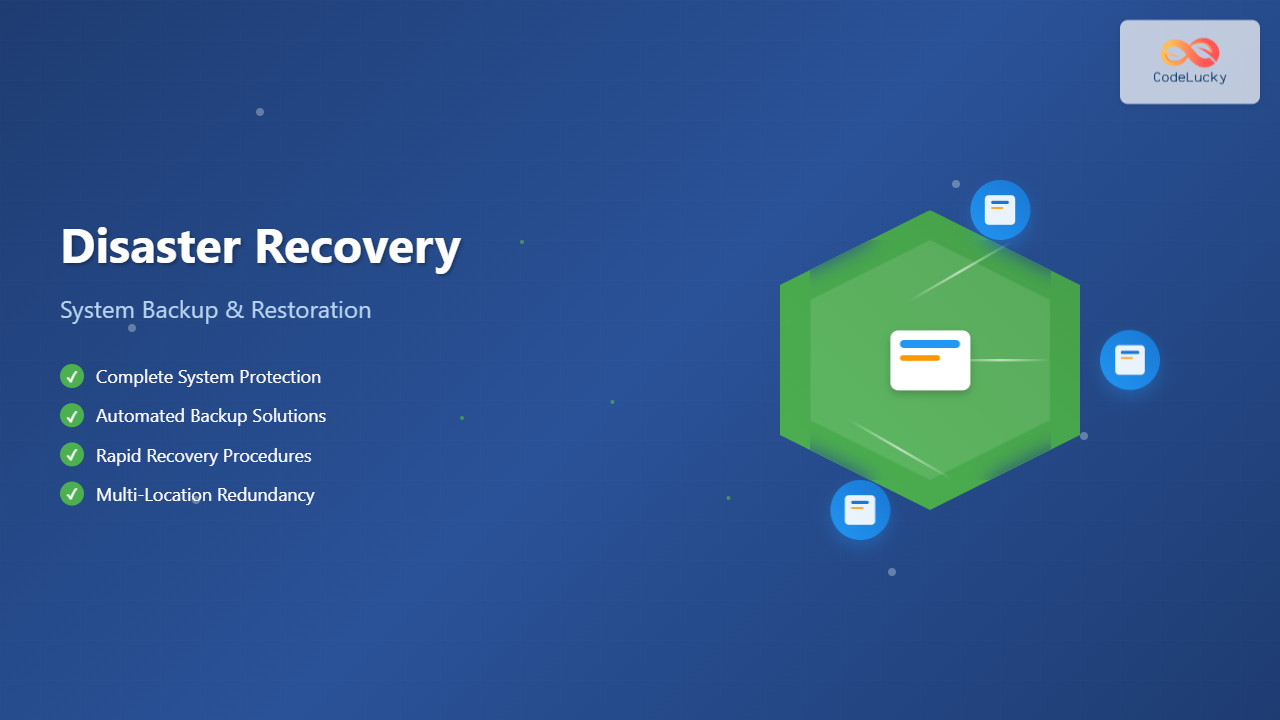
System disasters can strike without warning—hardware failures, cyberattacks, natural disasters, or human errors can instantly cripple your infrastructure. A robust disaster recovery plan with proper backup and restoration procedures is your lifeline to business continuity. This comprehensive guide explores everything you need to know about implementing effective disaster recovery strategies.
Understanding Disaster Recovery
Disaster recovery encompasses the policies, tools, and procedures organizations use to recover from catastrophic events that disrupt IT operations. It goes beyond simple data backup to include complete system restoration, infrastructure rebuilding, and business process continuity.

Key Components of Disaster Recovery
- Recovery Time Objective (RTO): Maximum acceptable downtime
- Recovery Point Objective (RPO): Maximum acceptable data loss
- Business Impact Analysis: Assessment of critical systems and processes
- Risk Assessment: Identification of potential threats and vulnerabilities
- Recovery Procedures: Step-by-step restoration processes
Types of System Backups
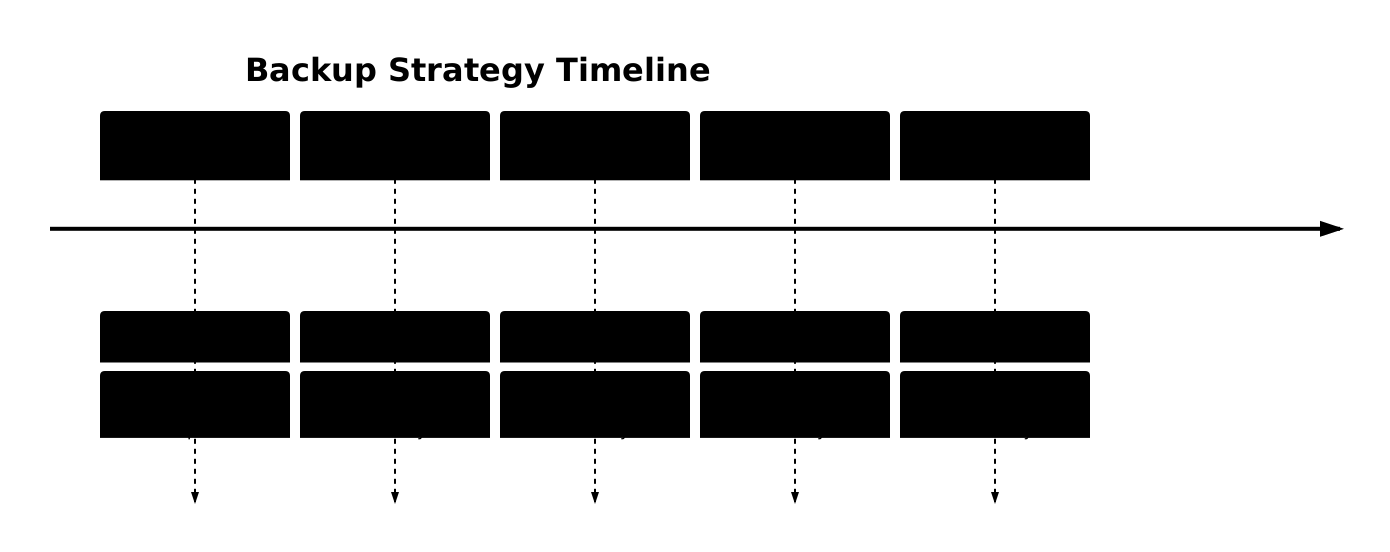
Understanding different backup types is crucial for designing an effective disaster recovery strategy. Each type offers unique advantages and serves specific recovery scenarios.
Full Backup
A complete copy of all data and system files. While time-consuming and resource-intensive, full backups provide the most comprehensive recovery option.
# Example: Full system backup using tar
sudo tar -czpvf /backup/full_backup_$(date +%Y%m%d).tar.gz \
  --exclude=/proc \
  --exclude=/sys \
  --exclude=/dev \
  --exclude=/tmp \
  --exclude=/backup \
  /

# Output:
# /
# /boot/
# /boot/grub/
# /boot/vmlinuz-5.4.0-74-generic
# /home/
# /home/user/documents/
# ... (continues for all files)
Incremental Backup
Backs up only files that have changed since the last backup (full or incremental). This method is faster and requires less storage but needs all incremental backups for complete restoration.
# Create incremental backup using rsync
rsync -av --link-dest=/backup/full_backup /source/ /backup/incremental_$(date +%Y%m%d)/

# Output:
# building file list ... done
# ./
# documents/report.doc
# images/new_photo.jpg
# sent 1,234 bytes  received 56 bytes  2,580.00 bytes/sec
# total size is 45,678  speedup is 35.41
Differential Backup
Backs up all files changed since the last full backup. Offers a middle ground between full and incremental backups in terms of speed and restoration complexity.
Backup Storage Solutions
Choosing the right storage solution is critical for ensuring backup accessibility and reliability during disaster recovery.
Local Storage
Advantages: Fast access, complete control, no internet dependency
Disadvantages: Vulnerable to local disasters, limited scalability
# Mount external drive for local backup
sudo mkdir /mnt/backup_drive
sudo mount /dev/sdb1 /mnt/backup_drive

# Verify mount
df -h /mnt/backup_drive

# Output:
# Filesystem      Size  Used Avail Use% Mounted on
# /dev/sdb1       2.0T  1.2T  800G  60% /mnt/backup_drive
Network Attached Storage (NAS)
Centralized storage accessible over network, ideal for multi-system environments.
# Mount NAS share
sudo mount -t nfs 192.168.1.100:/backup /mnt/nas_backup

# Configure automated backup script
#!/bin/bash
BACKUP_DIR="/mnt/nas_backup/$(hostname)"
DATE=$(date +%Y%m%d_%H%M%S)

mkdir -p $BACKUP_DIR
rsync -av --delete /home/ $BACKUP_DIR/home_$DATE/

echo "Backup completed at $(date)" >> $BACKUP_DIR/backup.log
Cloud Storage
Off-site storage providing geographic redundancy and scalability.
# Upload to AWS S3 using AWS CLI
aws s3 sync /local/backup/ s3://my-backup-bucket/server01/ \
  --storage-class GLACIER \
  --exclude "*.tmp"

# Output:
# upload: backup/system_20231201.tar.gz to s3://my-backup-bucket/server01/system_20231201.tar.gz
# upload: backup/database_20231201.sql to s3://my-backup-bucket/server01/database_20231201.sql
System Restoration Procedures
Effective restoration procedures ensure rapid recovery while maintaining data integrity. The approach varies based on the disaster scope and available backup types.

File-Level Restoration
Restoring specific files or directories without affecting the entire system.
# Restore specific directory from tar backup
cd /
sudo tar -xzpvf /backup/full_backup_20231201.tar.gz home/user/documents/

# Restore with rsync from backup location
rsync -av /backup/incremental_20231205/home/user/documents/ /home/user/documents/

# Set proper permissions
sudo chown -R user:user /home/user/documents/
sudo chmod -R 755 /home/user/documents/
System Image Restoration
Complete system recovery from disk images, ideal for bare-metal recovery scenarios.
# Create system image with dd
sudo dd if=/dev/sda of=/backup/system_image.img bs=64K conv=noerror,sync status=progress

# Restore system image
sudo dd if=/backup/system_image.img of=/dev/sda bs=64K status=progress

# Output during restoration:
# 512000000 bytes (512 MB, 488 MiB) copied, 45.2 s, 11.3 MB/s
# 1024000000 bytes (1.0 GB, 977 MiB) copied, 89.7 s, 11.4 MB/s
Database Recovery
Specialized procedures for database systems requiring consistent state recovery.
-- MySQL Point-in-Time Recovery
-- Step 1: Restore from full backup
mysql -u root -p < /backup/full_database_backup.sql

-- Step 2: Apply binary logs for point-in-time recovery
mysqlbinlog --start-datetime="2023-12-01 09:00:00" \
           --stop-datetime="2023-12-01 14:30:00" \
           /var/log/mysql/mysql-bin.000001 | mysql -u root -p

-- Verify recovery
SHOW MASTER STATUS;
SELECT NOW(), COUNT(*) FROM critical_table;
Disaster Recovery Testing
Regular testing validates your disaster recovery procedures and identifies weaknesses before actual disasters occur.
Testing Methods
| Test Type | Description | Disruption Level | Frequency |
|---|---|---|---|
| Tabletop Exercise | Discussion-based scenario walkthrough | None | Quarterly |
| Backup Verification | Automated backup integrity checks | Minimal | Daily |
| Partial Recovery | Test restoration of non-critical systems | Low | Monthly |
| Full DR Test | Complete disaster simulation | High | Annually |
Automated Testing Script
#!/bin/bash
# DR Test Automation Script

LOG_FILE="/var/log/dr_test.log"
TEST_DATE=$(date +%Y%m%d_%H%M%S)

echo "DR Test initiated at $(date)" >> $LOG_FILE

# Test 1: Backup integrity verification
echo "Testing backup integrity..." >> $LOG_FILE
if tar -tzf /backup/latest_backup.tar.gz > /dev/null 2>&1; then
    echo "✓ Backup integrity: PASSED" >> $LOG_FILE
else
    echo "✗ Backup integrity: FAILED" >> $LOG_FILE
fi

# Test 2: Database connectivity after restore
echo "Testing database restoration..." >> $LOG_FILE
mysql -u test_user -p test_db -e "SELECT 1" > /dev/null 2>&1
if [ $? -eq 0 ]; then
    echo "✓ Database restoration: PASSED" >> $LOG_FILE
else
    echo "✗ Database restoration: FAILED" >> $LOG_FILE
fi

# Test 3: Application service recovery
echo "Testing service recovery..." >> $LOG_FILE
systemctl status apache2 > /dev/null 2>&1
if [ $? -eq 0 ]; then
    echo "✓ Service recovery: PASSED" >> $LOG_FILE
else
    echo "✗ Service recovery: FAILED" >> $LOG_FILE
fi

echo "DR Test completed at $(date)" >> $LOG_FILE
Best Practices for Disaster Recovery
The 3-2-1 Backup Rule
Maintain 3 copies of critical data, on 2 different types of media, with 1 copy stored off-site. This rule provides multiple layers of protection against various disaster scenarios.

Documentation and Communication
- Recovery Procedures: Step-by-step documentation for all recovery scenarios
- Contact Lists: Updated emergency contact information
- System Dependencies: Mapping of interconnected systems and services
- Recovery Priorities: Ranked list of critical systems for restoration order
Security Considerations
# Encrypt backups before storage
gpg --cipher-algo AES256 --compress-algo 1 --symmetric \
    --output backup_encrypted.gpg backup_file.tar.gz

# Set secure permissions on backup files
chmod 600 /backup/*
chown root:root /backup/*

# Verify backup encryption
gpg --list-packets backup_encrypted.gpg | head -5

# Output:
# :symkey enc packet: version 4, cipher 9, s2k 3, hash 2
# 	salt 1234567890ABCDEF, count 65536 (96)
# :encrypted data packet:
# 	length: 1048576
# 	mdc_method: 2
Recovery Automation and Orchestration
Automation reduces recovery time and minimizes human error during high-stress disaster scenarios.
Infrastructure as Code for DR
# Docker Compose for disaster recovery environment
version: '3.8'
services:
  web-server:
    image: nginx:alpine
    volumes:
      - ./restored-data:/var/www/html
    ports:
      - "80:80"
    restart: unless-stopped

  database:
    image: mysql:8.0
    environment:
      MYSQL_ROOT_PASSWORD: ${DB_ROOT_PASSWORD}
      MYSQL_DATABASE: restored_db
    volumes:
      - ./db-backup:/docker-entrypoint-initdb.d
      - db-data:/var/lib/mysql
    ports:
      - "3306:3306"

  backup-agent:
    image: backup-agent:latest
    volumes:
      - /backup:/backup
      - /var/run/docker.sock:/var/run/docker.sock
    environment:
      - BACKUP_SCHEDULE=0 2 * * *
      - RETENTION_DAYS=30

volumes:
  db-data:
Monitoring and Alerting
# System monitoring script for DR readiness
#!/bin/bash

# Check backup age
BACKUP_AGE=$(find /backup -name "*.tar.gz" -mtime -1 | wc -l)
if [ $BACKUP_AGE -eq 0 ]; then
    echo "ALERT: No recent backups found" | mail -s "DR Alert" [email protected]
fi

# Check storage space
BACKUP_SPACE=$(df -h /backup | awk 'NR==2{print $5}' | sed 's/%//')
if [ $BACKUP_SPACE -gt 85 ]; then
    echo "ALERT: Backup storage $BACKUP_SPACE% full" | mail -s "DR Alert" [email protected]
fi

# Check DR site connectivity
if ! ping -c 1 dr-site.company.com > /dev/null 2>&1; then
    echo "ALERT: DR site unreachable" | mail -s "DR Alert" [email protected]
fi
Cloud-Based Disaster Recovery
Cloud platforms provide scalable, cost-effective disaster recovery solutions with global reach and automated failover capabilities.
Multi-Region Architecture
{
  "aws_dr_config": {
    "primary_region": "us-east-1",
    "dr_region": "us-west-2",
    "rpo_minutes": 15,
    "rto_minutes": 60,
    "replication": {
      "database": {
        "type": "RDS_cross_region",
        "automated_backups": true,
        "snapshot_frequency": "daily"
      },
      "storage": {
        "type": "S3_cross_region_replication",
        "storage_class": "STANDARD_IA"
      },
      "compute": {
        "type": "AMI_automated_snapshots",
        "launch_template": "lt-0123456789abcdef"
      }
    }
  }
}
Compliance and Regulatory Requirements
Many industries have specific disaster recovery requirements that must be incorporated into your DR strategy.
| Regulation | Industry | Key DR Requirements |
|---|---|---|
| SOX | Public Companies | Financial data backup, audit trails, recovery testing |
| HIPAA | Healthcare | Patient data encryption, access controls, backup integrity |
| PCI DSS | Payment Processing | Cardholder data protection, secure backup storage |
| GDPR | EU Data Processing | Data portability, breach notification, right to erasure |
Emerging Technologies in Disaster Recovery
New technologies are revolutionizing disaster recovery with improved automation, faster recovery times, and enhanced reliability.
AI-Powered Recovery
- Predictive Analytics: Identify potential failures before they occur
- Automated Decision Making: Intelligent failover based on real-time conditions
- Recovery Optimization: ML algorithms optimize recovery procedures
Container-Based Recovery
# Kubernetes disaster recovery with persistent volumes
apiVersion: v1
kind: PersistentVolumeClaim
metadata:
  name: app-data-pvc
spec:
  accessModes:
    - ReadWriteOnce
  resources:
    requests:
      storage: 100Gi
  storageClassName: fast-ssd

---
apiVersion: apps/v1
kind: Deployment
metadata:
  name: recovery-app
spec:
  replicas: 3
  selector:
    matchLabels:
      app: recovery-app
  template:
    metadata:
      labels:
        app: recovery-app
    spec:
      containers:
      - name: app
        image: myapp:recovery
        volumeMounts:
        - mountPath: /data
          name: app-data
      volumes:
      - name: app-data
        persistentVolumeClaim:
          claimName: app-data-pvc
Conclusion
Effective disaster recovery requires comprehensive planning, regular testing, and continuous improvement. By implementing robust backup strategies, automated restoration procedures, and thorough testing protocols, organizations can minimize downtime and data loss during catastrophic events.
Remember that disaster recovery is not a one-time implementation but an ongoing process that must evolve with your infrastructure and business requirements. Regular reviews, updates, and testing ensure your DR strategy remains effective against emerging threats and changing operational needs.
Start by assessing your current backup and recovery capabilities, identify gaps in your disaster recovery planning, and gradually implement the strategies outlined in this guide. The investment in comprehensive disaster recovery planning pays dividends when facing actual disasters, protecting both your data and business continuity.