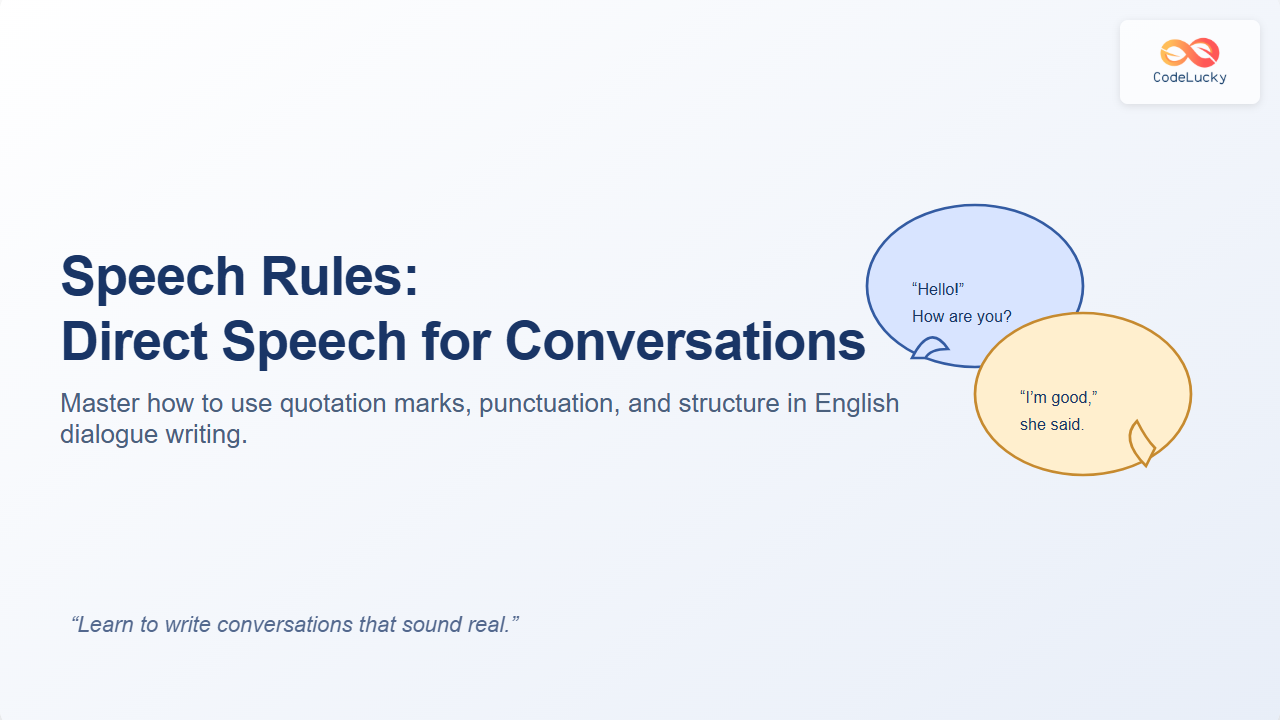
Direct speech brings conversations to life in writing. It lets readers hear exactly what someone said, word for word. Whether you’re writing a story, reporting news, or quoting someone in dialogue, knowing the rules of direct speech helps your sentences sound natural and grammatically correct.
What Is Direct Speech?
Direct speech is when you write down the exact words spoken by someone and enclose them in quotation marks (“”). It differs from indirect speech, which summarizes what someone said without quoting them exactly.
Example:
- Direct speech: Rita said, “I am learning English grammar.”
- Indirect speech: Rita said that she was learning English grammar.
Basic Structure of Direct Speech
The basic structure of direct speech includes three key parts:
- The reporting clause (who said it)
- The reporting verb (said, asked, replied, etc.)
- The quoted words (inside quotation marks)
Example structure:
Reporting clause + reporting verb + comma + opening quotation mark + spoken words + closing quotation mark
Example: The teacher said, “Open your books to page twelve.”

Punctuation Rules in Direct Speech
Punctuation placement is a common area of confusion in direct speech. Here are the main rules:
- Use a comma before the opening quotation mark when the speech comes after the reporting clause.
- End the spoken sentence with a period, question mark, or exclamation mark inside the quotation marks.
- If the reporting clause comes after the quoted words, use a comma inside the quotation before closing it.
Examples:
- She said, “Let’s start our lesson.”
- “Where are you going?” asked Rahul.
- “That’s amazing,” exclaimed Tina.

Capitalization in Direct Speech
Always start the quoted words with a capital letter. Even if it is in the middle of your sentence, the first word inside quotation marks should be capitalized.
Example: Ravi said, “This book is helpful.”
When Speech Breaks in the Middle
When a speaker’s sentence is interrupted by the reporting clause, split the sentence with commas and keep the rest of the sentence in lower case (unless it’s a new sentence).
Example:
- “I think,” said Neha, “that this topic is simple.”

Questions in Direct Speech
When quoting a question, keep the question mark inside the quotation marks. Do not add an extra period.
Example:
- Sana asked, “Are we meeting tomorrow?”
Even though the reporting verb (“asked”) ends the sentence, the question mark remains inside the quotes since it belongs to the quoted question.
Exclamations in Direct Speech
When quoting an excited or emotional sentence, place the exclamation mark inside the quotation marks as part of the speaker’s emotion.
Example: He shouted, “Watch out for the traffic!”
Combining Multiple Sentences in Speech
A speaker may say more than one sentence. Keep all sentences inside the same quotation marks.
Example: Rahul said, “It’s raining outside. Let’s stay indoors.”

Interactive Practice Section
Try this quick exercise. Identify if the punctuation and capitalization are correct:
- ravi said, “i love English grammar.”
- “do you want to join?” asked Meera.
- He said, “Let’s go to the park.”
Check your answers below:
Show Answers
- Incorrect: ravi said, “i love English grammar.” → Correct: Ravi said, “I love English grammar.”
- Incorrect: “do you want to join?” asked Meera. → Correct: “Do you want to join?” asked Meera.
- Correct: He said, “Let’s go to the park.”
Common Mistakes in Direct Speech
- Forgetting to capitalize the first word inside quotation marks.
- Placing punctuation outside the quotation marks.
- Using incorrect reporting verbs (like “told” without an object).
Incorrect: She told, “I am tired.”
Correct: She said, “I am tired.”
Summary Chart of Key Rules
| Rule | Example |
|---|---|
| Comma before opening quotes | He said, “Let’s go.” |
| Question mark inside quotes | “Where are you?” she asked. |
| Capital letter for first quoted word | Ravi said, “This is awesome.” |
| Reporting clause in the middle | “Yes,” he replied, “I understand.” |
| Multiple sentences within quotes | She said, “It’s sunny. Let’s go for a walk.” |
Conclusion
Mastering the rules of direct speech is essential for clear and natural writing. Once you understand punctuation, capitalization, and sentence structure, your dialogues will feel more realistic and grammatically sound. Practice with daily conversations, add emotional tone through exclamation marks, and soon, quoting speech will become effortless.
Next in this English Learning Series: Indirect Speech Rules and Transformations