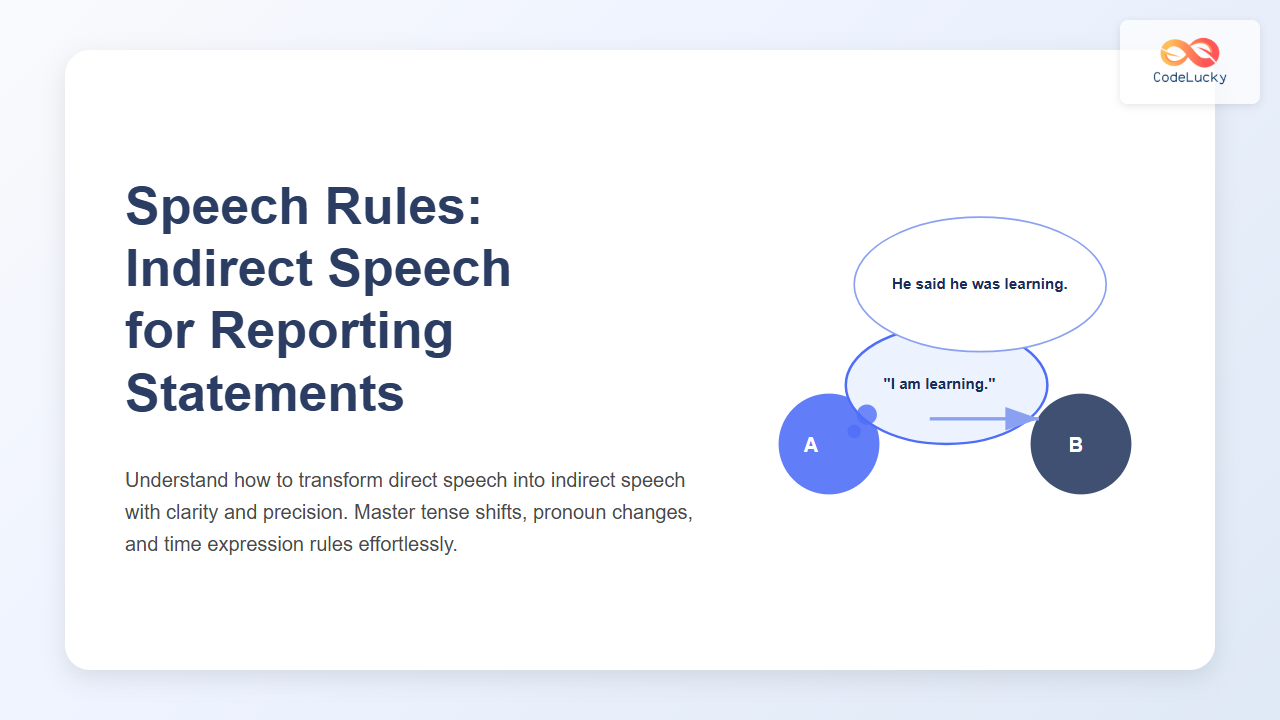
Indirect Speech, also known as Reported Speech, is a key concept in English grammar used to share what someone has said without quoting them directly. This rule-based transformation helps in formal writing, storytelling, and professional conversation.
What Is Indirect Speech?
Indirect speech occurs when the original words of a speaker are reported by someone else, often with changes in pronouns, tenses, and time expressions. Instead of quoting the speaker’s exact words, we summarize or rephrase their message.
Example:
- Direct Speech: He said, “I am studying.”
- Indirect Speech: He said that he was studying.
Notice how the tense changes from am studying to was studying, and quotation marks are removed.
When to Use Indirect Speech
Indirect speech is widely used in:
- News reporting and journalism
- Academic writing
- Business communication
- Story narration
Basic Rules for Changing Direct to Indirect Speech
1. Remove Quotation Marks
Quotation marks are dropped, and the sentence integrates smoothly with the reporting verb (e.g., said, told, explained).
Example:
Direct: She said, “I love chocolate.”
Indirect: She said that she loved chocolate.
2. Change of Tense
If the reporting verb is in the past tense, the tense of the reported speech usually moves one step back into the past.
| Direct Speech | Indirect Speech |
|---|---|
| Present Simple → “I play football.” | Past Simple → He said he played football. |
| Present Continuous → “I am eating.” | Past Continuous → She said she was eating. |
| Present Perfect → “I have eaten.” | Past Perfect → He said he had eaten. |
| Will → “I will call you.” | Would → She said she would call me. |
Note: If the reporting verb is in the present tense (e.g., says), then the tense of the reported speech does not change.
3. Pronoun Changes
Pronouns shift according to the point of view of the speaker and listener.
4. Changes in Time and Place Expressions
| Direct Speech | Indirect Speech Equivalent |
|---|---|
| Today | That day |
| Tomorrow | The next day / The following day |
| Yesterday | The previous day / The day before |
| Now | Then |
| Here | There |
5. Removal of “That”
The joining word that is optional in most reported statements, especially in informal speech.
Example:
She said that she was ready. → She said she was ready.
Visual Flow: Direct to Indirect Conversion

Types of Reported Statements
1. Affirmative Statements
Rule: Tense and pronoun changes apply normally.
Example:
Direct: She said, “I like coffee.”
Indirect: She said she liked coffee.
2. Negative Statements
Rule: Keep the word “not” in the clause.
Example:
Direct: He said, “I don’t smoke.”
Indirect: He said he didn’t smoke.
3. Statements with Modals
Some modals change while others remain the same:
| Modal in Direct Speech | Indirect Form |
|---|---|
| Can | Could |
| May | Might |
| Must | Had to |
| Shall | Should |
| Would / Could / Should / Might | No change |
Interactive Practice Example
Try this small exercise. Convert the following direct speech:
Direct: John said, “I am buying a new laptop tomorrow.”
See the Answer
Indirect: John said that he was buying a new laptop the next day.
Complex Sentence Reporting
When a complex sentence is reported, each clause’s tense and pronoun are adjusted accordingly.
Exceptions to Tense Change
Some rules allow keeping the tense unchanged:
- If the reported fact is still true.
- If the statement is a universal truth.
Example:
- Direct: The teacher said, “The earth revolves around the sun.”
- Indirect: The teacher said that the earth revolves around the sun. (No change)
Common Mistakes to Avoid
- Forgetting to shift time references (e.g., today → that day).
- Using incorrect pronoun reference.
- Unnecessary repetition of that.
Practice Exercise
Rewrite these sentences into indirect speech:
- He said, “I’m watching a movie.”
- She said, “I cannot come now.”
- They said, “We will attend the meeting tomorrow.”
Check Your Answers
- He said that he was watching a movie.
- She said she could not come then.
- They said they would attend the meeting the next day.
Final Summary Diagram

Conclusion
Mastering indirect speech makes your English sound natural and professional. Focus on the key transformations—tense, pronoun, and time—along with contextual logic. Regular practice with conversion exercises will help you report statements with accuracy and confidence.