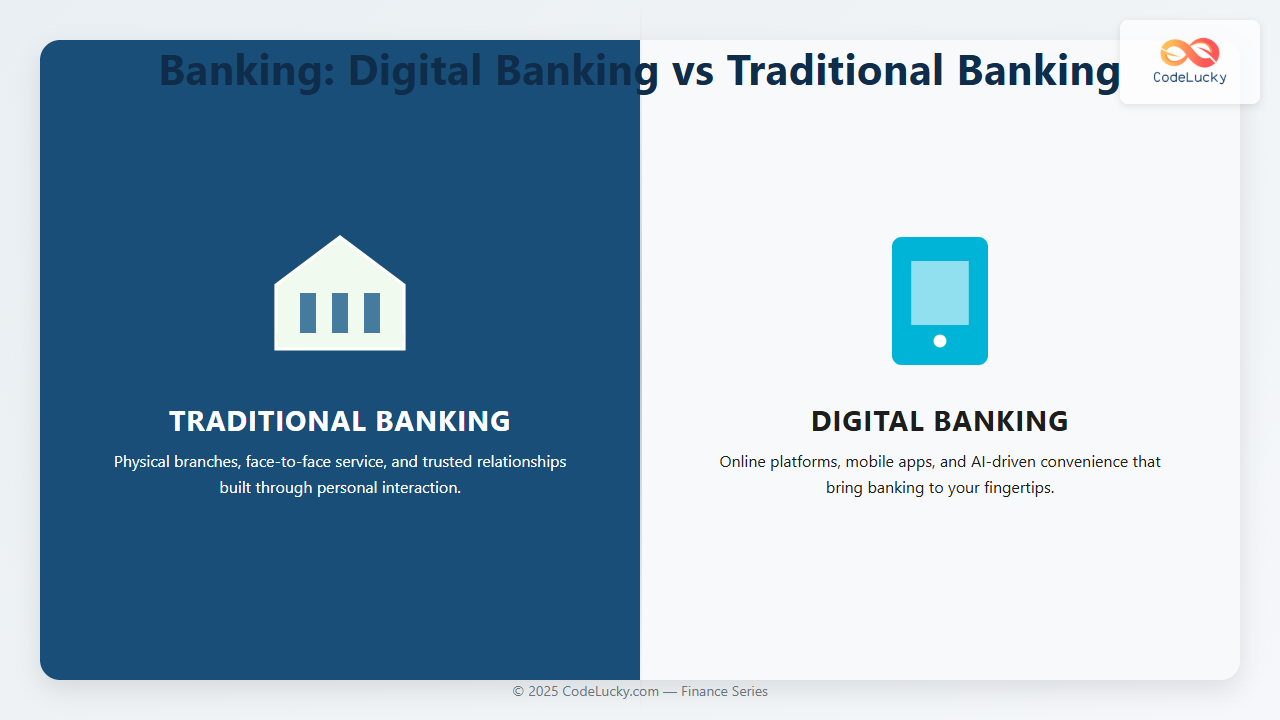
Banking has undergone massive transformation in the last two decades. From long queues and physical forms to seamless smartphone transactions — the industry has shifted from being paper-driven to being data-driven. This article explores the detailed comparison between Digital Banking and Traditional Banking — helping you understand how both systems work, their pros and cons, and what the future might hold for financial institutions.
What Is Traditional Banking?
Traditional banking refers to the banking system where customers visit branches physically to perform financial transactions — such as depositing money, applying for loans, or opening accounts. It’s based on in-person communication and manual operations.
Example: You visit your bank branch to withdraw cash, deposit checks, or ask for account statements. The teller verifies your identity and processes your request.
Key Features of Traditional Banking:
- Physical branches for customer service.
- Face-to-face verification and transactions.
- Limited working hours (usually 9 AM to 5 PM).
- Paper-based documentation and approvals.
- Strongly regulated with localized operations.
What Is Digital Banking?
Digital banking refers to online banking systems that enable customers to perform all essential banking activities digitally — without visiting a branch. This includes mobile apps, internet banking websites, chatbots, and even digital-only banks (like neobanks).
Example: Through your bank’s mobile app, you can transfer money using UPI, apply for loans instantly, or check your credit score — all within minutes, anytime, anywhere.
Core Features of Digital Banking:
- 24×7 access through apps and web portals.
- Instant transfers via UPI, RTGS, or NEFT.
- Automated and paperless account opening.
- AI-powered fraud detection and chat support.
- Seamless integration with digital wallets and payment gateways.
Comparison Between Digital and Traditional Banking

| Parameter | Traditional Banking | Digital Banking |
|---|---|---|
| Accessibility | Branch-based, limited hours | 24×7 online access |
| Convenience | Physical presence required | Remote access via phones or laptops |
| Speed | Manual processing, time-consuming | Instant transactions and approvals |
| Customer Interaction | Face-to-face communication | AI chatbots and online support |
| Security | Physical safeguards and signatures | Encryption, OTPs, biometrics |
| Operational Cost | High (branches and staff) | Low (digital infrastructure) |
Advantages of Digital Banking
- 24×7 Availability: Customers can perform transactions any time, day or night.
- Ease of Access: No need to visit a physical branch for most operations.
- Faster Transactions: Instant transfers and approvals save time.
- Better Analytics: Users get spending summaries and AI-based insights for smarter financial decisions.
- Eco-Friendly: Paperless transactions reduce ecological impact.
Challenges of Digital Banking
- Requires internet connectivity and digital literacy.
- Cybersecurity risks such as phishing or data theft.
- Reduced human touch in customer support.
- Some complex services might still require human verification.
Advantages of Traditional Banking
- Personal relationships and trust through face-to-face interactions.
- Better suited for rural or technologically underserved populations.
- Direct human assistance during complicated financial operations.
- Perceived as safer for less tech-savvy users.
How Digital Transformation Happens in Banking

Most banks start by launching an online banking platform, then introduce mobile apps and automation. The final stage is when the institution becomes a complete digital bank or partners with a fintech company to offer innovative solutions like instant lending and smart investments.
Hybrid Banking Models
Modern banking often combines the best of both worlds. Many banks maintain physical branches for complex needs but encourage customers to use their digital platforms for daily transactions. This hybrid model is considered the most balanced and customer-friendly approach.

Real-World Example: Axis Bank (India)
Axis Bank is a prominent example that successfully integrates both models. While it has an extensive branch network across India, its app Axis Mobile allows fund transfers, bill payments, and card management instantly. This hybrid approach helps maintain personal connections while offering digital convenience.
Future of Banking — What Lies Ahead?
- AI-Driven Services: AI will personalize investment advice and automate fraud alerts.
- Blockchain Integration: Transactions may become faster and more secure with decentralized ledgers.
- Voice-Based Banking: Smart assistants will handle commands like “Pay my electricity bill.”
- Neobanks: 100% online banks will reshape how people perceive financial institutions.
- Financial Inclusion: Digital banking is expanding banking reach to remote regions.
Summary: Choosing Between Digital and Traditional Banking
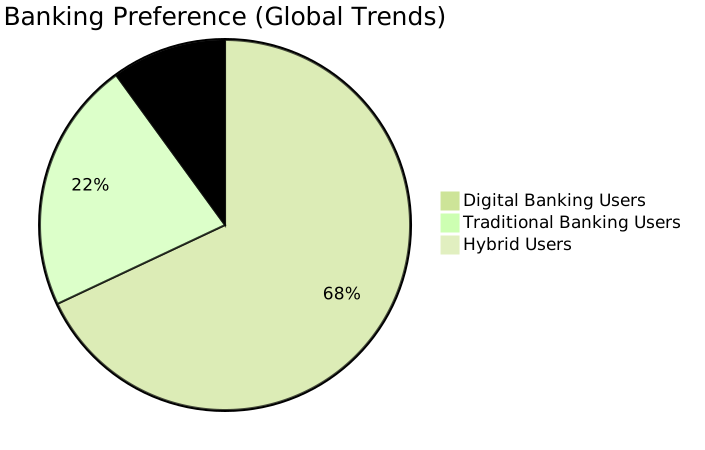
The right choice depends on your preferences. If you value convenience, speed, and innovation — digital banking is your path. However, if you prefer personal interaction and trust in physical presence — traditional banking may suit you better. Most people today use a hybrid mix — reaping the benefits of both.
Conclusion
The debate of digital banking vs traditional banking is not about replacement but evolution. Both systems serve essential roles: while traditional banking retains human touch and reliability, digital banking revolutionizes speed, convenience, and accessibility. Future banking will blend technology with personal service — offering the best of both worlds to empower global customers.