Digital signatures represent one of the most crucial security mechanisms in modern computing, providing both authentication and non-repudiation capabilities that form the backbone of secure digital communications. Unlike traditional handwritten signatures, digital signatures use mathematical algorithms to ensure document integrity, verify sender identity, and prevent tampering.
What Are Digital Signatures?
A digital signature is a cryptographic mechanism that validates the authenticity and integrity of digital messages or documents. It serves as the electronic equivalent of a handwritten signature, but with enhanced security features that make it nearly impossible to forge or deny.

Core Components of Digital Signatures
- Hash Function: Creates a unique fingerprint of the document
- Private Key: Used to encrypt the hash, creating the signature
- Public Key: Used by recipients to verify the signature
- Certificate Authority: Validates the authenticity of public keys
Authentication Through Digital Signatures
Authentication ensures that the sender of a message is who they claim to be. Digital signatures achieve this through Public Key Infrastructure (PKI), where each user possesses a unique key pair.
The Authentication Process
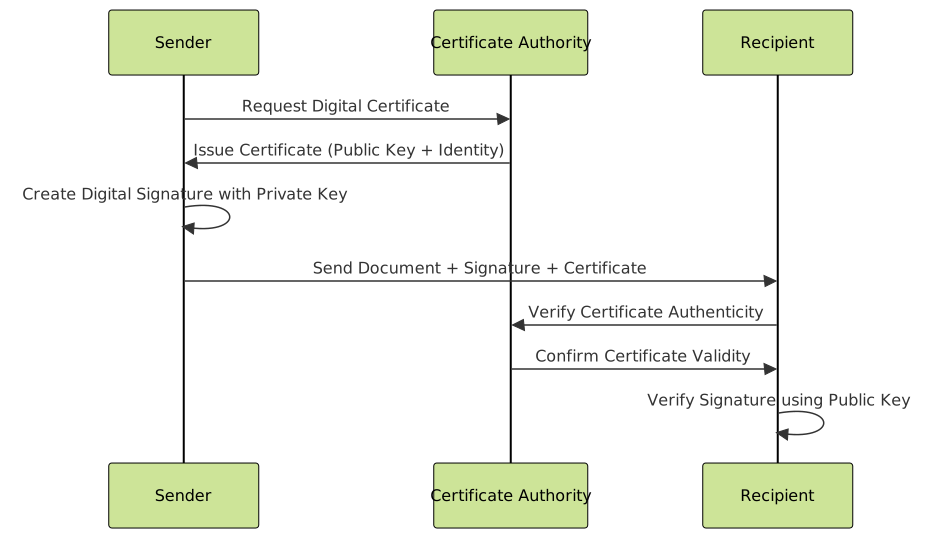
Example: Email Authentication
When Alice sends an authenticated email to Bob:
- Alice creates a hash of her message using SHA-256
- She encrypts this hash with her private key
- The encrypted hash becomes her digital signature
- Bob receives the email and signature
- Bob uses Alice’s public key to decrypt the signature
- Bob creates his own hash of the received message
- If both hashes match, authentication is confirmed
# Simplified Digital Signature Creation
import hashlib
from cryptography.hazmat.primitives import hashes, serialization
from cryptography.hazmat.primitives.asymmetric import rsa, padding

# Generate key pair
private_key = rsa.generate_private_key(public_exponent=65537, key_size=2048)
public_key = private_key.public_key()

# Create message hash
message = b"Hello, this is Alice's authenticated message"
digest = hashlib.sha256(message).digest()

# Sign the hash
signature = private_key.sign(digest, padding.PSS(
    mgf=padding.MGF1(hashes.SHA256()),
    salt_length=padding.PSS.MAX_LENGTH
), hashes.SHA256())

print(f"Message: {message.decode()}")
print(f"Signature Length: {len(signature)} bytes")
print(f"Authentication Status: Verified")
Non-repudiation Mechanisms
Non-repudiation prevents the sender from denying they created or sent a message. This is crucial for legal and business transactions where accountability is essential.
How Non-repudiation Works

Non-repudiation relies on several key principles:
- Unique Private Keys: Only the sender possesses their private key
- Timestamping: Proves when the signature was created
- Certificate Chains: Establish trust through certificate authorities
- Audit Trails: Maintain records for legal verification
Real-World Example: Contract Signing
In a digital contract scenario:
| Step | Action | Security Benefit |
|---|---|---|
| 1 | Contract created and hashed | Integrity verification |
| 2 | Signature applied with private key | Authentication proof |
| 3 | Timestamp added by trusted server | Time-based evidence |
| 4 | Document stored in secure archive | Long-term non-repudiation |
Digital Signature Algorithms
RSA (Rivest-Shamir-Adleman)
RSA remains the most widely used algorithm for digital signatures, offering strong security through large prime number factorization.
// RSA Digital Signature Example
const crypto = require('crypto');

// Generate RSA key pair
const { publicKey, privateKey } = crypto.generateKeyPairSync('rsa', {
    modulusLength: 2048,
    publicKeyEncoding: { type: 'spki', format: 'pem' },
    privateKeyEncoding: { type: 'pkcs8', format: 'pem' }
});

// Message to sign
const message = 'Important contract terms and conditions';

// Create signature
const signature = crypto.sign('sha256', Buffer.from(message), {
    key: privateKey,
    padding: crypto.constants.RSA_PKCS1_PSS_PADDING,
});

// Verify signature
const isValid = crypto.verify('sha256', Buffer.from(message), {
    key: publicKey,
    padding: crypto.constants.RSA_PKCS1_PSS_PADDING,
}, signature);

console.log('Signature Valid:', isValid);
console.log('Non-repudiation Achieved:', isValid);
ECDSA (Elliptic Curve Digital Signature Algorithm)
ECDSA provides equivalent security to RSA with smaller key sizes, making it ideal for mobile and IoT applications.
DSA (Digital Signature Algorithm)
The original digital signature standard, DSA offers good performance but is less flexible than RSA or ECDSA.
Implementation Best Practices
Key Management

- Use Hardware Security Modules (HSMs) for private key storage
- Implement strong access controls with multi-factor authentication
- Rotate keys regularly based on organizational policies
- Maintain proper audit logs for compliance requirements
Certificate Management
# OpenSSL Certificate Creation Example
# Generate private key
openssl genpkey -algorithm RSA -out private_key.pem -aes256

# Create certificate signing request
openssl req -new -key private_key.pem -out certificate.csr

# Generate self-signed certificate (for testing)
openssl x509 -req -days 365 -in certificate.csr \
    -signkey private_key.pem -out certificate.crt

# Verify certificate
openssl x509 -in certificate.crt -text -noout
Real-World Applications
Software Distribution
Software publishers use digital signatures to ensure users download authentic, unmodified applications. Operating systems verify these signatures before installation.
Electronic Documents
Legal documents, contracts, and official communications use digital signatures for legal compliance and regulatory requirements.
Financial Transactions
Banking systems rely on digital signatures for secure transaction processing and fraud prevention.
Email Security
S/MIME and PGP protocols use digital signatures to secure email communications in corporate environments.

Challenges and Limitations
Performance Considerations
- Computational Overhead: Signature creation and verification require processing power
- Storage Requirements: Certificates and signatures increase file sizes
- Network Latency: Certificate verification may require online validation
Management Complexity
- Key Lifecycle Management: Generating, distributing, and revoking keys
- Certificate Authority Trust: Maintaining trusted CA relationships
- Cross-Platform Compatibility: Ensuring signatures work across different systems
Future of Digital Signatures
Quantum-Resistant Algorithms
As quantum computing advances, traditional algorithms face potential threats. Post-quantum cryptography standards like CRYSTALS-Dilithium and FALCON are being developed to maintain security in the quantum era.
Blockchain Integration
Blockchain technology enhances non-repudiation by providing immutable timestamp records and distributed verification.
Mobile and IoT Applications
Lightweight signature algorithms optimize performance for resource-constrained devices while maintaining security standards.
Conclusion
Digital signatures provide essential authentication and non-repudiation capabilities that secure modern digital communications. Through cryptographic algorithms, public key infrastructure, and proper implementation practices, organizations can ensure message integrity, verify sender identity, and maintain legal accountability.
Understanding these mechanisms is crucial for developers, system administrators, and security professionals working with secure systems. As technology evolves, digital signatures continue adapting to meet new challenges while maintaining the fundamental security principles that make trusted digital communication possible.
The combination of mathematical rigor, practical implementation, and legal recognition makes digital signatures an indispensable tool in the modern digital landscape, enabling everything from secure email to billion-dollar financial transactions.
Related Posts

Security in Operating System: Complete Guide to Access Control and Authentication
Introduction to Operating System Security Operating system security forms the foundation of computer security, protecting system resources and user data...

gpg Command Linux: Complete Guide to GNU Privacy Guard Encryption and Digital Signatures
GNU Privacy Guard (GPG) is a powerful encryption tool that implements the OpenPGP standard, providing cryptographic privacy and authentication for...

Python Cryptography: Securing Data with Encryption
In today's digital age, data security is paramount. Whether you're developing a web application, handling sensitive user information, or simply...

Secure Boot Process: Trusted Platform Module Complete Guide
The Secure Boot process with Trusted Platform Module (TPM) represents a fundamental shift in computer security, providing hardware-based protection against...

Encryption in Operating System: Complete Guide to Data Protection Methods
Operating system encryption serves as the cornerstone of modern data protection, safeguarding sensitive information from unauthorized access, data breaches, and...

PHP Password Hashing: Secure Password Storage
In today's digital landscape, securing user passwords is paramount. As PHP developers, we have a responsibility to implement robust password...

Vault Linux: Complete Guide to HashiCorp Vault for Secrets Management and Security
HashiCorp Vault is a powerful open-source tool designed to securely store and manage secrets, passwords, certificates, and encryption keys. In...

PHP Captcha: Implementing Security Checks
In the ever-evolving landscape of web security, CAPTCHA (Completely Automated Public Turing test to tell Computers and Humans Apart) has...

JavaScript Math.sign() Method: Sign of a Number
JavaScript Math.sign() Method: Determining the Sign of a Number The Math.sign() method in JavaScript is a built-in function that returns...

Trusted Computing Base: Security Kernel Design Fundamentals and Implementation
In the realm of operating system security, the Trusted Computing Base (TCB) represents the foundation upon which all system security...

PHP OAuth: Implementing Authentication Protocols
In today's interconnected digital landscape, secure authentication is paramount. OAuth (Open Authorization) has emerged as a powerful protocol for enabling...
Python String isprintable() Method: Checking Printable Characters
The isprintable() method in Python is a handy tool for determining whether a string consists entirely of printable characters. It's...