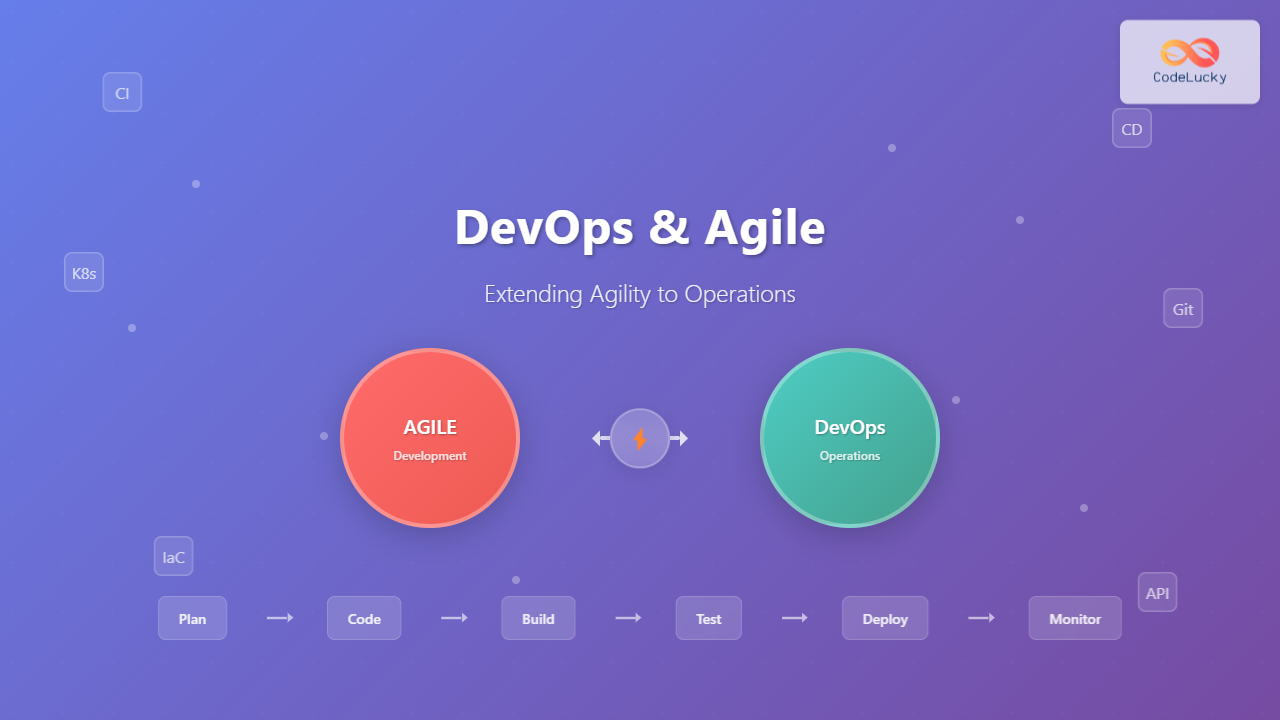
The evolution of software development has witnessed remarkable transformations, from traditional waterfall methodologies to Agile practices, and now to the integration of DevOps with Agile frameworks. This powerful combination represents a paradigm shift that extends agility beyond development teams to encompass the entire software delivery lifecycle, including operations, infrastructure, and deployment processes.
Understanding the DevOps-Agile Synergy
DevOps and Agile share fundamental principles that make their integration natural and highly effective. Both methodologies emphasize collaboration, continuous improvement, rapid feedback loops, and customer-centric approaches. While Agile focuses primarily on development practices and team dynamics, DevOps extends these principles to bridge the gap between development and operations teams.
The traditional separation between development and operations often created bottlenecks, with development teams working in short sprints while operations teams followed longer, more rigid deployment cycles. This disconnect frequently led to delayed releases, increased errors, and frustrated stakeholders. DevOps addresses these challenges by creating a culture of shared responsibility and continuous collaboration.
Core Principles Alignment
The alignment between DevOps and Agile principles creates a foundation for seamless integration. Agile’s emphasis on individuals and interactions translates perfectly to DevOps’ focus on breaking down silos between teams. The Agile principle of working software over comprehensive documentation aligns with DevOps’ emphasis on automation and continuous delivery practices.
Customer collaboration, a cornerstone of Agile methodology, extends in DevOps to include operations teams in customer feedback loops. This ensures that performance, reliability, and user experience concerns are addressed throughout the development process rather than after deployment. The Agile principle of responding to change over following a plan becomes even more powerful when combined with DevOps’ infrastructure-as-code and automated deployment capabilities.
The Evolution from Agile to DevOps Integration
The journey from pure Agile practices to DevOps-integrated workflows represents a natural evolution in software development maturity. Organizations initially adopting Agile methodologies often discovered that while development velocity increased significantly, deployment and operations remained bottlenecks. This realization led to the recognition that true agility requires extending Agile principles throughout the entire software delivery pipeline.
Early adopters of this integrated approach found that combining Agile development practices with DevOps operational excellence created unprecedented levels of software delivery performance. Teams could not only develop features rapidly but also deploy them safely and reliably, monitor their performance in real-time, and iterate based on actual user feedback and system metrics.
Historical Context and Industry Adoption
The integration of DevOps with Agile gained momentum as organizations recognized the limitations of implementing Agile practices in isolation. Companies like Netflix, Amazon, and Google demonstrated that combining rapid development cycles with robust operational practices could achieve both speed and reliability at scale. These pioneers showed that it was possible to deploy code thousands of times per day while maintaining high availability and performance standards.
The success of these early adopters sparked widespread industry interest in DevOps-Agile integration. Organizations across various sectors began recognizing that competitive advantage in the digital age required not just fast development but also rapid, reliable deployment and operations capabilities.
Key Benefits of DevOps-Agile Integration
The integration of DevOps with Agile methodologies delivers numerous benefits that extend far beyond simple process improvements. These advantages create compound effects that transform organizational capabilities and competitive positioning in the marketplace.
Enhanced Delivery Speed and Frequency
One of the most immediately visible benefits of DevOps-Agile integration is the dramatic increase in deployment frequency and delivery speed. Organizations implementing this approach often see deployment frequencies increase from monthly or quarterly releases to daily or even hourly deployments. This acceleration occurs because DevOps practices eliminate many of the manual bottlenecks that traditionally slowed down release processes.
Automated testing, continuous integration, and deployment pipelines ensure that code changes can move from development to production quickly and safely. The combination of Agile’s iterative development approach with DevOps’ automation capabilities creates a smooth, fast-flowing pipeline that delivers value to customers continuously rather than in large, infrequent batches.
Improved Quality and Reliability
Contrary to the common misconception that speed comes at the expense of quality, DevOps-Agile integration actually improves both software quality and system reliability. Automated testing throughout the pipeline catches defects earlier in the development process when they are less expensive to fix. Continuous monitoring and feedback loops enable teams to identify and address issues before they impact users significantly.
The practice of infrastructure-as-code ensures that environments are consistent and reproducible, eliminating many configuration-related errors that plague traditional deployment processes. Feature flags and blue-green deployments allow teams to release features safely and roll back quickly if issues are detected.
Reduced Time to Market
The combination of Agile development practices with DevOps operational efficiency significantly reduces time to market for new features and products. Traditional development-to-deployment cycles that once took months can be compressed to weeks or even days. This acceleration provides substantial competitive advantages, allowing organizations to respond quickly to market opportunities and customer needs.
The ability to deploy small, incremental changes frequently also reduces the risk associated with each release, making it safer to experiment with new features and pivot quickly based on market feedback. This rapid iteration capability is particularly valuable in today’s fast-changing digital marketplace.
Core DevOps Practices in Agile Environments
Implementing DevOps practices within Agile environments requires careful consideration of how these methodologies complement and enhance each other. The most successful integrations focus on practices that naturally extend Agile principles into operational domains.
Continuous Integration and Continuous Deployment (CI/CD)
CI/CD represents one of the most critical DevOps practices for Agile teams. Continuous Integration ensures that code changes are regularly integrated into the main branch, with automated tests validating each integration. This practice aligns perfectly with Agile’s emphasis on working software and rapid feedback loops.
Continuous Deployment extends this concept by automatically deploying validated code changes to production environments. For Agile teams, this means that completed user stories and features can be delivered to customers immediately upon completion, rather than waiting for scheduled release windows. This immediate delivery capability transforms the traditional concept of sprint reviews, as stakeholders can see and interact with new features in production environments.
The implementation of CI/CD pipelines also supports Agile’s principle of sustainable development pace. By automating deployment processes, teams spend less time on manual deployment tasks and more time on value-creating development activities. The reduced manual effort and lower error rates associated with automated deployments contribute to more predictable and sustainable development rhythms.
Infrastructure as Code (IaC)
Infrastructure as Code brings Agile principles to infrastructure management by treating infrastructure configurations as code that can be versioned, tested, and deployed using the same practices applied to application code. This approach enables infrastructure changes to be implemented with the same speed and reliability as application features.
For Agile teams, IaC means that infrastructure requirements can be defined and implemented as part of user story development. Rather than waiting for separate infrastructure provisioning processes, development teams can include infrastructure changes in their sprint planning and execution. This integration eliminates traditional bottlenecks and ensures that infrastructure evolves at the same pace as application requirements.
The version control and testing capabilities enabled by IaC also support Agile’s emphasis on rapid iteration and experimentation. Teams can easily create and tear down environments for testing new features, conducting experiments, or providing demonstration environments for stakeholder reviews.
Automated Testing and Quality Assurance
DevOps extends Agile testing practices by implementing comprehensive automated testing throughout the entire deployment pipeline. This includes not only unit and integration tests traditionally associated with Agile development but also infrastructure tests, security tests, and performance tests that validate operational readiness.
Automated testing in DevOps-Agile environments operates at multiple levels, from individual code commits to full system deployments. This comprehensive testing approach ensures that both functional requirements and operational requirements are validated continuously, supporting Agile’s definition of “done” while ensuring production readiness.
The feedback loops created by automated testing enable Agile teams to maintain their rapid iteration pace while ensuring that quality standards are met consistently. Test automation also supports the sustainable development practices emphasized in Agile methodologies by reducing the manual effort required for quality assurance activities.
Cultural Transformation and Team Dynamics
The successful integration of DevOps with Agile requires significant cultural transformation that goes beyond implementing new tools and processes. This transformation involves reshaping team structures, communication patterns, and fundamental approaches to software delivery.
Breaking Down Organizational Silos
Traditional organizational structures often create silos between development, testing, operations, and security teams. DevOps-Agile integration requires breaking down these silos to create cross-functional teams that share responsibility for the entire software delivery lifecycle. This transformation extends Agile’s cross-functional team concept to include operational responsibilities.
The process of eliminating silos involves more than reorganizing reporting structures. It requires developing shared vocabularies, common goals, and mutual understanding between traditionally separate disciplines. Development teams must understand operational concerns like monitoring, scalability, and security, while operations teams must understand development practices like testing, version control, and continuous integration.
Successful silo elimination often involves creating new roles and responsibilities that bridge traditional boundaries. Site Reliability Engineers, DevOps Engineers, and Platform Engineers represent examples of roles that combine development and operational expertise, serving as catalysts for broader cultural transformation.
Shared Responsibility and Accountability
DevOps-Agile integration establishes shared responsibility models where development teams take ownership of their applications’ operational performance, while operations teams become partners in the development process. This shared responsibility model extends Agile’s emphasis on team accountability to include production system performance and reliability.
Implementing shared responsibility requires establishing clear metrics and feedback mechanisms that make system performance and reliability visible to all team members. Developers need access to production monitoring data, while operations staff need visibility into development plans and priorities. This transparency enables collaborative problem-solving and continuous improvement across the entire delivery pipeline.
The accountability aspects of shared responsibility also extend to incident response and post-mortem processes. Rather than assigning blame to specific teams or individuals, DevOps-Agile organizations focus on systemic improvements that prevent similar issues from recurring. This approach aligns with Agile’s emphasis on team collaboration and continuous improvement.
Communication and Collaboration Enhancement
Effective communication and collaboration represent foundational requirements for successful DevOps-Agile integration. This involves establishing communication channels, meeting rhythms, and collaboration tools that support the increased coordination required for integrated delivery pipelines.
Daily standups in DevOps-Agile environments often include operational metrics and deployment status alongside traditional development progress updates. Sprint planning sessions incorporate infrastructure requirements and operational considerations into user story estimation and prioritization. Retrospectives examine both development and operational aspects of delivery pipeline performance.
The collaboration tools used in DevOps-Agile environments must support the integrated workflow requirements of cross-functional teams. This includes tools that provide visibility into both development progress and operational metrics, enabling team members from different disciplines to collaborate effectively on shared objectives.
Tools and Technologies for DevOps-Agile Integration
The successful implementation of DevOps-Agile integration depends heavily on selecting and configuring appropriate tools that support integrated workflows. The tool landscape for DevOps-Agile environments is rich and diverse, with options ranging from comprehensive platforms to specialized point solutions.
CI/CD Pipeline Tools
Modern CI/CD tools form the backbone of DevOps-Agile integration by automating the flow of code from development through production deployment. Leading platforms like Jenkins, GitLab CI/CD, Azure DevOps, and GitHub Actions provide comprehensive pipeline capabilities that support both Agile development practices and DevOps operational requirements.
The selection of CI/CD tools should consider integration capabilities with existing Agile toolchains, including project management platforms, version control systems, and testing frameworks. The most effective implementations create seamless workflows where code commits automatically trigger builds, tests, and deployments based on Agile team configurations and approval processes.
Advanced CI/CD implementations support sophisticated deployment strategies like blue-green deployments, canary releases, and feature flag management. These capabilities enable Agile teams to release features safely and experiment with new capabilities without risking system stability or user experience.
Monitoring and Observability Platforms
Comprehensive monitoring and observability platforms are essential for DevOps-Agile integration because they provide the feedback loops necessary for rapid iteration and continuous improvement. Tools like Prometheus, Grafana, New Relic, and Datadog enable teams to monitor application performance, infrastructure health, and user experience metrics in real-time.
The integration of monitoring tools with Agile workflows enables teams to validate user story acceptance criteria not only through functional testing but also through production performance metrics. This approach ensures that delivered features meet both functional and operational requirements, supporting Agile’s definition of “done” while maintaining production quality standards.
Advanced observability implementations include distributed tracing, log aggregation, and synthetic monitoring capabilities that provide comprehensive visibility into system behavior. This visibility enables Agile teams to understand the impact of their changes on overall system performance and user experience.
Configuration Management and Infrastructure Tools
Configuration management tools like Ansible, Puppet, Chef, and Terraform enable Infrastructure as Code practices that are essential for DevOps-Agile integration. These tools allow infrastructure configurations to be managed with the same version control and testing practices used for application code.
The integration of configuration management tools with Agile development workflows enables infrastructure changes to be planned, implemented, and tested as part of sprint activities. This integration eliminates traditional bottlenecks where infrastructure changes required separate processes and timelines that didn’t align with Agile development cycles.
Container orchestration platforms like Kubernetes provide additional layers of abstraction that support both development agility and operational reliability. These platforms enable Agile teams to deploy applications consistently across different environments while providing operations teams with the control and visibility needed for production management.
Implementing DevOps in Agile Workflows
The practical implementation of DevOps practices within existing Agile workflows requires careful planning and gradual transformation. Successful implementations typically follow evolutionary approaches that build on existing Agile practices while gradually introducing DevOps concepts and tools.
Sprint Planning Integration
DevOps-Agile integration begins with incorporating operational considerations into Agile sprint planning processes. This involves expanding the definition of user stories to include deployment, monitoring, and operational requirements alongside traditional functional requirements. The planning process must also consider infrastructure dependencies, security requirements, and performance objectives.
Effective sprint planning in DevOps-Agile environments includes representatives from operations, security, and infrastructure teams in addition to traditional development team members. This expanded participation ensures that all aspects of feature delivery are considered during planning activities, reducing the likelihood of deployment bottlenecks or operational issues.
The estimation processes used in DevOps-Agile sprint planning must account for the additional complexity introduced by integrated delivery pipelines. Story point estimation should consider not only development effort but also testing automation, deployment automation, and monitoring implementation requirements.
Definition of Done Expansion
The Agile concept of “Definition of Done” must be expanded in DevOps-Agile environments to include operational readiness criteria. This expanded definition ensures that user stories are not considered complete until they can be deployed, monitored, and operated successfully in production environments.
A comprehensive Definition of Done in DevOps-Agile environments typically includes automated testing completion, security scanning clearance, performance validation, monitoring implementation, documentation updates, and successful deployment to production or staging environments. This expanded definition ensures that features are truly ready for customer use when marked as complete.
The implementation of expanded Definition of Done criteria requires establishing clear checkpoints and validation processes that can be completed within sprint timeframes. This often involves creating automated validation pipelines that can verify operational readiness without requiring extensive manual effort from team members.
Continuous Feedback Integration
DevOps-Agile workflows must incorporate continuous feedback mechanisms that provide real-time insights into both development progress and operational performance. This feedback integration extends beyond traditional Agile feedback loops to include production metrics, user behavior data, and system performance indicators.
The integration of continuous feedback requires establishing dashboards and reporting mechanisms that make relevant metrics visible to all team members. Development teams need access to production performance data, while operations teams need visibility into development progress and upcoming changes that might impact system performance.
Feedback loops in DevOps-Agile environments operate at multiple timescales, from immediate automated test results to longer-term trend analysis of system performance and user satisfaction. This multi-layered feedback approach enables teams to make both tactical adjustments and strategic improvements to their delivery processes.
Measuring Success: Metrics and KPIs
The success of DevOps-Agile integration requires comprehensive measurement frameworks that capture both development velocity and operational excellence. These measurement frameworks must balance leading and lagging indicators while providing actionable insights for continuous improvement.
Development Velocity Metrics
Traditional Agile velocity metrics remain important in DevOps-Agile environments but must be supplemented with additional measures that capture the end-to-end delivery pipeline performance. Key metrics include sprint velocity, story completion rates, and cycle time from story initiation to production deployment.
The measurement of development velocity in DevOps-Agile environments must account for the expanded scope of work that includes operational activities. This often requires adjusting velocity calculations to reflect the additional effort required for deployment automation, monitoring implementation, and operational documentation.
Lead time metrics become particularly important in DevOps-Agile environments because they measure the total time required to deliver value to customers. These metrics help teams identify bottlenecks in their integrated delivery pipelines and focus improvement efforts on the most impactful areas.
Operational Excellence Indicators
Operational excellence metrics in DevOps-Agile environments focus on system reliability, performance, and availability. Key indicators include mean time to recovery (MTTR), mean time between failures (MTBF), deployment success rates, and system availability percentages.
The integration of operational metrics with Agile workflows enables teams to understand the operational impact of their development decisions. This understanding supports more informed trade-off decisions during sprint planning and feature prioritization activities.
Error rates, performance metrics, and user satisfaction scores provide insights into the quality of delivered features and the effectiveness of development practices. These metrics help teams validate that their focus on speed and agility is not compromising user experience or system reliability.
Business Value Realization
The ultimate success of DevOps-Agile integration must be measured in terms of business value delivery. This includes metrics like customer satisfaction scores, revenue impact of delivered features, time to market for new capabilities, and competitive positioning improvements.
Business value metrics help organizations understand the return on investment from their DevOps-Agile transformation efforts. These metrics also provide justification for continued investment in tooling, training, and process improvements that support integrated delivery capabilities.
The measurement of business value often requires establishing baselines before DevOps-Agile implementation and tracking improvements over time. This longitudinal measurement approach helps organizations understand the cumulative benefits of their transformation efforts and identify opportunities for further improvement.
Challenges and Solutions
The implementation of DevOps-Agile integration presents numerous challenges that organizations must address to achieve successful transformation. Understanding these challenges and their solutions is critical for planning and executing effective integration strategies.
Organizational Resistance and Change Management
Organizational resistance represents one of the most significant challenges in DevOps-Agile integration. This resistance often stems from concerns about job security, increased responsibility, and uncertainty about new roles and processes. Addressing this resistance requires comprehensive change management strategies that include communication, training, and support for affected team members.
Successful change management for DevOps-Agile integration typically involves identifying and developing change champions within the organization. These champions help communicate the benefits of integration, provide peer support during the transition, and serve as examples of successful adaptation to new ways of working.
The approach to managing organizational resistance must also address the legitimate concerns that drive resistance. This includes providing adequate training and support for new tools and processes, clarifying new roles and responsibilities, and ensuring that performance evaluation criteria are updated to reflect integrated delivery expectations.
Technical Complexity and Tool Integration
The technical complexity of integrating DevOps tools with existing Agile toolchains can present significant implementation challenges. These challenges often involve compatibility issues, data integration requirements, and the need to maintain multiple tool configurations that support different aspects of the integrated workflow.
Addressing technical complexity requires careful tool selection and integration planning that considers both current requirements and future scalability needs. The most successful implementations often adopt platform approaches that provide integrated capabilities rather than attempting to integrate multiple point solutions.
The management of technical complexity also requires developing internal expertise in DevOps tools and practices. This often involves investing in training for existing team members and hiring new team members with relevant expertise. The development of internal expertise reduces dependence on external consultants and enables more effective long-term tool management.
Skills Gap and Training Requirements
The skills gap between traditional Agile development skills and the broader skill set required for DevOps-Agile integration represents a significant challenge for many organizations. This gap often includes technical skills related to automation tools, infrastructure management, and monitoring platforms, as well as cultural skills related to collaboration and shared responsibility.
Addressing the skills gap requires comprehensive training programs that cover both technical and cultural aspects of DevOps-Agile integration. These programs must be tailored to different roles and experience levels within the organization, from individual contributors to senior leadership.
The most effective training approaches combine formal education with hands-on experience and mentoring. This might include workshops, online courses, conference attendance, and pairing experienced practitioners with team members who are developing new skills. The investment in skills development must be sustained over time to support the ongoing evolution of DevOps-Agile practices.
Future Trends and Evolution
The landscape of DevOps-Agile integration continues to evolve rapidly, driven by technological advances, changing business requirements, and lessons learned from early implementations. Understanding these trends is essential for organizations planning long-term transformation strategies.
Artificial Intelligence and Machine Learning Integration
The integration of artificial intelligence and machine learning capabilities into DevOps-Agile workflows represents one of the most significant emerging trends. AI and ML technologies are being applied to areas like predictive testing, automated code review, intelligent deployment decisions, and proactive system monitoring.
AI-powered testing tools can analyze code changes and automatically generate test cases, reducing the manual effort required for comprehensive test coverage. Machine learning algorithms can analyze historical deployment data to predict the likelihood of deployment success and recommend optimal deployment strategies.
The application of AI and ML to monitoring and observability enables more sophisticated anomaly detection and root cause analysis capabilities. These capabilities can automatically identify performance issues, predict system failures, and recommend remediation actions, reducing the mean time to resolution for operational issues.
Cloud-Native Architecture Adoption
The adoption of cloud-native architectures, including microservices, containers, and serverless computing, is reshaping DevOps-Agile integration approaches. These architectures enable more granular deployment and scaling capabilities that align well with Agile development practices.
Microservices architectures enable Agile teams to develop, test, and deploy individual services independently, reducing coordination overhead and enabling faster iteration cycles. Container technologies provide consistent deployment environments that support both development agility and operational reliability.
Serverless computing platforms abstract away infrastructure management concerns, enabling development teams to focus more on business logic and less on operational complexity. This abstraction can accelerate Agile development cycles while reducing the operational burden on DevOps teams.
Security Integration (DevSecOps)
The integration of security practices into DevOps-Agile workflows, often called DevSecOps, represents a critical evolution in response to increasing cybersecurity threats and regulatory requirements. This integration involves incorporating security testing, vulnerability scanning, and compliance validation into automated delivery pipelines.
DevSecOps practices include automated security testing that runs alongside functional tests, infrastructure security scanning that validates configuration compliance, and continuous monitoring that detects security anomalies in production systems. These practices ensure that security considerations are addressed throughout the development lifecycle rather than as an afterthought.
The cultural aspects of DevSecOps integration require developing security awareness and skills within development and operations teams. This includes training on secure coding practices, threat modeling, and incident response procedures that enable teams to address security concerns proactively.
Best Practices and Recommendations
Successful DevOps-Agile integration requires following proven best practices while adapting approaches to specific organizational contexts. These recommendations represent lessons learned from successful implementations across various industries and organizational sizes.
Start Small and Scale Gradually
The most successful DevOps-Agile integrations begin with pilot projects that allow organizations to learn and refine their approaches before scaling to larger initiatives. These pilot projects should be selected to maximize learning opportunities while minimizing risk to critical business operations.
Pilot projects should include representation from all relevant disciplines and should focus on delivering measurable business value. The lessons learned from pilot implementations should be documented and used to refine processes, tools, and training approaches for broader organizational adoption.
The scaling process should be incremental and should include regular assessment and adjustment based on feedback from teams and stakeholders. This evolutionary approach enables organizations to adapt their integration strategies based on real-world experience and changing business requirements.
Invest in Automation and Tooling
Comprehensive automation represents a critical success factor for DevOps-Agile integration. This automation should cover not only deployment processes but also testing, monitoring, security scanning, and infrastructure management. The investment in automation pays dividends through reduced manual effort, improved consistency, and faster feedback loops.
Tool selection should prioritize integration capabilities and ease of use over feature completeness. The most effective toolchains provide seamless workflows that support integrated development and operations activities without requiring extensive context switching or manual coordination.
The automation strategy should include plans for ongoing maintenance and evolution of automated processes. This includes regular review and update of automated tests, deployment scripts, and monitoring configurations to ensure they remain effective as systems and requirements evolve.
Foster a Culture of Continuous Learning
DevOps-Agile integration requires ongoing learning and adaptation as technologies, practices, and business requirements continue to evolve. Organizations must invest in creating learning cultures that encourage experimentation, knowledge sharing, and continuous improvement.
Continuous learning initiatives should include formal training programs, conference attendance, internal knowledge sharing sessions, and experimentation time for team members to explore new tools and practices. These initiatives help teams stay current with evolving best practices and emerging technologies.
The learning culture should also include systematic capture and sharing of lessons learned from both successes and failures. This organizational learning capability enables teams to build on their experiences and avoid repeating mistakes as they scale their DevOps-Agile practices.
Conclusion
The integration of DevOps practices with Agile methodologies represents a natural evolution in software development that addresses the limitations of implementing either approach in isolation. This integration extends the benefits of Agile development practices throughout the entire software delivery lifecycle, creating unprecedented capabilities for rapid, reliable software delivery.
Organizations successfully implementing DevOps-Agile integration report significant improvements in deployment frequency, lead time, system reliability, and customer satisfaction. These improvements translate directly into competitive advantages in today’s fast-paced digital marketplace, where the ability to deliver high-quality software quickly and reliably determines market success.
The journey toward effective DevOps-Agile integration requires commitment to cultural transformation, investment in automation and tooling, and dedication to continuous learning and improvement. While the challenges are significant, the benefits of successful integration make this transformation essential for organizations seeking to remain competitive in the digital economy.
As technologies continue to evolve and new practices emerge, the integration of DevOps and Agile will continue to evolve as well. Organizations that establish strong foundations in DevOps-Agile integration will be best positioned to adapt to future changes and take advantage of emerging opportunities in software development and delivery.
The future of software development clearly lies in the continued integration of development and operations practices, supported by advancing automation technologies and evolving organizational cultures. Organizations that embrace this integration today will be the leaders in tomorrow’s digital landscape, delivering exceptional software experiences that delight customers and drive business success.
Related Posts
Agile vs DevOps: Understanding the Relationship Between Two Powerful Software Development Methodologies
In today's fast-paced software development landscape, organizations are constantly seeking methodologies that can accelerate delivery while maintaining quality. Two prominent...
Agile in Non-Software: Complete Guide to Implementation Beyond IT Applications
Introduction to Agile Beyond Software Development While Agile methodologies originated in software development, their core principles of flexibility, collaboration, and...
Remote Agile Teams: Complete Guide to Distributed Development Success
Remote Agile teams have become the backbone of modern software development, enabling organizations to tap into global talent while maintaining...
Scaling Agile Adoption: Complete Guide to Enterprise-Wide Transformation Success
Scaling Agile adoption from a single team to an entire enterprise represents one of the most challenging yet rewarding transformations...
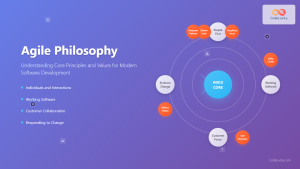
Agile Philosophy: Understanding Core Principles and Values for Modern Software Development
Introduction to Agile Philosophy Agile philosophy represents a fundamental shift in how software development teams approach project management, collaboration, and...
Agile Transformation: Complete Guide to Organizational Change Management
Agile transformation represents one of the most significant organizational changes companies undertake today. This comprehensive shift from traditional project management...
Agile Operations: Complete Guide to Streamlining Business Processes with Modern Methodologies
Agile Operations represents a transformative approach to managing business processes that combines the flexibility of agile methodologies with operational excellence....
DevOps Demystified: A Practical Guide to Transforming Your Development Process
Welcome to the first installment of our "DevOps from Scratch" series! Whether you're a seasoned developer looking to streamline your...
What is Agile Methodology: Complete Beginner’s Guide to Modern Software Development
Agile methodology has revolutionized how software development teams work, moving away from rigid traditional approaches to embrace flexibility, collaboration, and...
Benefits of Agile Methodology: Why Teams Choose Agile for Project Success
Agile methodology has revolutionized how teams approach project management and software development. Since its introduction through the Agile Manifesto in...
Agile Innovation: Complete Guide to Fostering Creative Solutions in Modern Development
In today's rapidly evolving technological landscape, the ability to innovate quickly and effectively has become the cornerstone of successful software...
Tools for Remote Agile: Essential Collaboration Platforms for Distributed Teams
Remote Agile development has become the norm for countless software teams worldwide. The success of distributed Agile teams heavily depends...