In today’s rapidly evolving digital landscape, organizations are discovering that technical excellence alone isn’t enough to create products that truly resonate with users. The most successful teams are those that seamlessly blend Design Thinking with Agile methodologies to create human-centered innovations that solve real problems while delivering exceptional user experiences.
This powerful combination transforms how teams approach product development, shifting from feature-driven to user-driven solutions. By integrating Design Thinking’s empathy-focused approach with Agile’s iterative delivery model, organizations can build products that not only meet technical requirements but genuinely improve users’ lives.
Understanding Design Thinking: The Foundation of Human-Centered Innovation
Design Thinking is a problem-solving methodology that prioritizes understanding user needs, challenging assumptions, and exploring creative solutions. Unlike traditional approaches that start with technical constraints or business requirements, Design Thinking begins with deep empathy for the people who will ultimately use the product.
The Five Stages of Design Thinking
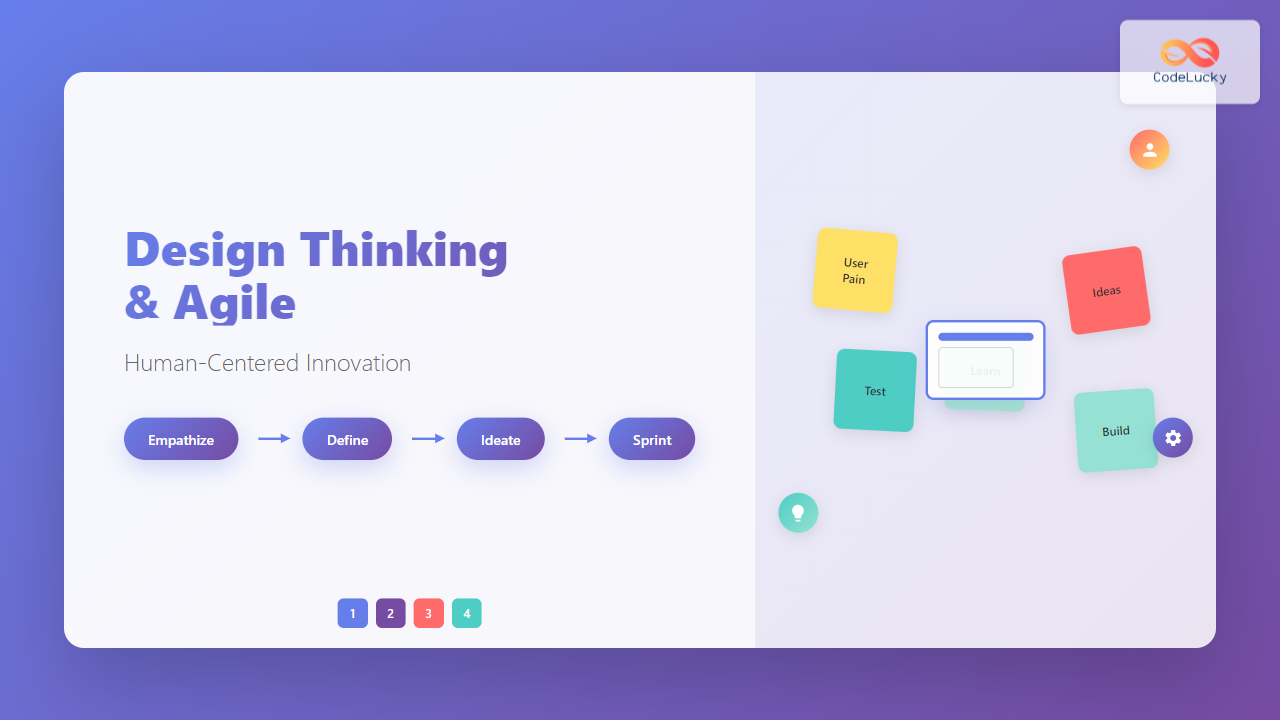
Empathize: This foundational stage involves immersing yourself in the user’s world to understand their experiences, motivations, and pain points. Teams conduct user interviews, observe behaviors, and gather insights that reveal the underlying human needs behind surface-level requests.
Define: Based on empathy research, teams synthesize findings to clearly articulate the core problem they’re solving. This stage creates a human-centered problem statement that guides all subsequent decision-making.
Ideate: With a clear problem definition, teams brainstorm creative solutions without immediate judgment. This divergent thinking phase encourages wild ideas and builds upon each other’s thoughts to explore the full solution space.
Prototype: Ideas are quickly transformed into tangible representations that can be tested with users. These prototypes can range from paper sketches to interactive digital mockups, focusing on learning rather than perfection.
Test: Users interact with prototypes while teams observe and gather feedback. This stage validates assumptions, reveals unexpected insights, and informs the next iteration of the design.
Agile Methodology: Iterative Excellence in Software Development
Agile methodology revolutionized software development by emphasizing collaboration, adaptability, and continuous delivery of value. Its core principles align remarkably well with Design Thinking’s human-centered approach, creating natural synergies when combined effectively.
Core Agile Principles That Support Design Thinking
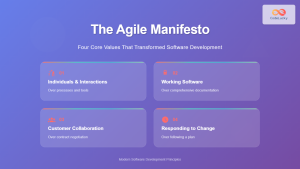
Individuals and interactions over processes and tools: This principle perfectly complements Design Thinking’s emphasis on empathy and human connection. Both methodologies prioritize understanding people over following rigid procedures.
Working software over comprehensive documentation: Like Design Thinking’s prototype-first approach, Agile values tangible results that can be tested and improved upon, rather than theoretical plans.
Customer collaboration over contract negotiation: Both methodologies emphasize ongoing dialogue with users and stakeholders, ensuring that solutions remain aligned with real needs throughout the development process.
Responding to change over following a plan: Design Thinking’s iterative nature requires flexibility to adapt based on user feedback, which aligns perfectly with Agile’s embrace of change as a competitive advantage.
The Synergy: Where Design Thinking Meets Agile
When Design Thinking and Agile methodologies combine, they create a powerful framework for human-centered innovation that addresses both user needs and business objectives. This integration occurs at multiple levels, from strategic planning to daily execution.
Sprint Zero: Setting the Human-Centered Foundation
Before traditional Agile sprints begin, many teams now incorporate a “Sprint Zero” phase that focuses on Design Thinking activities. This period allows teams to conduct user research, define core problems, and establish a shared understanding of user needs before writing any code.
During Sprint Zero, teams might conduct user interviews, create personas, map user journeys, and develop initial prototypes. This foundation ensures that all subsequent development work is grounded in real user insights rather than assumptions.
Design Sprints Within Agile Sprints
Rather than treating design as a separate phase, successful teams integrate Design Thinking activities throughout their Agile cycles. Each sprint might include dedicated time for user research, prototype creation, and user testing alongside traditional development tasks.
This integration ensures that design decisions are continuously validated with users, preventing the common scenario where teams build features perfectly according to specifications that don’t actually meet user needs.
Practical Implementation Strategies
Successfully combining Design Thinking with Agile requires intentional changes to team structure, processes, and mindset. The following strategies help organizations make this transition effectively.
Cross-Functional Team Composition
Traditional Agile teams often focus primarily on developers, testers, and product owners. Human-centered Agile teams expand this composition to include UX researchers, interaction designers, and visual designers as core team members rather than external consultants.
This integrated approach ensures that design thinking is embedded in daily decision-making rather than being an occasional add-on. When designers work closely with developers throughout the sprint, they can rapidly iterate on solutions based on technical constraints and user feedback.
Dual-Track Development
Many successful teams adopt a dual-track approach where discovery and delivery work happen in parallel. The discovery track focuses on Design Thinking activities like user research and prototyping, while the delivery track implements and tests solutions with users.
This approach ensures that teams are always learning about users while simultaneously building and refining solutions. The discovery track typically runs one or two sprints ahead of delivery, providing a constant stream of validated ideas for implementation.
User Story Evolution
Traditional Agile user stories often focus on functional requirements: “As a user, I want to be able to log in so that I can access my account.” Human-centered user stories dig deeper into the emotional and contextual aspects of user needs.
Enhanced user stories might read: “As a busy parent trying to check my child’s school progress during my lunch break, I want to quickly and securely access their grades without complex navigation, so I can stay informed without feeling overwhelmed by technical barriers.”
These richer stories help development teams understand not just what to build, but why it matters to users and how it fits into their broader life context.
Overcoming Common Integration Challenges
While the benefits of combining Design Thinking with Agile are significant, teams often encounter predictable challenges during implementation. Understanding these obstacles and their solutions helps ensure successful adoption.
Balancing Speed and Depth
Agile’s emphasis on rapid delivery can sometimes feel at odds with Design Thinking’s thorough exploration of user needs. Teams may worry that taking time for user research will slow down development cycles.
The solution lies in right-sizing research activities for Agile timelines. Instead of conducting months-long research studies, teams can use rapid research techniques like guerrilla user testing, online surveys, and analytics analysis to gather insights quickly.
Additionally, research should be treated as an investment that actually speeds up overall delivery by preventing the need to rebuild features that don’t meet user needs.
Managing Stakeholder Expectations
Stakeholders accustomed to traditional development approaches may be skeptical of spending time on “soft” activities like user empathy when they want to see concrete features being built.
Successful teams address this by clearly communicating the business value of user-centered design. They share metrics showing how user research reduces support tickets, increases user engagement, and improves conversion rates. Regular demonstrations of prototype testing help stakeholders see the direct impact of design thinking on product success.
Scaling Across Large Organizations
While integrating Design Thinking and Agile works well for small teams, larger organizations face additional complexity when trying to coordinate multiple teams working on interconnected products.
Successful scaling often involves creating design systems that provide consistent user experiences across teams while allowing for localized innovation. Organizations also establish communities of practice where teams share research insights and design patterns, preventing duplicated effort and ensuring coherent user experiences.
Measuring Success in Human-Centered Agile
Traditional Agile metrics like velocity and burn-down charts remain important, but human-centered teams also need metrics that capture the quality of user experiences and the effectiveness of design decisions.
User-Centered Metrics
User Satisfaction Scores: Regular measurement of user satisfaction through surveys, Net Promoter Scores, and user interviews provides direct feedback on whether products are meeting human needs.
Task Completion Rates: Measuring how successfully users can complete key tasks reveals whether design solutions are actually usable in real-world contexts.
Time to Value: Tracking how quickly new users can achieve their first meaningful outcome with the product indicates whether the design successfully reduces friction and cognitive load.
Process Effectiveness Metrics
Research Velocity: Measuring how quickly teams can gather and act on user insights helps optimize the research process and ensure it’s providing timely value to development.
Prototype-to-Production Time: Tracking how efficiently teams can move from initial prototypes to tested, production-ready features indicates the effectiveness of the design-development collaboration.
Iteration Quality: Measuring how much user feedback improves with each iteration helps teams understand whether their design thinking process is effectively solving user problems.
Real-World Success Stories
Organizations across industries have successfully combined Design Thinking with Agile to create breakthrough innovations that delight users while achieving business objectives.
Financial Services Innovation
A major bank transformed its mobile banking experience by integrating Design Thinking into their Agile development process. Instead of starting with feature requirements, they began each sprint cycle with user interviews to understand the emotional and practical challenges customers faced when managing their finances.
This approach revealed that customers didn’t just want more features – they wanted confidence and control over their financial decisions. The resulting app focused on providing contextual insights and gentle guidance rather than overwhelming users with complex functionality. User satisfaction scores increased by 40% while development velocity actually improved due to clearer user-centered priorities.
Healthcare Technology Transformation
A healthcare technology company used human-centered Agile to redesign their patient portal. Traditional requirements gathering had focused on administrative efficiency, but Design Thinking research revealed that patients were primarily concerned with understanding their health status and feeling connected to their care team.
By running parallel design and development tracks, the team rapidly prototyped and tested new approaches to presenting medical information in ways that reduced anxiety and increased patient engagement. The result was a 60% increase in portal usage and significantly improved patient satisfaction scores.
Tools and Techniques for Integration
Successful integration of Design Thinking and Agile requires both mindset changes and practical tools that support human-centered development processes.
Digital Collaboration Platforms
Modern teams leverage digital tools that support both design thinking and agile processes. Platforms like Miro and Figma enable real-time collaboration on user journey maps, wireframes, and prototypes, while tools like Jira and Azure DevOps help manage the development workflow.
The key is choosing tools that support rapid iteration and easy sharing of design artifacts with development teams, ensuring that user insights can quickly influence technical decisions.
Research and Testing Integration
Teams use tools like UserTesting, Hotjar, and Amplitude to gather user feedback continuously rather than waiting for formal research phases. These platforms enable rapid prototype testing and behavioral analytics that inform both design and development decisions within sprint timelines.
Automated user feedback collection helps teams maintain connection with user needs even when dedicated research time is limited, ensuring that human-centered insights remain central to development decisions.
Building Human-Centered Culture
The most successful implementations of Design Thinking and Agile go beyond process changes to create cultural transformation that puts users at the center of all decision-making.
Leadership Commitment
Sustainable human-centered innovation requires leadership that values user insights as much as technical metrics. Leaders must be willing to invest in research activities and support teams when user feedback suggests changing direction, even if it means adjusting planned features or timelines.
This commitment is demonstrated through resource allocation, performance metrics that include user satisfaction, and public celebration of teams that make user-centered decisions even when they’re difficult or expensive.
Continuous Learning Mindset
Human-centered Agile teams embrace uncertainty and treat every interaction with users as a learning opportunity. This mindset shift from “building what we planned” to “learning what users need” requires psychological safety where team members feel comfortable admitting when assumptions are wrong and pivoting based on new insights.
Teams that successfully maintain this learning orientation regularly reflect on what they’ve discovered about users and how those insights should influence future development priorities.
Future Trends and Evolution
The integration of Design Thinking and Agile continues to evolve as organizations learn more about creating human-centered innovation at scale.
AI-Augmented User Research
Artificial intelligence is beginning to augment traditional user research methods, enabling teams to analyze user behavior patterns at scale while maintaining the human empathy that makes Design Thinking effective. AI tools can help identify user pain points in large datasets while human researchers focus on understanding the emotional and contextual factors behind those patterns.
Continuous User Involvement
Forward-thinking organizations are moving beyond periodic user testing to create ongoing relationships with user communities that provide continuous feedback throughout the development process. This approach enables even more responsive and user-centered development cycles.
Getting Started: Your Human-Centered Agile Journey
Organizations ready to begin integrating Design Thinking with Agile should start with small experiments that demonstrate value before scaling across larger teams.
Pilot Project Selection
Choose a pilot project that has direct user impact and stakeholder visibility. Products with clear user interactions and measurable outcomes provide the best opportunities to demonstrate the value of human-centered approaches.
Start with a single team that’s already comfortable with Agile practices and add Design Thinking elements gradually. This approach allows teams to learn and adapt without overwhelming existing processes.
Building Design Thinking Capabilities
Invest in training that helps team members develop empathy skills, user research techniques, and rapid prototyping abilities. These capabilities are as important as technical skills for creating human-centered innovations.
Consider bringing in experienced Design Thinking facilitators for initial projects while building internal capabilities that can sustain the approach long-term.
The combination of Design Thinking and Agile represents a fundamental shift toward more human-centered innovation that creates better outcomes for users, businesses, and development teams. By starting with user empathy, iterating rapidly based on feedback, and maintaining focus on human needs throughout the development process, organizations can create products that truly make a difference in people’s lives while achieving their business objectives.
Success in this approach requires commitment, patience, and willingness to learn from users even when their feedback challenges existing assumptions. The organizations that master this integration will be best positioned to create the innovative, user-centered products that define the future of digital experiences.
Related Posts
Agile Innovation: Complete Guide to Fostering Creative Solutions in Modern Development
In today's rapidly evolving technological landscape, the ability to innovate quickly and effectively has become the cornerstone of successful software...
Systems Thinking: Complete Guide to Holistic Agile Development
Systems thinking revolutionizes how Agile teams approach software development by viewing projects as interconnected ecosystems rather than isolated components. This...
Agile in Non-Software: Complete Guide to Implementation Beyond IT Applications
Introduction to Agile Beyond Software Development While Agile methodologies originated in software development, their core principles of flexibility, collaboration, and...
Agile Mindset: Developing the Right Mental Framework for Software Success
The agile mindset represents far more than following a set of practices or ceremonies—it's a fundamental shift in how we...
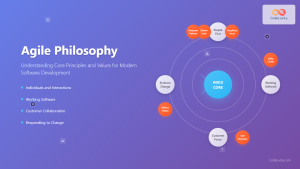
Agile Philosophy: Understanding Core Principles and Values for Modern Software Development
Introduction to Agile Philosophy Agile philosophy represents a fundamental shift in how software development teams approach project management, collaboration, and...
The Agile Manifesto: Four Core Values Explained for Modern Software Development
The Agile Manifesto, published in 2001 by seventeen software development thought leaders, fundamentally transformed how we approach software development. This...
Future of Agile: Emerging Trends and Evolution in Modern Software Development
The Agile methodology has revolutionized software development since the publication of the Agile Manifesto in 2001. As we move deeper...
Value-Driven Development: Complete Guide to Maximizing Customer Value in Agile Projects
What is Value-Driven Development? Value-driven development is a software development approach that prioritizes delivering maximum customer value with every iteration,...
Agile vs DevOps: Understanding the Relationship Between Two Powerful Software Development Methodologies
In today's fast-paced software development landscape, organizations are constantly seeking methodologies that can accelerate delivery while maintaining quality. Two prominent...
Customer Development: Complete Guide to Market-Driven Innovation in Agile
Customer development represents a fundamental shift from traditional product development, placing market validation and customer feedback at the core of...
Agile Psychology: Understanding Team Behavior and Mental Dynamics in Software Development
The success of Agile methodologies extends far beyond frameworks and processes—it's deeply rooted in understanding human psychology and team behavior....
Agile Architecture: Designing for Change – Building Flexible Software Systems
In today's rapidly evolving digital landscape, traditional waterfall architecture approaches often fail to meet the dynamic needs of modern software...