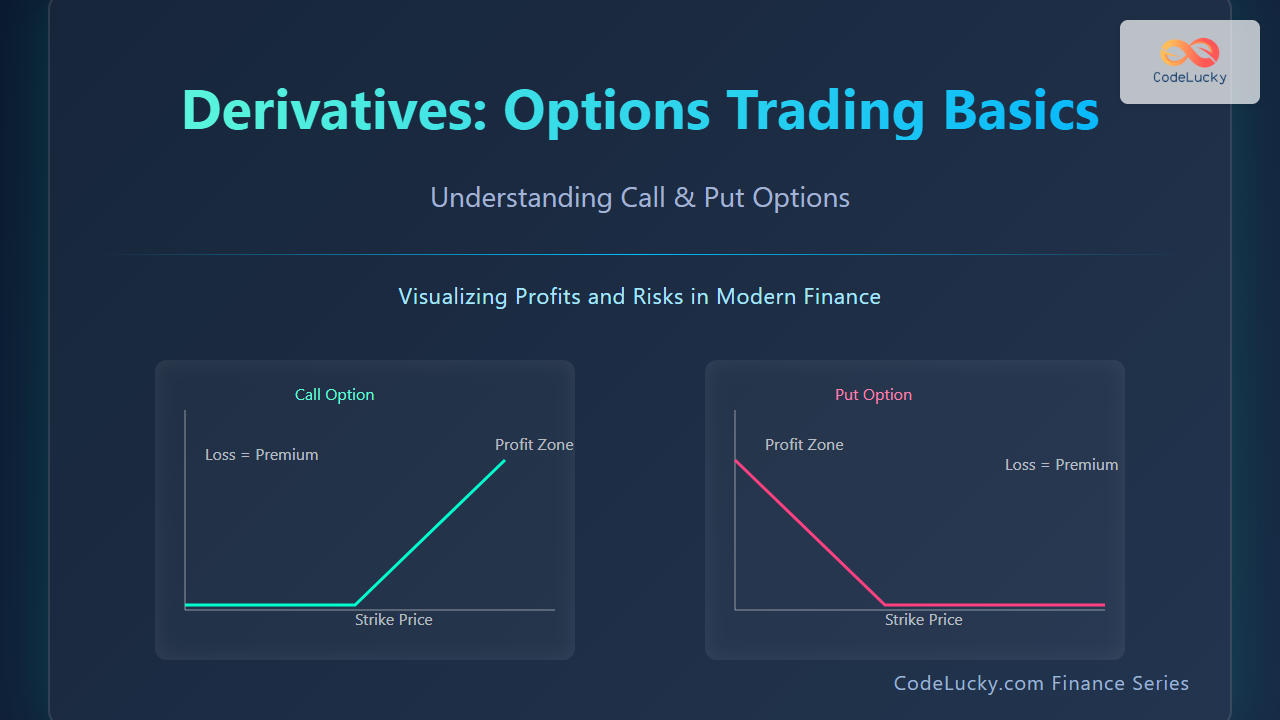
Derivatives: Options Trading Basics (Call & Put) is the foundation for anyone entering the world of modern finance and investment. Options are among the most popular derivative instruments used by traders to speculate on price movements or hedge against potential losses. In this article, we’ll break down the fundamentals of call and put options, explain how they work, and explore visual payoff structures to help you master the topic with confidence.
What Are Derivatives?
A derivative is a financial instrument whose value is derived from an underlying asset such as a stock, commodity, index, currency, or bond. The main purpose of derivatives is to manage risk or gain exposure to price movements without directly owning the asset.
- Futures and Forwards – Agreements to buy or sell an asset at a future date for a predetermined price.
- Options – Rights (but not obligations) to buy or sell an asset at a specific price before or on a set date.
- Swaps – Contracts that exchange cash flows or financial obligations between two parties.
Among these, options are the most flexible and accessible for retail investors.
What Are Options?
An option is a contract that gives the holder the right, but not the obligation, to buy or sell an underlying asset at a fixed price—called the strike price—before or on a specific expiration date.
Two Types of Options

Let’s examine each type in detail:
Call Option (Right to Buy)
A call option gives the buyer the right (but not obligation) to buy an asset at a specified strike price within a set time period. Buyers of call options expect the price of the underlying asset to rise.
Example: Call Option
Imagine you buy a call option for ABC Ltd. stock at a strike price of ₹100, with a premium of ₹5 and expiry in one month.
- If the stock price rises to ₹120, you can exercise the option to buy at ₹100, making a profit of ₹15 (₹20 gain – ₹5 premium).
- If the price stays below ₹100 (say ₹95), you will not exercise it, losing only your ₹5 premium.

Call Option Payoff Diagram
The payoff of a call option increases as the price rises above the strike price. The loss is limited to the premium paid.

Profit = Max(0, Market Price - Strike Price) - Premium
Put Option (Right to Sell)
A put option gives the buyer the right (but not obligation) to sell the underlying asset at the strike price. Buyers of put options expect the market price to fall, allowing them to sell the asset at a higher strike price.
Example: Put Option
You buy a put option for XYZ Corp. with a strike price of ₹200, paying a premium of ₹8.
- If the stock price falls to ₹170, you can sell at ₹200, making ₹22 profit per share (₹30 gain – ₹8 premium).
- If the stock stays above ₹200, you’ll skip exercising and lose only the ₹8 premium.

Put Option Payoff Diagram
The payoff of a put option increases when the asset price falls below the strike price, making it ideal for hedging or betting on downturns.

Profit = Max(0, Strike Price - Market Price) - Premium
Key Terms in Options Trading
- Strike Price: The fixed price at which you can buy/sell the asset.
- Premium: The cost paid for owning the option contract.
- Expiration Date: The last date by which the option can be exercised.
- Intrinsic Value: The current value if exercised immediately.
- Time Value: Extra amount an investor is willing to pay expecting favorable price moves before expiry.
How to Use Options
Traders and investors use options for various purposes:
- Speculation: Predicting movement of stocks or indices for profit.
- Hedging: Protecting existing holdings from downside risk.
- Income Strategy: Writing (selling) covered calls or puts for steady premiums.
Example: Using Options for Hedging
Suppose you own 100 shares of a company trading at ₹500 each. You fear a downturn, so you buy a put option at ₹480 strike for ₹10 premium. If the price falls to ₹450, your loss on the stock (₹50×100) is balanced by the gain from your put option (₹30×100 – ₹10×100 = ₹2000 net gain). Hence, your losses are limited—this is the essence of hedging.
Interactive Example: Calculate Option Profit or Loss
Try adjusting the strike price, market price, and premium in the simple example below:
// Call Option P/L Calculator
function callOptionProfit(marketPrice, strike, premium) {
  return Math.max(0, marketPrice - strike) - premium;
}

// Example:
console.log(callOptionProfit(120, 100, 5)); // Output: 15
This logic helps investors dynamically assess returns and break-even levels.
Real-World Applications of Options
- Hedging portfolio risk against market corrections.
- Generating passive income through writing covered options.
- Speculating on volatility using straddles or strangles.
- Arbitrage opportunities in price discrepancies between derivatives and spot markets.
Advantages and Risks
| Advantages | Risks |
|---|---|
| Limited upfront investment vs direct stock | Time decay reduces value as expiry nears |
| High leverage potential for returns | Can lose entire premium if market doesn’t move favorably |
| Useful for hedging | Complexity requires knowledge and market awareness |
Final Thoughts
Options trading can be a powerful tool for investors when used wisely. Understanding the structure of call and put options, along with their payoff profiles, helps traders craft strategies suited to different market conditions. As a derivative, an option’s value is tied to the underlying asset—yet its versatility makes it one of the most exciting instruments in finance today.
When practiced with discipline, risk management, and education, options trading opens the door to a new realm of financial opportunity and flexibility.