Understanding Deadlock and Circular Wait
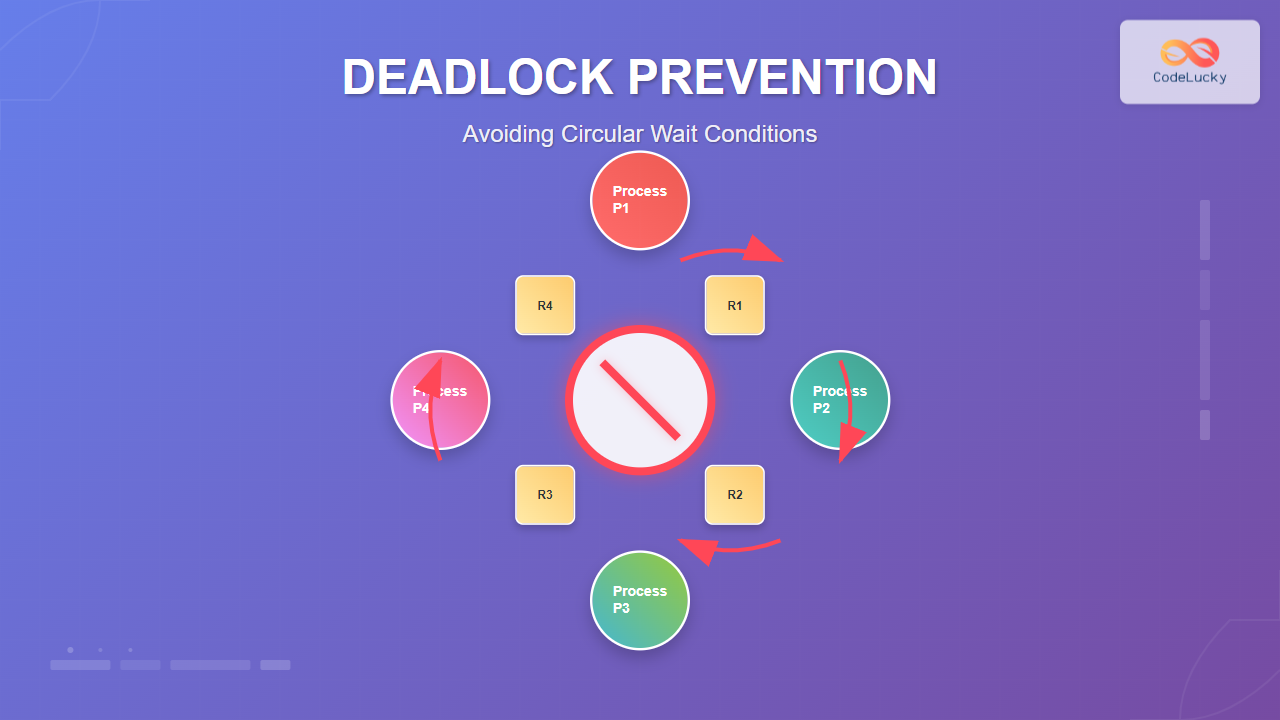
Deadlock is one of the most critical issues in operating systems where two or more processes become permanently blocked, each waiting for resources held by the other. Among the four necessary conditions for deadlock (mutual exclusion, hold and wait, no preemption, and circular wait), circular wait is often the most practical target for prevention strategies.
Circular wait occurs when processes form a chain where each process holds a resource needed by the next process in the chain, creating a closed loop. By preventing this condition, we can effectively eliminate the possibility of deadlock occurrence.

Core Strategies for Preventing Circular Wait
1. Resource Ordering (Linear Ordering)
The most widely implemented approach involves assigning a unique numerical order to all resources in the system. Processes must request resources in ascending order of their assigned numbers, preventing the formation of circular dependencies.
Implementation Example
// Resource ordering example
#define PRINTER 1
#define SCANNER 2
#define DISK 3
#define NETWORK 4

// Correct implementation - ascending order
void process_A() {
    acquire_resource(PRINTER);    // Resource 1
    acquire_resource(DISK);       // Resource 3
    // ... perform operations
    release_resource(DISK);
    release_resource(PRINTER);
}

void process_B() {
    acquire_resource(SCANNER);    // Resource 2
    acquire_resource(NETWORK);    // Resource 4
    // ... perform operations
    release_resource(NETWORK);
    release_resource(SCANNER);
}

2. Two-Phase Locking Protocol
This approach divides resource acquisition into two distinct phases: growing phase (acquire resources) and shrinking phase (release resources). Once a process begins releasing resources, it cannot acquire new ones.
Practical Implementation
class TwoPhaseLocking:
    def __init__(self):
        self.phase = "GROWING"  # GROWING or SHRINKING
        self.held_resources = []
        self.lock = threading.Lock()

    def acquire_resource(self, resource_id):
        with self.lock:
            if self.phase == "SHRINKING":
                raise Exception("Cannot acquire resources in shrinking phase")

            # Simulate resource acquisition
            self.held_resources.append(resource_id)
            print(f"Acquired resource {resource_id}")
            return True

    def release_resource(self, resource_id):
        with self.lock:
            self.phase = "SHRINKING"  # Switch to shrinking phase
            if resource_id in self.held_resources:
                self.held_resources.remove(resource_id)
                print(f"Released resource {resource_id}")
            return True
3. Timestamp-Based Resource Allocation
Each process receives a unique timestamp when it starts. Resources are allocated based on these timestamps, ensuring a consistent ordering that prevents circular wait conditions.
public class TimestampBasedAllocation {
    private static long globalTimestamp = 0;
    private long processTimestamp;
    private Map<Integer, Long> resourceOwners;

    public TimestampBasedAllocation() {
        this.processTimestamp = ++globalTimestamp;
        this.resourceOwners = new ConcurrentHashMap<>();
    }

    public boolean requestResource(int resourceId) {
        Long currentOwner = resourceOwners.get(resourceId);

        // If resource is free or owned by newer process
        if (currentOwner == null || currentOwner > this.processTimestamp) {
            resourceOwners.put(resourceId, this.processTimestamp);
            return true;
        }

        // Wait-die: if older process needs resource from newer, wait
        // Otherwise, die (restart with same timestamp)
        return false;
    }
}
Advanced Prevention Techniques
Hierarchical Resource Allocation
This method organizes resources into a hierarchical structure where processes can only request resources from higher levels after completing operations on lower levels.

Resource Allocation Graph Analysis
Before granting any resource request, the system analyzes the resource allocation graph to ensure that granting the request won’t create a cycle.
class ResourceAllocationGraph:
    def __init__(self):
        self.processes = set()
        self.resources = set()
        self.allocation = {}  # resource -> process
        self.request = {}     # process -> set of resources

    def has_cycle(self):
        """Check if the graph contains a cycle using DFS"""
        visited = set()
        rec_stack = set()

        def dfs(node):
            visited.add(node)
            rec_stack.add(node)

            # Get neighbors based on graph structure
            neighbors = self.get_neighbors(node)

            for neighbor in neighbors:
                if neighbor not in visited:
                    if dfs(neighbor):
                        return True
                elif neighbor in rec_stack:
                    return True

            rec_stack.remove(node)
            return False

        for node in self.processes.union(self.resources):
            if node not in visited:
                if dfs(node):
                    return True
        return False

    def safe_to_allocate(self, process, resource):
        """Check if allocation is safe before proceeding"""
        # Temporarily make the allocation
        old_allocation = self.allocation.get(resource)
        self.allocation[resource] = process

        # Check for cycles
        safe = not self.has_cycle()

        # Restore previous state
        if old_allocation:
            self.allocation[resource] = old_allocation
        else:
            del self.allocation[resource]

        return safe
Real-World Implementation Examples
Database Transaction Management
Database systems commonly implement ordered locking to prevent deadlocks in concurrent transactions.
-- Example: Banking transaction with ordered locking
BEGIN TRANSACTION;

-- Always lock accounts in ascending order by account_id
DECLARE @account1 INT = CASE WHEN @from_account < @to_account
                            THEN @from_account ELSE @to_account END;
DECLARE @account2 INT = CASE WHEN @from_account > @to_account
                            THEN @from_account ELSE @to_account END;

-- Lock accounts in order
SELECT balance FROM accounts WHERE account_id = @account1 WITH (UPDLOCK);
SELECT balance FROM accounts WHERE account_id = @account2 WITH (UPDLOCK);

-- Perform transfer
UPDATE accounts SET balance = balance - @amount
WHERE account_id = @from_account;

UPDATE accounts SET balance = balance + @amount
WHERE account_id = @to_account;

COMMIT TRANSACTION;
Operating System Process Synchronization
// Linux kernel-style resource ordering
struct resource_manager {
    spinlock_t lock;
    struct list_head resources;
    int max_resource_id;
};

int acquire_resources_ordered(int *resource_ids, int count) {
    // Sort resource IDs to ensure consistent ordering
    qsort(resource_ids, count, sizeof(int), compare_int);

    for (int i = 0; i < count; i++) {
        if (!try_acquire_resource(resource_ids[i])) {
            // Release already acquired resources in reverse order
            for (int j = i - 1; j >= 0; j--) {
                release_resource(resource_ids[j]);
            }
            return -1; // Failed to acquire all resources
        }
    }
    return 0; // Success
}

Performance Considerations and Trade-offs
Overhead Analysis
Resource ordering introduces minimal runtime overhead but may reduce system throughput due to artificial constraints on resource access patterns. The key trade-offs include:
- Memory overhead: Maintaining resource ordering information
- CPU overhead: Sorting resource requests and validation
- Throughput impact: Potentially longer waiting times for optimal resource combinations
- Fairness considerations: Some processes may consistently wait longer
Optimization Strategies
class OptimizedResourceManager {
private:
    std::vector<std::mutex> resource_mutexes;
    std::atomic<int> next_resource_id{0};

public:
    // Batch acquisition with timeout
    bool acquire_multiple_resources(
        const std::vector<int>& resource_ids,
        std::chrono::milliseconds timeout
    ) {
        auto sorted_ids = resource_ids;
        std::sort(sorted_ids.begin(), sorted_ids.end());

        std::vector<std::unique_lock<std::mutex>> locks;
        auto deadline = std::chrono::steady_clock::now() + timeout;

        for (int id : sorted_ids) {
            auto remaining_time = deadline - std::chrono::steady_clock::now();
            if (remaining_time <= std::chrono::milliseconds(0)) {
                return false; // Timeout
            }

            locks.emplace_back(
                resource_mutexes[id],
                std::defer_lock
            );

            if (!locks.back().try_lock_for(remaining_time)) {
                return false; // Could not acquire within timeout
            }
        }

        // All resources acquired successfully
        return true;
    }
};
Testing and Validation
Deadlock Detection Testing
import threading
import time
import random

class DeadlockTester:
    def __init__(self, num_resources=5, num_processes=10):
        self.resources = [threading.Lock() for _ in range(num_resources)]
        self.resource_order = list(range(num_resources))
        self.deadlock_detected = False

    def ordered_acquisition_test(self, process_id):
        """Test ordered resource acquisition"""
        # Randomly select resources to acquire
        needed_resources = random.sample(
            range(len(self.resources)),
            random.randint(2, 4)
        )

        # Sort for ordered acquisition
        needed_resources.sort()

        acquired_locks = []
        try:
            for resource_id in needed_resources:
                print(f"Process {process_id} acquiring resource {resource_id}")
                self.resources[resource_id].acquire(timeout=5)
                acquired_locks.append(resource_id)

                # Simulate work
                time.sleep(random.uniform(0.1, 0.5))

        except Exception as e:
            print(f"Process {process_id} failed: {e}")
            self.deadlock_detected = True

        finally:
            # Release in reverse order
            for resource_id in reversed(acquired_locks):
                self.resources[resource_id].release()
                print(f"Process {process_id} released resource {resource_id}")

    def run_test(self, duration=30):
        """Run concurrent deadlock test"""
        threads = []
        start_time = time.time()

        while time.time() - start_time < duration:
            if len(threads) < 10:  # Limit concurrent processes
                t = threading.Thread(
                    target=self.ordered_acquisition_test,
                    args=(len(threads),)
                )
                threads.append(t)
                t.start()

            # Clean up completed threads
            threads = [t for t in threads if t.is_alive()]
            time.sleep(0.1)

        # Wait for all threads to complete
        for t in threads:
            t.join(timeout=10)

        return not self.deadlock_detected
Best Practices and Implementation Guidelines
Design Principles
- Establish consistent resource ordering early in system design
- Document resource hierarchy clearly for all developers
- Implement timeout mechanisms as a secondary safety measure
- Use automated testing to validate deadlock prevention
- Monitor resource contention patterns in production
Common Implementation Mistakes
- Inconsistent ordering: Different modules using different resource orders
- Dynamic resource creation: New resources not properly integrated into ordering scheme
- Exception handling gaps: Failing to release resources during error conditions
- Performance optimization bypasses: Circumventing ordering for performance gains
Conclusion
Preventing circular wait conditions is a highly effective approach to deadlock prevention that can be implemented with reasonable overhead. By establishing consistent resource ordering, implementing proper acquisition protocols, and maintaining rigorous testing practices, systems can achieve robust deadlock prevention.
The key to successful implementation lies in choosing the right strategy for your specific use case, whether it’s simple resource ordering for basic systems, timestamp-based allocation for distributed environments, or hierarchical approaches for complex resource dependencies. Remember that prevention is generally more efficient than detection and recovery, making these techniques valuable tools in system design.
Modern operating systems and database management systems successfully employ these techniques, demonstrating their practical viability in real-world applications. As systems become increasingly concurrent and distributed, mastering these deadlock prevention strategies becomes even more critical for building reliable software.
Related Posts
Deadlock in Operating System: Complete Guide to Necessary Conditions and Detection Methods
Deadlock is one of the most critical challenges in operating system design, where multiple processes become permanently blocked while waiting...
Deadlock Detection and Recovery: Graph-based Algorithms for Operating Systems
Introduction to Deadlock Detection and Recovery Deadlock is one of the most critical challenges in operating systems where multiple processes...
Wait-for Graph: Comprehensive Guide to Deadlock Detection in Distributed Systems
Introduction to Wait-for Graphs In distributed systems, deadlock detection remains one of the most critical challenges for maintaining system reliability...
Critical Section Problem: Complete Guide to Mutual Exclusion Solutions in Operating Systems
What is the Critical Section Problem? The critical section problem is a fundamental challenge in operating systems where multiple processes...

Spin Locks in Operating System: Complete Guide to Busy Waiting Synchronization
Spin locks are fundamental synchronization primitives in operating systems that implement busy waiting mechanisms to protect critical sections from concurrent...

Banker’s Algorithm: Complete Guide to Safe State Detection and Resource Allocation
The Banker's Algorithm is a fundamental deadlock avoidance algorithm in operating systems, designed to ensure that resource allocation maintains the...
Resource Allocation Graph: Complete Guide to Deadlock Detection and Prevention
Resource Allocation Graphs (RAG) serve as powerful visual tools in operating systems for detecting and preventing deadlocks. This comprehensive guide...
Deadlock Avoidance: Banker’s Algorithm Implementation and Examples
Introduction to Deadlock Avoidance Deadlock avoidance is a crucial concept in operating systems that prevents the system from entering an...

Dining Philosophers Problem: Classic Synchronization Challenge in Operating Systems
The Dining Philosophers Problem stands as one of the most iconic examples in computer science for understanding synchronization challenges in...

File Locking Mechanisms: Complete Guide to Advisory and Mandatory Locking in Operating Systems
File locking mechanisms are essential components of modern operating systems that prevent data corruption and ensure data integrity when multiple...
Lamport’s Bakery Algorithm: Complete Guide to N-Process Mutual Exclusion
Lamport's Bakery Algorithm stands as one of the most elegant solutions to the N-process mutual exclusion problem in concurrent programming....

Thread Synchronization: Mutexes, Semaphores and Deadlocks in Operating Systems
Introduction to Thread Synchronization Thread synchronization is a fundamental concept in operating systems that ensures multiple threads can safely access...