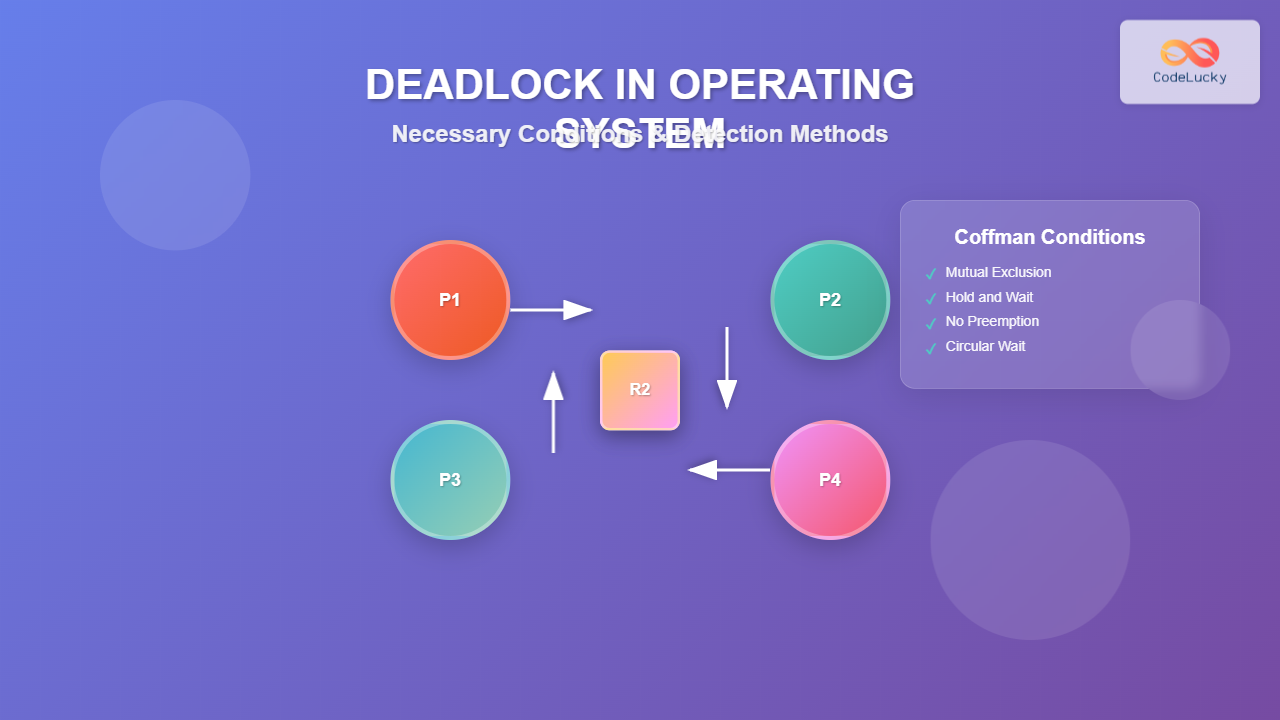
Deadlock is one of the most critical challenges in operating system design, where multiple processes become permanently blocked while waiting for resources held by each other. Understanding deadlock conditions and detection methods is essential for system administrators, developers, and computer science students working with concurrent systems.
What is Deadlock?
A deadlock occurs when two or more processes are blocked indefinitely, each waiting for resources that are held by other processes in the set. This creates a circular dependency where no process can proceed, effectively bringing the entire system to a standstill in the affected resource allocation chain.
Consider this real-world analogy: imagine two people approaching a narrow bridge from opposite ends, each refusing to back up and waiting for the other to move first. Neither can proceed, creating a deadlock situation.

The Four Necessary Conditions for Deadlock (Coffman Conditions)
For a deadlock to occur, all four of the following conditions must be present simultaneously. These conditions, known as the Coffman conditions, were identified by Edward G. Coffman Jr. in 1971:
1. Mutual Exclusion
Mutual exclusion means that resources cannot be shared simultaneously among multiple processes. At least one resource must be held in a non-shareable mode, where only one process can use the resource at any given time.
Example: A printer can only print one document at a time. If Process A is using the printer, Process B must wait until Process A releases it.
// Example: Printer resource with mutex
pthread_mutex_t printer_mutex = PTHREAD_MUTEX_INITIALIZER;

void print_document(int process_id) {
    pthread_mutex_lock(&printer_mutex);  // Acquire exclusive access
    printf("Process %d is printing...\n", process_id);
    sleep(2);  // Simulate printing time
    printf("Process %d finished printing\n", process_id);
    pthread_mutex_unlock(&printer_mutex);  // Release resource
}
2. Hold and Wait
The hold and wait condition occurs when a process holds at least one resource while simultaneously waiting to acquire additional resources that are currently held by other processes.
Example: Process A holds a scanner and waits for a printer, while Process B holds the printer and waits for the scanner.
// Process A
acquire_lock(scanner);
// ... some work with scanner ...
acquire_lock(printer);  // Wait for printer while holding scanner
// ... use both resources ...
release_lock(printer);
release_lock(scanner);

// Process B
acquire_lock(printer);
// ... some work with printer ...
acquire_lock(scanner);  // Wait for scanner while holding printer
// ... use both resources ...
release_lock(scanner);
release_lock(printer);
3. No Preemption
No preemption means that resources cannot be forcibly taken away from processes. A resource can only be released voluntarily by the process holding it, after the process has completed its task.
Example: Once a process acquires a database connection, the operating system cannot forcibly take it away. The process must explicitly close the connection.
4. Circular Wait
A circular wait exists when there is a circular chain of two or more processes, where each process is waiting for a resource held by the next process in the chain.

Deadlock Detection Algorithms
Operating systems employ various algorithms to detect deadlocks. The choice of algorithm depends on system requirements, resource types, and performance considerations.
Wait-for Graph Algorithm (Single Instance Resources)
The wait-for graph is used when each resource type has exactly one instance. This algorithm maintains a directed graph where:
- Nodes represent processes
- Edges represent wait relationships
- A cycle in the graph indicates a deadlock

class WaitForGraph:
    def __init__(self, num_processes):
        self.num_processes = num_processes
        self.graph = [[] for _ in range(num_processes)]

    def add_edge(self, u, v):
        """Add edge from process u to process v (u waits for v)"""
        self.graph[u].append(v)

    def has_cycle_util(self, node, visited, rec_stack):
        visited[node] = True
        rec_stack[node] = True

        for neighbor in self.graph[node]:
            if not visited[neighbor]:
                if self.has_cycle_util(neighbor, visited, rec_stack):
                    return True
            elif rec_stack[neighbor]:
                return True

        rec_stack[node] = False
        return False

    def detect_deadlock(self):
        visited = [False] * self.num_processes
        rec_stack = [False] * self.num_processes

        for node in range(self.num_processes):
            if not visited[node]:
                if self.has_cycle_util(node, visited, rec_stack):
                    return True
        return False

# Example usage
wfg = WaitForGraph(4)
wfg.add_edge(0, 1)  # P0 waits for P1
wfg.add_edge(1, 2)  # P1 waits for P2
wfg.add_edge(2, 0)  # P2 waits for P0 (creates cycle)

if wfg.detect_deadlock():
    print("Deadlock detected!")
else:
    print("No deadlock found.")
Resource Allocation Graph Algorithm (Multiple Instance Resources)
For systems with multiple instances of resource types, we use a more complex resource allocation graph that tracks both allocation and request relationships.
Banker’s Algorithm for Deadlock Detection
The Banker’s algorithm can be adapted for deadlock detection by checking if the current state can lead to a safe sequence of process completion.
def detect_deadlock_bankers(allocation, request, available):
    """
    Banker's algorithm for deadlock detection
    allocation: current resource allocation matrix
    request: current resource request matrix
    available: available resource vector
    """
    n_processes = len(allocation)
    n_resources = len(available)

    # Mark processes that can potentially complete
    finish = [False] * n_processes
    work = available.copy()

    while True:
        found = False
        for i in range(n_processes):
            if not finish[i]:
                # Check if process i can be satisfied
                can_satisfy = True
                for j in range(n_resources):
                    if request[i][j] > work[j]:
                        can_satisfy = False
                        break

                if can_satisfy:
                    # Process i can complete
                    finish[i] = True
                    found = True

                    # Add allocated resources back to work
                    for j in range(n_resources):
                        work[j] += allocation[i][j]

        if not found:
            break

    # If any process cannot finish, deadlock exists
    deadlocked_processes = [i for i in range(n_processes) if not finish[i]]
    return deadlocked_processes

# Example usage
allocation = [[0, 1, 0], [2, 0, 0], [3, 0, 2], [2, 1, 1], [0, 0, 2]]
request = [[0, 0, 0], [2, 0, 2], [0, 0, 0], [1, 0, 0], [0, 0, 2]]
available = [0, 0, 0]

deadlocked = detect_deadlock_bankers(allocation, request, available)
if deadlocked:
    print(f"Deadlocked processes: {deadlocked}")
else:
    print("No deadlock detected")
Practical Deadlock Detection Implementation
Here’s a comprehensive example showing how deadlock detection might be implemented in a real system:
#include <stdio.h>
#include <stdlib.h>
#include <stdbool.h>

#define MAX_PROCESSES 10
#define MAX_RESOURCES 10

typedef struct {
    int allocation[MAX_PROCESSES][MAX_RESOURCES];
    int request[MAX_PROCESSES][MAX_RESOURCES];
    int available[MAX_RESOURCES];
    int n_processes;
    int n_resources;
} SystemState;

bool is_deadlocked(SystemState *state) {
    bool finish[MAX_PROCESSES] = {false};
    int work[MAX_RESOURCES];

    // Initialize work with available resources
    for (int i = 0; i < state->n_resources; i++) {
        work[i] = state->available[i];
    }

    bool progress = true;
    while (progress) {
        progress = false;

        for (int i = 0; i < state->n_processes; i++) {
            if (!finish[i]) {
                bool can_proceed = true;

                // Check if request can be satisfied
                for (int j = 0; j < state->n_resources; j++) {
                    if (state->request[i][j] > work[j]) {
                        can_proceed = false;
                        break;
                    }
                }

                if (can_proceed) {
                    // Mark process as finished
                    finish[i] = true;
                    progress = true;

                    // Release allocated resources
                    for (int j = 0; j < state->n_resources; j++) {
                        work[j] += state->allocation[i][j];
                    }
                }
            }
        }
    }

    // Check if any process is not finished
    for (int i = 0; i < state->n_processes; i++) {
        if (!finish[i]) {
            return true; // Deadlock detected
        }
    }

    return false; // No deadlock
}

void print_deadlock_info(SystemState *state) {
    printf("System State Analysis:\n");
    printf("Allocation Matrix:\n");
    for (int i = 0; i < state->n_processes; i++) {
        printf("P%d: ", i);
        for (int j = 0; j < state->n_resources; j++) {
            printf("%d ", state->allocation[i][j]);
        }
        printf("\n");
    }

    printf("\nRequest Matrix:\n");
    for (int i = 0; i < state->n_processes; i++) {
        printf("P%d: ", i);
        for (int j = 0; j < state->n_resources; j++) {
            printf("%d ", state->request[i][j]);
        }
        printf("\n");
    }

    printf("\nAvailable Resources: ");
    for (int i = 0; i < state->n_resources; i++) {
        printf("%d ", state->available[i]);
    }
    printf("\n");
}
Detection Algorithm Performance Analysis
Different deadlock detection algorithms have varying time complexities:
| Algorithm | Time Complexity | Space Complexity | Best Use Case |
|---|---|---|---|
| Wait-for Graph | O(V + E) | O(V + E) | Single instance resources |
| Resource Allocation Graph | O(V²) | O(V²) | Multiple instance resources |
| Banker’s Algorithm | O(n × m²) | O(n × m) | Complete system analysis |
Where V = number of vertices (processes), E = number of edges, n = number of processes, and m = number of resource types.
When to Run Deadlock Detection
The frequency of deadlock detection depends on several factors:
Periodic Detection
Run detection algorithms at regular intervals (e.g., every 30 seconds). This approach provides predictable overhead but may allow deadlocks to persist for the detection interval.
Triggered Detection
Execute detection when system performance degrades or when resource utilization reaches certain thresholds. This approach is more responsive but can be unpredictable.
On-demand Detection
Run detection algorithms only when requested by system administrators or specific events occur. This minimizes overhead but requires manual intervention.

Deadlock Recovery Strategies
When deadlock is detected, the system must take corrective action:
Process Termination
- Abort all deadlocked processes: Drastic but effective, causes loss of work
- Abort one process at a time: Less disruptive, requires repeated detection
Resource Preemption
- Forcibly remove resources from processes
- Rollback affected processes to safe checkpoints
- Prevent starvation through careful victim selection
Best Practices for Deadlock Management
Prevention strategies are often more effective than detection and recovery:
- Resource ordering: Always acquire resources in a predefined order
- Timeout mechanisms: Implement maximum wait times for resource requests
- Banker’s algorithm: Use conservative resource allocation
- Lock-free programming: Employ atomic operations and lock-free data structures
// Example: Resource ordering to prevent deadlock
enum ResourceType { SCANNER = 1, PRINTER = 2, NETWORK = 3 };

void acquire_resources_safely() {
    // Always acquire resources in ascending order
    acquire_lock(SCANNER);   // ID: 1
    acquire_lock(PRINTER);   // ID: 2
    acquire_lock(NETWORK);   // ID: 3

    // Use resources...

    // Release in reverse order
    release_lock(NETWORK);
    release_lock(PRINTER);
    release_lock(SCANNER);
}
Real-world Applications and Case Studies
Deadlock detection is crucial in various scenarios:
- Database systems: Transaction deadlock detection in concurrent database operations
- Web servers: Connection pool management and resource allocation
- Operating system kernels: Process scheduling and memory management
- Distributed systems: Cross-node resource coordination and consensus algorithms
Conclusion
Understanding deadlock conditions and detection methods is fundamental for building robust concurrent systems. The four necessary conditions provide a framework for both understanding when deadlocks can occur and designing prevention strategies. Detection algorithms like wait-for graphs and resource allocation graphs offer different trade-offs between computational complexity and accuracy.
Modern systems often combine multiple approaches: using prevention techniques to minimize deadlock probability, implementing efficient detection algorithms for early identification, and maintaining recovery mechanisms for graceful handling when deadlocks do occur. The key is finding the right balance between system performance and reliability based on specific application requirements.
As systems become increasingly concurrent and distributed, mastering these deadlock management concepts becomes even more critical for system architects and developers working on high-performance applications.
Related Posts
Deadlock Detection and Recovery: Graph-based Algorithms for Operating Systems
Introduction to Deadlock Detection and Recovery Deadlock is one of the most critical challenges in operating systems where multiple processes...

Deadlock Prevention: Complete Guide to Avoiding Circular Wait Conditions
Understanding Deadlock and Circular Wait Deadlock is one of the most critical issues in operating systems where two or more...
Wait-for Graph: Comprehensive Guide to Deadlock Detection in Distributed Systems
Introduction to Wait-for Graphs In distributed systems, deadlock detection remains one of the most critical challenges for maintaining system reliability...
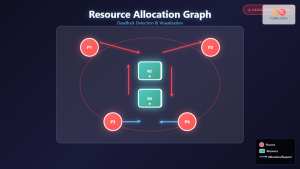
Resource Allocation Graph: Complete Guide to Deadlock Detection and Prevention
Resource Allocation Graphs (RAG) serve as powerful visual tools in operating systems for detecting and preventing deadlocks. This comprehensive guide...

Banker’s Algorithm: Complete Guide to Safe State Detection and Resource Allocation
The Banker's Algorithm is a fundamental deadlock avoidance algorithm in operating systems, designed to ensure that resource allocation maintains the...
Critical Section Problem: Complete Guide to Mutual Exclusion Solutions in Operating Systems
What is the Critical Section Problem? The critical section problem is a fundamental challenge in operating systems where multiple processes...
Deadlock Avoidance: Banker’s Algorithm Implementation and Examples
Introduction to Deadlock Avoidance Deadlock avoidance is a crucial concept in operating systems that prevents the system from entering an...
Spin Locks in Operating System: Complete Guide to Busy Waiting Synchronization
Spin locks are fundamental synchronization primitives in operating systems that implement busy waiting mechanisms to protect critical sections from concurrent...

File Locking Mechanisms: Complete Guide to Advisory and Mandatory Locking in Operating Systems
File locking mechanisms are essential components of modern operating systems that prevent data corruption and ensure data integrity when multiple...
Process Synchronization: Critical Sections and Race Conditions in Operating Systems
Introduction to Process Synchronization Process synchronization is a fundamental concept in operating systems that ensures multiple processes can safely access...

Peterson’s Algorithm: Complete Guide to Two-Process Mutual Exclusion in Operating Systems
What is Peterson's Algorithm? Peterson's Algorithm is a classic solution for achieving mutual exclusion between two processes or threads in...
Thread in Operating System: Lightweight Processes and Multithreading Explained
What are Threads in Operating Systems? A thread is the smallest unit of execution within a process that can be...