Cycle detection in graphs is a fundamental problem in computer science and graph theory, with applications in network analysis, deadlock detection, and validating certain data structures. One of the most efficient methods to detect cycles, especially in undirected graphs, is by using the Union-Find algorithm, also known as the Disjoint Set Union (DSU) data structure.
In this article, we will explore how Union-Find works for cycle detection, provide detailed explanations along with step-by-step examples, and show graphical representations using Mermaid diagrams where helpful. This guide is perfect for programmers, students, and professionals looking to deepen their understanding or write optimized graph algorithms.
Understanding Cycle Detection in Graphs
A cycle in a graph occurs when a path starts and ends at the same vertex, traversing edges without repetition. Detecting cycles is crucial because they can represent problems in networks (like routing loops) or violations in data integrity (e.g., circular dependencies).
For undirected graphs, detecting a cycle means identifying at least one set of nodes connected back to a previously visited node via a different path. For directed graphs, the detection method varies, but this article focuses on cycle detection in undirected graphs using Union-Find.
What is Union-Find (Disjoint Set)?
Union-Find is a data structure that keeps track of a set of elements partitioned into disjoint subsets. It supports two primary operations:
- Find: Determine which subset a particular element belongs to, typically returning the representative or “parent” of that set.
- Union: Merge two subsets into a single subset.
This structure is extremely efficient, especially with optimizations like path compression and union by rank/size. It lends itself naturally to detecting cycles because if two vertices of an edge belong to the same subset, adding that edge would form a cycle.
How Union-Find Detects Cycles in an Undirected Graph
Consider each vertex as part of its own subset initially. For each edge in the graph:
- Use
findto find the root representatives (parents) of both vertices connected by the edge. - If both vertices have the same root, adding this edge would create a cycle.
- If different, union their sets, effectively connecting the two components.
This process continues until either a cycle is detected or all edges are processed without forming cycles.
Step-by-Step Example with Code
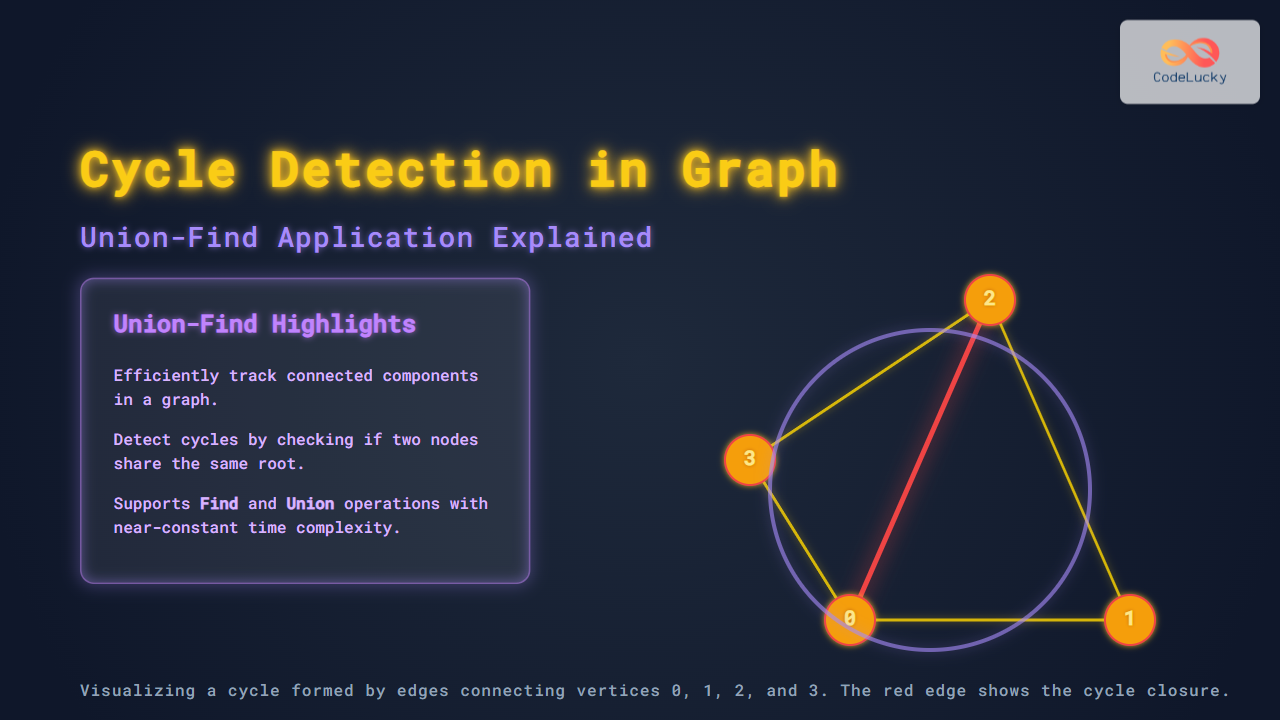
Let’s consider the following undirected graph represented by edges:
- Edge 1: (0, 1)
- Edge 2: (1, 2)
- Edge 3: (2, 3)
- Edge 4: (3, 0)
Visualizing the graph:

Let’s see how Union-Find helps detect the cycle at edge (3, 0):
// Union-Find implementation
class UnionFind:
    def __init__(self, n):
        self.parent = list(range(n))
        self.rank = [0] * n

    def find(self, x):
        if self.parent[x] != x:
            self.parent[x] = self.find(self.parent[x])  # Path compression
        return self.parent[x]

    def union(self, x, y):
        rootX = self.find(x)
        rootY = self.find(y)

        if rootX == rootY:
            return False  # Cycle detected

        # Union by rank
        if self.rank[rootX] < self.rank[rootY]:
            self.parent[rootX] = rootY
        elif self.rank[rootX] > self.rank[rootY]:
            self.parent[rootY] = rootX
        else:
            self.parent[rootY] = rootX
            self.rank[rootX] += 1
        return True

def detect_cycle(edges, n):
    uf = UnionFind(n)
    for u, v in edges:
        if not uf.union(u, v):
            return True  # Cycle found
    return False

edges = [(0,1), (1,2), (2,3), (3,0)]
print(detect_cycle(edges, 4))  # Output: True
Explanation: We initialize each vertex as its own set. When we add the edge (3, 0), both vertices belong to the same set, so union returns False, indicating a cycle.
Interactive Visualization Idea
While full interactive UI embedding isn’t possible here, a typical interactive Union-Find cycle detection visualization would allow users to add/remove edges stepwise and watch how sets merge and cycle detection triggers. This boosts conceptual clarity, especially for beginners.
Union-Find Cycle Detection Complexity
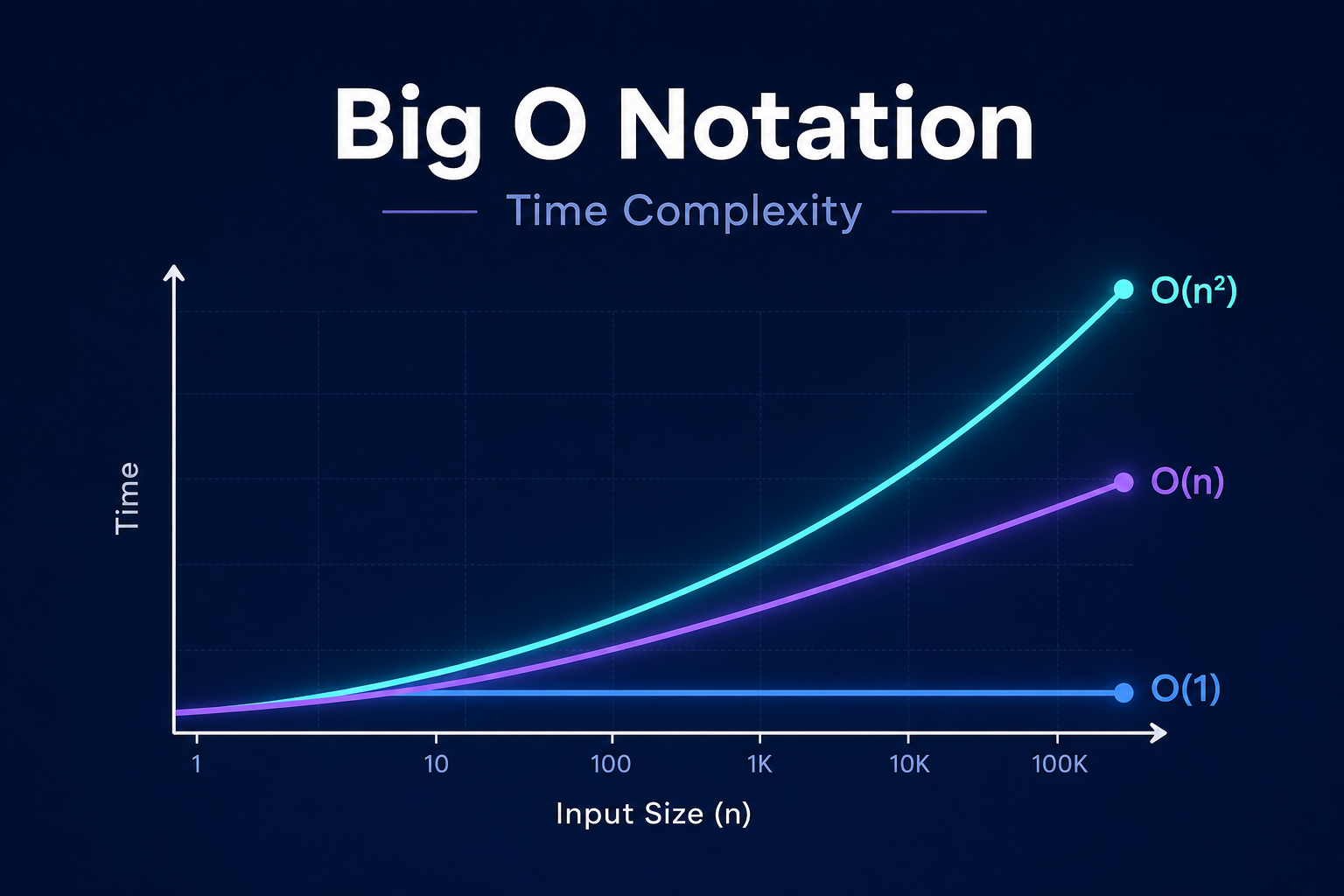
Union-Find gives nearly constant time complexity on average for each find and union operation due to path compression and union by rank:
- Time Complexity: Approximately
O(α(n))per operation, whereα(n)is the inverse Ackermann function, which grows extremely slowly. - Overall Complexity: For a graph with
Vvertices andEedges, cycle detection runs inO(E α(V))time, very close to linear.
Summary
Detecting cycles in an undirected graph using the Union-Find algorithm is an efficient and elegant approach. Its power lies in maintaining and merging disjoint sets, allowing quick checks if adding an edge closes a loop. Implementing it correctly with optimizations ensures performance suitable for large-scale graph problems.
Understanding this method opens doors to more advanced graph algorithms, spanning trees, and network connectivity analysis—core topics for every computer scientist and software engineer.