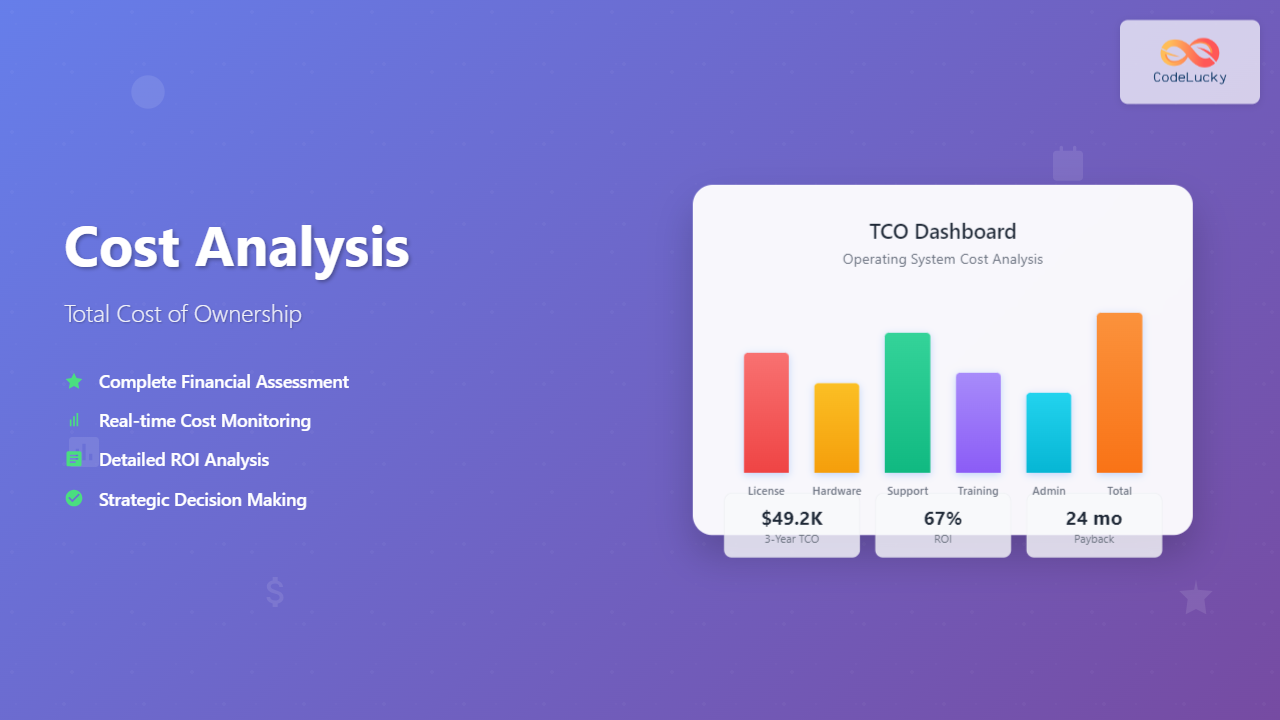
Total Cost of Ownership (TCO) is a comprehensive financial assessment that helps organizations understand the complete cost of implementing, maintaining, and operating an operating system throughout its lifecycle. This analysis extends far beyond the initial purchase price to include all direct and indirect costs associated with the system.
Understanding Total Cost of Ownership
TCO analysis provides a holistic view of all expenses related to an operating system, enabling informed decision-making for IT investments. It encompasses acquisition costs, operational expenses, maintenance fees, and often-overlooked indirect costs that can significantly impact your budget.

Key Components of TCO Analysis
1. Direct Costs
Software Licensing
This includes the initial operating system license fees, upgrade costs, and ongoing subscription fees. For enterprise environments, consider volume licensing agreements and their associated benefits.
Example: Windows Server 2022 Licensing
- Standard Edition: $972 per 16-core license
- Datacenter Edition: $6,155 per 16-core license
- Client Access Licenses (CALs): $38 per user/device
Hardware Requirements
Different operating systems have varying hardware requirements that directly impact infrastructure costs. Modern systems often require more powerful hardware to run efficiently.
Minimum Hardware Requirements Comparison:
Windows 11 Enterprise:
- RAM: 4GB (64-bit)
- Storage: 64GB
- Processor: 1 GHz dual-core

Ubuntu Server 22.04 LTS:
- RAM: 2GB
- Storage: 25GB
- Processor: 1 GHz single-core
Implementation and Migration Costs
These include professional services, consulting fees, data migration expenses, and system integration costs. Complex environments may require specialized expertise, increasing implementation costs.
2. Operational Costs
Maintenance and Support
Ongoing maintenance includes security patches, system updates, and technical support contracts. Enterprise support often costs 15-25% of the initial license fee annually.
Administrative Overhead
System administration requires skilled personnel, and different operating systems demand varying levels of expertise and time investment.
Annual Administrative Time Estimates:
Windows Server Environment (100 users):
- System Administration: 20 hours/month
- Security Management: 15 hours/month
- Backup Management: 8 hours/month

Linux Server Environment (100 users):
- System Administration: 25 hours/month
- Security Management: 10 hours/month
- Backup Management: 5 hours/month
3. Indirect Costs
Training and Skill Development
Staff training is crucial for efficient system operation. New operating systems often require significant training investments, especially when migrating between different platforms.
Productivity Impact
User productivity can be affected during transition periods, system downtime, or when learning new interfaces. This hidden cost can be substantial in large organizations.

TCO Calculation Framework
Step-by-Step Calculation Process
Follow this systematic approach to calculate TCO accurately:
- Define the analysis period (typically 3-5 years)
- Identify all cost categories
- Gather cost data from vendors and internal sources
- Calculate present value of future costs
- Sum all costs to determine total TCO
TCO Formula
TCO = Acquisition Costs + Operating Costs + Indirect Costs

Where:
- Acquisition Costs = Licensing + Hardware + Implementation
- Operating Costs = Maintenance + Support + Administration
- Indirect Costs = Training + Downtime + Productivity Loss
Practical TCO Example
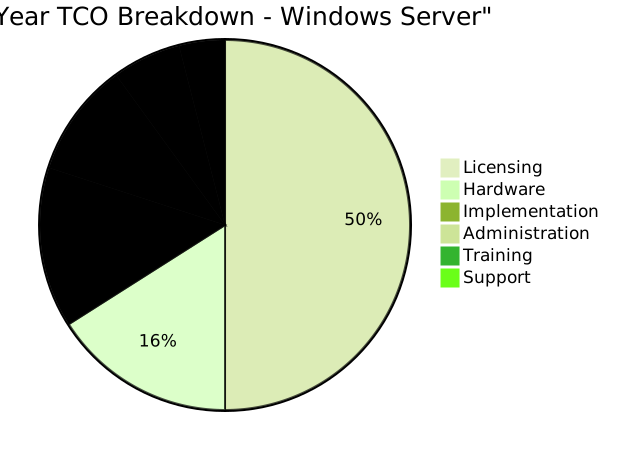
Let’s calculate TCO for a 100-user organization over 3 years:
Scenario: Small Business Windows vs. Linux Comparison

Windows Server Solution:
Year 1:
- Server Licenses: $3,000
- Client Access Licenses: $3,800
- Hardware: $8,000
- Implementation: $5,000
- Training: $2,000
Total Year 1: $21,800

Years 2-3 (Annual):
- Maintenance & Support: $1,200
- Administration (240h × $50): $12,000
- Updates & Patches: $500
Annual Ongoing: $13,700

3-Year Windows TCO: $49,200

Linux Server Solution:
Year 1:
- Software Cost: $0
- Hardware: $6,000
- Implementation: $8,000
- Training: $4,000
Total Year 1: $18,000

Years 2-3 (Annual):
- Support Contract: $2,000
- Administration (300h × $60): $18,000
- Security Updates: $0
Annual Ongoing: $20,000

3-Year Linux TCO: $58,000
Industry-Specific TCO Considerations
Enterprise Environments
Large organizations face unique TCO challenges:
- Scale economics: Volume licensing can significantly reduce per-unit costs
- Compliance costs: Regulatory requirements may mandate specific operating systems
- Integration complexity: Legacy system integration increases implementation costs
- Security requirements: Enhanced security features may justify higher costs
Small and Medium Businesses
SMBs should focus on:
- Simplicity: Choose systems with lower administrative overhead
- Vendor support: Reliable support is crucial with limited IT staff
- Scalability: Ensure the chosen system can grow with the business
- Cloud integration: Consider cloud-first strategies to reduce TCO
TCO Optimization Strategies
Cost Reduction Techniques
1. Standardization
Reducing the number of different operating systems in your environment can significantly lower TCO by:
- Simplifying administration and support
- Reducing training requirements
- Leveraging volume licensing discounts
- Streamlining security management
2. Automation
Implementing automation tools can reduce operational costs:
Automation Benefits:
- Patch Management: 70% reduction in manual effort
- System Monitoring: 60% faster issue detection
- Backup Operations: 80% reduction in administrative time
- Security Compliance: 90% improvement in consistency
3. Cloud Migration
Moving to cloud-based operating systems can transform TCO structure:

Long-term Planning
Lifecycle Management
Effective lifecycle planning reduces unexpected costs:
- End-of-life planning: Budget for system replacements before support ends
- Upgrade scheduling: Plan major upgrades during low-impact periods
- Technology roadmap: Align OS choices with long-term business strategy
Vendor Relationship Management
Strong vendor relationships can improve TCO through:
- Better licensing terms and conditions
- Priority technical support
- Early access to new features and updates
- Flexible payment terms
ROI and TCO Relationship
Return on Investment (ROI) and TCO work together to provide complete financial insight:
ROI = (Benefits - TCO) / TCO × 100

Example ROI Calculation:
Project Benefits: $100,000
Total TCO: $60,000
ROI = ($100,000 - $60,000) / $60,000 × 100 = 67%
Quantifiable Benefits
Consider these measurable benefits in your analysis:
- Productivity improvements: Reduced time to complete tasks
- Operational efficiency: Lower administrative overhead
- Risk reduction: Fewer security incidents and their associated costs
- Business agility: Faster response to market opportunities

Common TCO Calculation Mistakes
Overlooked Costs
Avoid these common oversights:
- Hidden licensing fees: Additional components, connectors, or premium features
- Compliance costs: Audit fees, compliance tools, and reporting requirements
- Opportunity costs: Resources tied up in system management instead of strategic initiatives
- End-of-life costs: Data migration, system decommissioning, and disposal
Estimation Errors
Common miscalculations include:
- Underestimating training time: Complex systems require more training than anticipated
- Ignoring inflation: Multi-year analyses should account for cost increases
- Overlooking scale effects: Per-user costs often decrease with larger deployments
- Forgetting contingencies: Always include a buffer for unexpected costs
Tools and Resources for TCO Analysis
TCO Calculators and Models
Several tools can assist with TCO calculations:
- Vendor-provided calculators: Microsoft, Red Hat, and other vendors offer specialized tools
- Third-party analysis tools: Independent research organizations provide neutral assessments
- Spreadsheet models: Custom Excel or Google Sheets templates for detailed analysis
- Enterprise software: Comprehensive IT financial management platforms
Best Practices for Accurate Analysis
- Use multiple data sources: Validate costs with vendor quotes, industry benchmarks, and internal data
- Include all stakeholders: Involve IT, finance, and business users in the analysis
- Regular updates: Review and update TCO calculations as conditions change
- Document assumptions: Clear documentation helps with future reviews and updates
Conclusion
Total Cost of Ownership analysis is essential for making informed decisions about operating system investments. By considering all direct and indirect costs, organizations can avoid budget surprises and optimize their IT spending. Remember that the lowest initial cost doesn’t always result in the lowest TCO, and the most expensive solution might provide the best value when all factors are considered.
Successful TCO analysis requires thorough planning, accurate data collection, and regular review. Use the frameworks and examples provided in this guide to develop comprehensive TCO models that support your organization’s strategic objectives and financial constraints.
The key to effective TCO management is treating it as an ongoing process rather than a one-time calculation. Regular reviews and updates ensure that your analysis remains relevant and continues to provide value for decision-making throughout the operating system lifecycle.