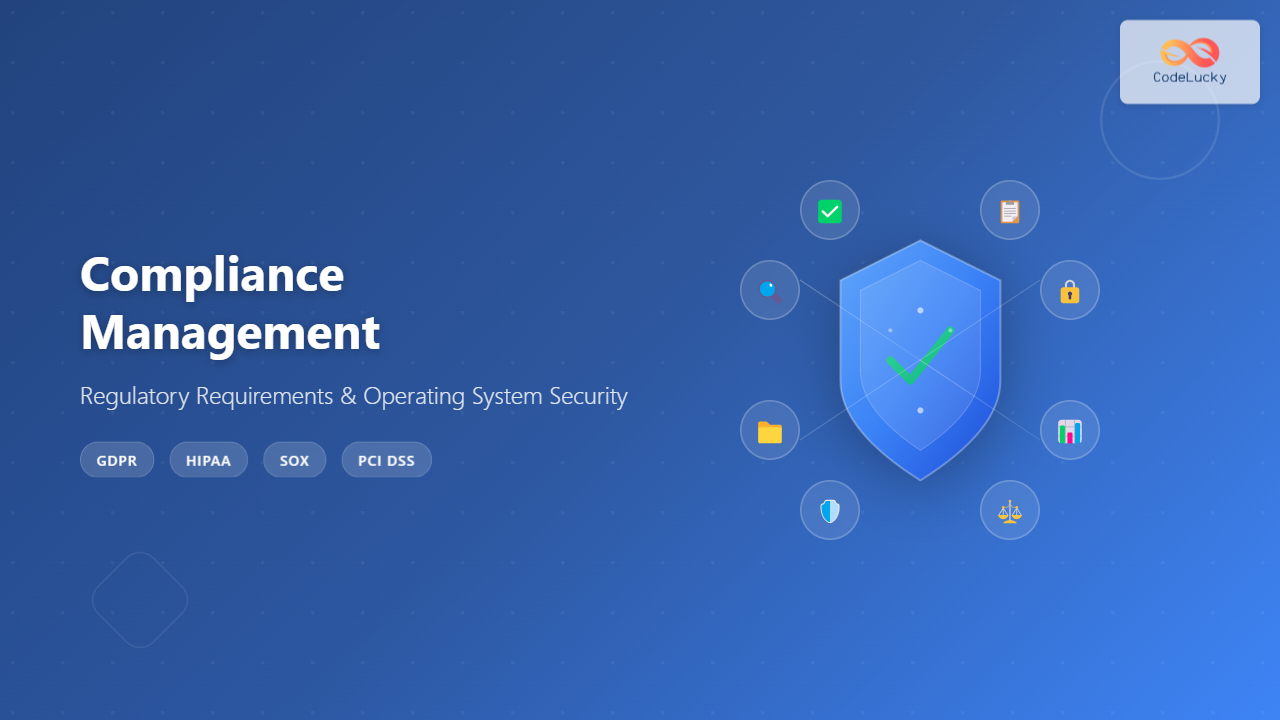
Compliance management in operating systems represents a critical intersection where technology meets legal and regulatory obligations. As organizations increasingly rely on digital infrastructure, ensuring that operating systems adhere to various regulatory frameworks has become paramount for business continuity, legal protection, and maintaining customer trust.
This comprehensive guide explores the multifaceted world of compliance management, examining how operating systems must be configured, monitored, and maintained to meet stringent regulatory requirements across different industries and jurisdictions.
Understanding Compliance Management in Operating Systems
Compliance management refers to the systematic approach of ensuring that an organization’s operating systems and related processes conform to relevant laws, regulations, standards, and internal policies. This involves continuous monitoring, assessment, and remediation activities designed to maintain regulatory adherence while supporting business objectives.

Core Components of OS Compliance
Operating system compliance encompasses several fundamental areas that must be addressed comprehensively:
- Security Configuration: Implementing baseline security settings that meet regulatory standards
- Access Management: Controlling user access through authentication, authorization, and accounting mechanisms
- Data Protection: Ensuring data confidentiality, integrity, and availability through encryption and secure storage
- Audit Logging: Maintaining comprehensive logs of system activities for compliance verification
- Vulnerability Management: Regularly identifying and addressing security vulnerabilities
- Change Control: Managing system modifications through controlled processes
Major Regulatory Frameworks
General Data Protection Regulation (GDPR)
GDPR represents one of the most comprehensive data protection regulations globally, requiring organizations to implement appropriate technical and organizational measures to protect personal data. For operating systems, this translates to specific requirements:
Technical Requirements:
- Data Encryption: Personal data must be encrypted both at rest and in transit
- Access Controls: Role-based access control (RBAC) implementation
- Data Minimization: Systems should process only necessary personal data
- Right to be Forgotten: Capability to securely delete personal data upon request
GDPR Compliance Implementation Example:
# Linux GDPR Compliance Script
#!/bin/bash

# Enable full disk encryption
cryptsetup luksFormat /dev/sdb1
cryptsetup luksOpen /dev/sdb1 encrypted_data

# Configure audit logging for data access
auditctl -w /var/lib/personal_data -p rwxa -k gdpr_data_access

# Set up automated log rotation with secure deletion
cat >> /etc/logrotate.d/gdpr_logs << EOF
/var/log/gdpr/*.log {
    daily
    rotate 90
    compress
    delaycompress
    missingok
    create 0640 root adm
    postrotate
        shred -vfz -n 3 \$1
    endscript
}
EOF

# Configure user access controls
groupadd gdpr_data_processors
usermod -a -G gdpr_data_processors dataprocessor1
setfacl -m g:gdpr_data_processors:r /var/lib/personal_data
Health Insurance Portability and Accountability Act (HIPAA)
HIPAA mandates specific safeguards for protected health information (PHI) in healthcare environments. Operating systems handling PHI must implement comprehensive security controls:

HIPAA Technical Safeguards Implementation:
# Windows HIPAA Compliance PowerShell Script
# Configure BitLocker encryption for PHI storage
Enable-BitLocker -MountPoint "C:" -EncryptionMethod XtsAes256 -UsedSpaceOnly

# Set up audit policies for PHI access
auditpol /set /subcategory:"File Share" /success:enable /failure:enable
auditpol /set /subcategory:"File System" /success:enable /failure:enable

# Configure automatic screen lock for workstations
Set-ItemProperty -Path "HKLM:\SOFTWARE\Microsoft\Windows\CurrentVersion\Policies\System" -Name "InactivityTimeoutSecs" -Value 900

# Enable Windows Defender and configure real-time protection
Set-MpPreference -DisableRealtimeMonitoring $false
Set-MpPreference -SubmitSamplesConsent SendAllSamples

# Configure PHI data classification
New-DlpCompliancePolicy -Name "HIPAA PHI Protection" -ExchangeLocation All -SharePointLocation All
Sarbanes-Oxley Act (SOX)
SOX compliance focuses on financial data integrity and requires robust internal controls over financial reporting systems. Operating systems supporting financial applications must implement:
- Change Management: All system changes must be documented and approved
- Segregation of Duties: Separation between development, testing, and production environments
- Data Integrity: Mechanisms to ensure financial data accuracy and completeness
- Audit Trail: Comprehensive logging of all financial system activities
Implementation Strategies
Risk-Based Approach
Implementing a risk-based compliance approach allows organizations to prioritize resources effectively while maintaining regulatory adherence:

Automated Compliance Monitoring
Automation plays a crucial role in maintaining continuous compliance across large-scale environments:
Python Compliance Monitoring Script:
#!/usr/bin/env python3
"""
Automated Compliance Monitoring System
Monitors OS compliance across multiple regulatory frameworks
"""

import os
import json
import logging
import subprocess
from datetime import datetime
from dataclasses import dataclass
from typing import List, Dict, Optional

@dataclass
class ComplianceCheck:
    name: str
    regulation: str
    check_type: str
    command: str
    expected_result: str
    severity: str

class ComplianceMonitor:
    def __init__(self, config_file: str):
        self.config = self.load_config(config_file)
        self.logger = self.setup_logging()
        self.results = []

    def load_config(self, config_file: str) -> Dict:
        """Load compliance check configuration"""
        with open(config_file, 'r') as f:
            return json.load(f)

    def setup_logging(self) -> logging.Logger:
        """Configure compliance logging"""
        logger = logging.getLogger('compliance_monitor')
        logger.setLevel(logging.INFO)

        handler = logging.FileHandler('/var/log/compliance/monitor.log')
        formatter = logging.Formatter(
            '%(asctime)s - %(levelname)s - %(message)s'
        )
        handler.setFormatter(formatter)
        logger.addHandler(handler)

        return logger

    def execute_check(self, check: ComplianceCheck) -> Dict:
        """Execute individual compliance check"""
        try:
            result = subprocess.run(
                check.command,
                shell=True,
                capture_output=True,
                text=True,
                timeout=30
            )

            status = "PASS" if check.expected_result in result.stdout else "FAIL"

            return {
                "name": check.name,
                "regulation": check.regulation,
                "status": status,
                "output": result.stdout.strip(),
                "timestamp": datetime.now().isoformat(),
                "severity": check.severity
            }

        except subprocess.TimeoutExpired:
            return {
                "name": check.name,
                "regulation": check.regulation,
                "status": "TIMEOUT",
                "output": "Check timed out",
                "timestamp": datetime.now().isoformat(),
                "severity": check.severity
            }

    def run_compliance_checks(self) -> List[Dict]:
        """Run all configured compliance checks"""
        self.logger.info("Starting compliance check run")

        for check_config in self.config['checks']:
            check = ComplianceCheck(**check_config)
            result = self.execute_check(check)
            self.results.append(result)

            if result['status'] == 'FAIL':
                self.logger.warning(
                    f"Compliance check failed: {check.name} ({check.regulation})"
                )

        return self.results

    def generate_report(self) -> str:
        """Generate compliance report"""
        passed = sum(1 for r in self.results if r['status'] == 'PASS')
        failed = sum(1 for r in self.results if r['status'] == 'FAIL')
        total = len(self.results)

        report = f"""
Compliance Report - {datetime.now().strftime('%Y-%m-%d %H:%M:%S')}
================================================================
Total Checks: {total}
Passed: {passed}
Failed: {failed}
Success Rate: {(passed/total)*100:.2f}%

Failed Checks:
"""

        for result in self.results:
            if result['status'] == 'FAIL':
                report += f"- {result['name']} ({result['regulation']}) - {result['severity']}\n"

        return report

# Example usage
if __name__ == "__main__":
    monitor = ComplianceMonitor('/etc/compliance/checks.json')
    results = monitor.run_compliance_checks()
    report = monitor.generate_report()

    print(report)

    # Send alerts for critical failures
    critical_failures = [
        r for r in results
        if r['status'] == 'FAIL' and r['severity'] == 'CRITICAL'
    ]

    if critical_failures:
        # Implement alerting mechanism here
        pass
Configuration Management
Maintaining consistent, compliant configurations across all systems requires robust configuration management practices:
Ansible Compliance Playbook Example:
---
- name: Enterprise Compliance Configuration
  hosts: all
  become: yes
  vars:
    compliance_standards:
      - gdpr
      - hipaa
      - sox
      - pci_dss

  tasks:
    - name: Configure system audit logging
      blockinfile:
        path: /etc/audit/rules.d/compliance.rules
        block: |
          # File access monitoring
          -w /etc/passwd -p wa -k identity
          -w /etc/group -p wa -k identity
          -w /etc/shadow -p wa -k identity

          # Network configuration changes
          -w /etc/network/ -p wa -k network-config
          -w /etc/sysconfig/network-scripts/ -p wa -k network-config

          # Privilege escalation monitoring
          -w /etc/sudoers -p wa -k privilege-escalation
          -w /etc/sudoers.d/ -p wa -k privilege-escalation

          # System administration
          -w /var/log/wtmp -p wa -k session
          -w /var/log/btmp -p wa -k session
          -w /var/run/utmp -p wa -k session
      notify: restart auditd

    - name: Configure password policy
      blockinfile:
        path: /etc/security/pwquality.conf
        block: |
          minlen = 12
          minclass = 3
          maxrepeat = 2
          dcredit = -1
          ucredit = -1
          lcredit = -1
          ocredit = -1
          difok = 8

    - name: Set login banner
      copy:
        content: |
          WARNING: This system is restricted to authorized users only.
          All activities are monitored and logged for compliance purposes.
          Unauthorized access is prohibited and may result in prosecution.
        dest: /etc/issue
        mode: '0644'

    - name: Configure automatic updates for security patches
      cron:
        name: "Security updates"
        hour: "2"
        minute: "0"
        job: "/usr/bin/yum update --security -y >> /var/log/security-updates.log 2>&1"
        user: root

    - name: Install and configure fail2ban
      package:
        name: fail2ban
        state: present

    - name: Configure fail2ban for SSH protection
      copy:
        content: |
          [sshd]
          enabled = true
          port = ssh
          filter = sshd
          logpath = /var/log/auth.log
          maxretry = 3
          bantime = 3600
          findtime = 600
        dest: /etc/fail2ban/jail.d/sshd.conf
        mode: '0644'
      notify: restart fail2ban

  handlers:
    - name: restart auditd
      service:
        name: auditd
        state: restarted

    - name: restart fail2ban
      service:
        name: fail2ban
        state: restarted
Monitoring and Auditing
Continuous Compliance Monitoring
Effective compliance management requires continuous monitoring rather than periodic assessments. This approach enables organizations to identify and address compliance gaps in real-time:

Audit Trail Management
Comprehensive audit trails are essential for demonstrating compliance and supporting forensic investigations. Key considerations include:
- Log Integrity: Protecting audit logs from tampering through cryptographic signatures
- Retention Policies: Maintaining logs for required retention periods
- Log Analysis: Automated analysis to identify compliance violations
- Secure Storage: Storing logs in tamper-evident, encrypted storage
Advanced Log Management Script:
#!/bin/bash
# Advanced Compliance Log Management System

LOG_DIR="/var/log/compliance"
ARCHIVE_DIR="/var/log/compliance/archive"
HASH_DIR="/var/log/compliance/hashes"

# Create directories if they don't exist
mkdir -p "$LOG_DIR" "$ARCHIVE_DIR" "$HASH_DIR"

# Function to generate log hash for integrity verification
generate_log_hash() {
    local log_file="$1"
    local hash_file="$HASH_DIR/$(basename "$log_file").sha256"

    sha256sum "$log_file" > "$hash_file"
    echo "Generated hash for $log_file"
}

# Function to verify log integrity
verify_log_integrity() {
    local log_file="$1"
    local hash_file="$HASH_DIR/$(basename "$log_file").sha256"

    if [[ -f "$hash_file" ]]; then
        if sha256sum -c "$hash_file" &>/dev/null; then
            echo "✓ Log integrity verified: $log_file"
            return 0
        else
            echo "✗ Log integrity FAILED: $log_file"
            # Alert security team
            logger -p auth.crit "SECURITY ALERT: Log tampering detected in $log_file"
            return 1
        fi
    else
        echo "⚠ No hash file found for $log_file"
        return 2
    fi
}

# Function to archive old logs with compression and encryption
archive_logs() {
    local retention_days=90
    local encryption_key="/etc/ssl/private/log-encryption.key"

    find "$LOG_DIR" -name "*.log" -mtime +$retention_days | while read -r log_file; do
        # Verify integrity before archiving
        if verify_log_integrity "$log_file"; then
            # Compress and encrypt the log file
            gzip "$log_file"
            openssl enc -aes-256-cbc -salt -in "${log_file}.gz" -out "$ARCHIVE_DIR/$(basename "$log_file")-$(date +%Y%m%d).enc" -pass file:"$encryption_key"

            # Remove original compressed file
            rm "${log_file}.gz"

            echo "Archived and encrypted: $log_file"
        else
            echo "Skipping archive due to integrity failure: $log_file"
        fi
    done
}

# Function to generate compliance report from logs
generate_compliance_report() {
    local report_file="$LOG_DIR/compliance-report-$(date +%Y%m%d).txt"
    local start_date="${1:-$(date -d '1 month ago' +%Y-%m-%d)}"
    local end_date="${2:-$(date +%Y-%m-%d)}"

    {
        echo "Compliance Report: $start_date to $end_date"
        echo "Generated on: $(date)"
        echo "========================================"
        echo

        # Failed login attempts
        echo "Failed Login Attempts:"
        grep "Failed password" /var/log/auth.log | \
            awk -v start="$start_date" -v end="$end_date" \
            '$0 >= start && $0 <= end' | wc -l
        echo

        # Privilege escalation events
        echo "Privilege Escalation Events:"
        grep -E "(sudo|su):" /var/log/auth.log | \
            awk -v start="$start_date" -v end="$end_date" \
            '$0 >= start && $0 <= end' | wc -l
        echo

        # File access violations
        echo "Unauthorized File Access Attempts:"
        grep "DENIED" /var/log/audit/audit.log | \
            awk -v start="$start_date" -v end="$end_date" \
            '$0 >= start && $0 <= end' | wc -l
        echo

        # Network connection anomalies
        echo "Suspicious Network Connections:"
        grep -E "(REJECT|DROP)" /var/log/iptables.log | \
            awk -v start="$start_date" -v end="$end_date" \
            '$0 >= start && $0 <= end' | wc -l

    } > "$report_file"

    # Generate hash for the report
    generate_log_hash "$report_file"

    echo "Compliance report generated: $report_file"
}

# Main execution
case "$1" in
    "hash")
        generate_log_hash "$2"
        ;;
    "verify")
        verify_log_integrity "$2"
        ;;
    "archive")
        archive_logs
        ;;
    "report")
        generate_compliance_report "$2" "$3"
        ;;
    *)
        echo "Usage: $0 {hash|verify|archive|report} [parameters]"
        echo "  hash         - Generate hash for log file"
        echo "  verify       - Verify log file integrity"
        echo "  archive               - Archive old log files"
        echo "  report [start] [end]  - Generate compliance report"
        exit 1
        ;;
esac
Best Practices and Recommendations
Organizational Strategies
- Establish Clear Governance: Define roles, responsibilities, and accountability for compliance management
- Regular Training: Ensure all personnel understand compliance requirements and their responsibilities
- Documentation Management: Maintain comprehensive documentation of all compliance-related processes and controls
- Incident Response Planning: Develop and test incident response procedures for compliance violations
Technical Implementation Guidelines
- Defense in Depth: Implement multiple layers of security controls to ensure comprehensive protection
- Principle of Least Privilege: Grant users and processes only the minimum access necessary to perform their functions
- Regular Vulnerability Assessments: Conduct periodic security assessments to identify and address potential compliance gaps
- Encryption Everywhere: Implement encryption for data at rest, in transit, and in processing
Monitoring and Maintenance
- Automated Compliance Checking: Deploy automated tools to continuously monitor compliance status
- Regular Audits: Conduct both internal and external audits to validate compliance effectiveness
- Metrics and KPIs: Establish measurable indicators to track compliance performance over time
- Continuous Improvement: Regularly review and enhance compliance processes based on lessons learned and evolving requirements
Challenges and Solutions
Common Compliance Challenges
Organizations face numerous challenges when implementing compliance management in operating systems:
- Regulatory Complexity: Navigating multiple, sometimes conflicting regulatory requirements
- Technology Evolution: Keeping pace with rapidly changing technology landscapes
- Resource Constraints: Balancing compliance costs with business objectives
- Integration Difficulties: Ensuring compliance tools work effectively with existing systems
- Cultural Resistance: Overcoming organizational resistance to compliance processes

Emerging Trends and Future Considerations
The landscape of compliance management continues to evolve, driven by technological advancement and changing regulatory environments:
- AI-Powered Compliance: Leveraging artificial intelligence for automated compliance monitoring and remediation
- Cloud Compliance: Addressing unique challenges in cloud and hybrid environments
- Privacy by Design: Integrating privacy and compliance considerations into system design from the outset
- Zero Trust Architecture: Implementing zero trust principles to enhance compliance posture
- Continuous Compliance: Moving from periodic assessments to real-time compliance validation
Conclusion
Compliance management in operating systems represents a critical capability for modern organizations operating in regulated environments. Success requires a comprehensive approach that combines technical controls, process excellence, and organizational commitment to maintaining regulatory adherence while supporting business objectives.
The implementation of effective compliance management involves careful planning, robust technical implementation, continuous monitoring, and regular assessment and improvement. Organizations that invest in building strong compliance capabilities position themselves for long-term success in an increasingly regulated digital landscape.
By following the strategies, implementing the technical solutions, and adopting the best practices outlined in this guide, organizations can build resilient compliance management capabilities that protect both their systems and their business interests while meeting the evolving demands of regulatory compliance.
Remember that compliance is not a destination but a continuous journey that requires ongoing attention, investment, and adaptation to changing requirements and threats. The key to success lies in building flexible, scalable compliance management systems that can evolve with both regulatory requirements and organizational needs.