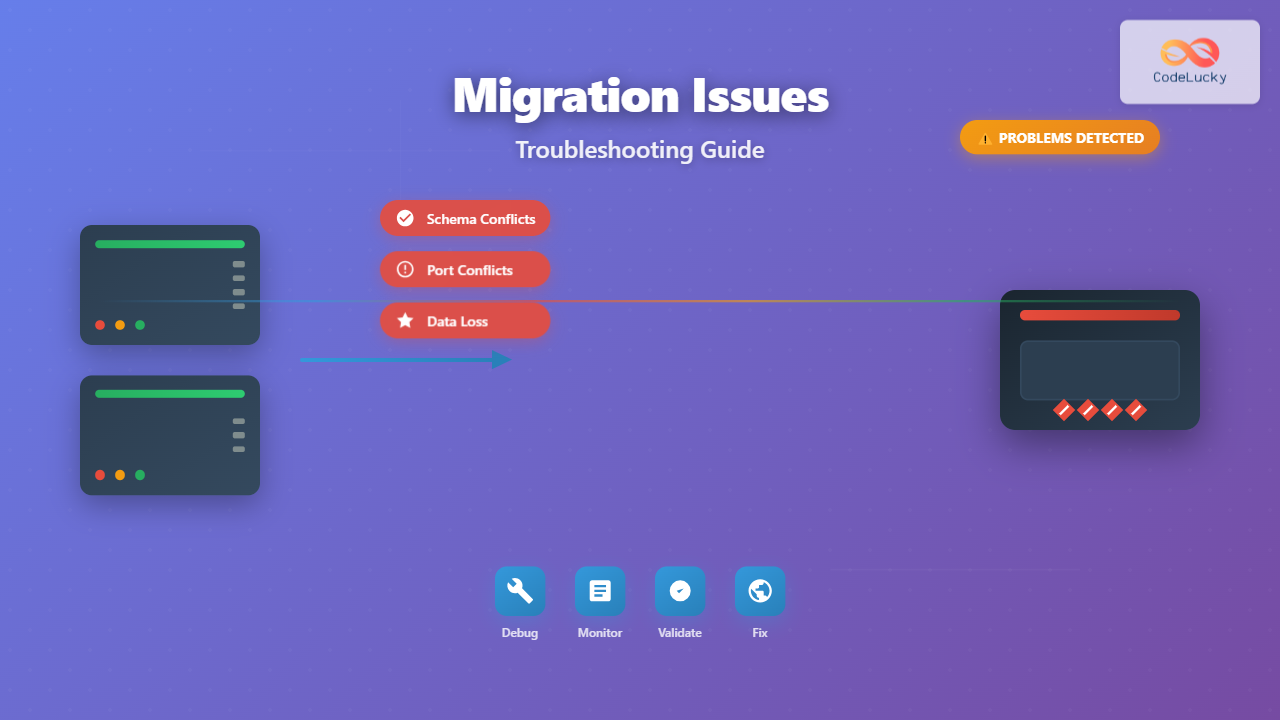
Understanding Migration Issues: The Foundation of Troubleshooting
Migration issues are inevitable challenges that arise when transferring data, applications, or entire systems from one environment to another. Whether you’re migrating databases, moving applications to the cloud, or upgrading infrastructure, understanding common problems and their solutions is crucial for maintaining system integrity and minimizing downtime.

Database Migration Issues
Schema Compatibility Problems
One of the most frequent migration issues involves schema incompatibilities between source and target databases. This typically occurs when migrating between different database systems or versions.
Common Schema Issues:
- Data type mismatches: VARCHAR vs TEXT, INTEGER vs BIGINT
- Constraint violations: Foreign key relationships, unique constraints
- Index incompatibilities: Different indexing strategies between systems
Example: MySQL to PostgreSQL Data Type Migration
-- Original MySQL Schema
CREATE TABLE users (
    id INT AUTO_INCREMENT PRIMARY KEY,
    username VARCHAR(255) NOT NULL,
    created_at TIMESTAMP DEFAULT CURRENT_TIMESTAMP,
    is_active TINYINT(1) DEFAULT 1
);

-- PostgreSQL Compatible Schema
CREATE TABLE users (
    id SERIAL PRIMARY KEY,
    username VARCHAR(255) NOT NULL,
    created_at TIMESTAMP DEFAULT CURRENT_TIMESTAMP,
    is_active BOOLEAN DEFAULT TRUE
);
Solution Approach:
- Create a mapping document for data types
- Use migration tools with built-in type conversion
- Implement custom transformation scripts for complex cases
Performance Degradation During Migration
Large-scale migrations often suffer from performance issues that can extend migration windows and impact business operations.
Performance Optimization Script Example:
import psycopg2
import threading
from concurrent.futures import ThreadPoolExecutor

def migrate_table_chunk(table_name, offset, limit, source_conn, target_conn):
    """Migrate a chunk of data from source to target database"""
    try:
        source_cursor = source_conn.cursor()
        target_cursor = target_conn.cursor()

        # Fetch data chunk
        source_cursor.execute(f"""
            SELECT * FROM {table_name}
            ORDER BY id
            LIMIT {limit} OFFSET {offset}
        """)

        rows = source_cursor.fetchall()

        if rows:
            # Bulk insert to target
            placeholders = ','.join(['%s'] * len(rows[0]))
            insert_query = f"INSERT INTO {table_name} VALUES ({placeholders})"
            target_cursor.executemany(insert_query, rows)
            target_conn.commit()

        return len(rows)

    except Exception as e:
        print(f"Error migrating chunk {offset}-{offset+limit}: {str(e)}")
        return 0

# Usage example
def parallel_migration(table_name, chunk_size=10000, max_workers=4):
    total_migrated = 0
    offset = 0

    with ThreadPoolExecutor(max_workers=max_workers) as executor:
        while True:
            future = executor.submit(
                migrate_table_chunk,
                table_name,
                offset,
                chunk_size,
                source_conn,
                target_conn
            )

            migrated_count = future.result()
            if migrated_count == 0:
                break

            total_migrated += migrated_count
            offset += chunk_size
            print(f"Migrated {total_migrated} rows from {table_name}")
Application Migration Challenges
Environment Configuration Mismatches
Applications often fail after migration due to environment-specific configurations that weren’t properly transferred or adapted.

Configuration Management Example:
# migration-config.yml
source_environment:
  database_url: "mysql://localhost:3306/old_db"
  redis_url: "redis://localhost:6379"
  file_storage: "/var/www/uploads"

target_environment:
  database_url: "postgresql://new-host:5432/new_db"
  redis_url: "redis://redis-cluster:6379"
  file_storage: "s3://my-bucket/uploads"

migration_mappings:
  - source: "localhost"
    target: "new-host.company.com"
  - source: "/var/www/uploads"
    target: "s3://my-bucket/uploads"
Dependency Version Conflicts
Version mismatches between libraries, frameworks, and runtime environments frequently cause post-migration failures.
Dependency Resolution Script:
#!/bin/bash
# dependency-check.sh

echo "=== Migration Dependency Validation ==="

# Check Node.js version
REQUIRED_NODE="16.14.0"
CURRENT_NODE=$(node --version | sed 's/v//')

if [ "$(printf '%s\n' "$REQUIRED_NODE" "$CURRENT_NODE" | sort -V | head -n1)" != "$REQUIRED_NODE" ]; then
    echo "❌ Node.js version mismatch. Required: $REQUIRED_NODE, Current: $CURRENT_NODE"
    exit 1
else
    echo "✅ Node.js version compatible"
fi

# Validate package dependencies
npm audit --audit-level high
if [ $? -ne 0 ]; then
    echo "❌ High severity vulnerabilities found"
    echo "Run: npm audit fix --force"
    exit 1
fi

# Check environment variables
REQUIRED_VARS=("DATABASE_URL" "REDIS_URL" "API_KEY")
for var in "${REQUIRED_VARS[@]}"; do
    if [ -z "${!var}" ]; then
        echo "❌ Missing environment variable: $var"
        exit 1
    else
        echo "✅ $var is set"
    fi
done

echo "=== All dependency checks passed ==="
Data Integrity and Consistency Issues
Data Loss Prevention
Ensuring no data is lost during migration is critical. Implementing comprehensive validation checks helps identify missing or corrupted data early.

Data Validation Implementation:
import hashlib
import json

class DataIntegrityValidator:
    def __init__(self, source_conn, target_conn):
        self.source_conn = source_conn
        self.target_conn = target_conn
        self.validation_results = {}

    def generate_table_checksum(self, connection, table_name):
        """Generate checksum for entire table data"""
        cursor = connection.cursor()
        cursor.execute(f"SELECT * FROM {table_name} ORDER BY id")
        rows = cursor.fetchall()

        # Convert to string and generate hash
        data_string = json.dumps(rows, sort_keys=True, default=str)
        return hashlib.md5(data_string.encode()).hexdigest()

    def validate_table_migration(self, table_name):
        """Validate that table data migrated correctly"""
        source_checksum = self.generate_table_checksum(self.source_conn, table_name)
        target_checksum = self.generate_table_checksum(self.target_conn, table_name)

        is_valid = source_checksum == target_checksum

        self.validation_results[table_name] = {
            'valid': is_valid,
            'source_checksum': source_checksum,
            'target_checksum': target_checksum
        }

        return is_valid

    def validate_record_counts(self, table_name):
        """Compare record counts between source and target"""
        source_cursor = self.source_conn.cursor()
        target_cursor = self.target_conn.cursor()

        source_cursor.execute(f"SELECT COUNT(*) FROM {table_name}")
        source_count = source_cursor.fetchone()[0]

        target_cursor.execute(f"SELECT COUNT(*) FROM {table_name}")
        target_count = target_cursor.fetchone()[0]

        return source_count == target_count, source_count, target_count

# Usage example
validator = DataIntegrityValidator(source_conn, target_conn)
tables_to_validate = ['users', 'orders', 'products']

for table in tables_to_validate:
    if validator.validate_table_migration(table):
        print(f"✅ {table}: Data integrity verified")
    else:
        print(f"❌ {table}: Data integrity check failed")
        count_match, src_count, tgt_count = validator.validate_record_counts(table)
        print(f"   Source records: {src_count}, Target records: {tgt_count}")
Network and Connectivity Issues
Firewall and Security Group Problems
Migration failures often stem from network connectivity issues between source and target systems, particularly in cloud environments.
Network Connectivity Test Script:
#!/bin/bash
# network-migration-test.sh

echo "=== Network Migration Connectivity Test ==="

# Test database connectivity
DB_HOST="new-database-host.com"
DB_PORT="5432"

echo "Testing database connectivity..."
if timeout 10 bash -c "cat < /dev/null > /dev/tcp/$DB_HOST/$DB_PORT"; then
    echo "✅ Database port $DB_PORT is accessible on $DB_HOST"
else
    echo "❌ Cannot connect to database on $DB_HOST:$DB_PORT"
    echo "Check firewall rules and security groups"
fi

# Test API endpoints
API_ENDPOINTS=("https://api.service.com/health" "https://storage.service.com/test")

for endpoint in "${API_ENDPOINTS[@]}"; do
    response=$(curl -s -o /dev/null -w "%{http_code}" --connect-timeout 10 "$endpoint")
    if [ "$response" -eq 200 ]; then
        echo "✅ $endpoint is accessible"
    else
        echo "❌ $endpoint returned status code: $response"
    fi
done

# DNS resolution test
HOSTS=("database.company.com" "cache.company.com" "api.company.com")

for host in "${HOSTS[@]}"; do
    if nslookup "$host" > /dev/null 2>&1; then
        echo "✅ DNS resolution successful for $host"
    else
        echo "❌ DNS resolution failed for $host"
    fi
done
Performance Monitoring and Optimization
Resource Utilization Tracking
Monitoring system resources during migration helps identify bottlenecks and optimize the process for future migrations.

Resource Monitoring Implementation:
import psutil
import time
import json
from datetime import datetime

class MigrationMonitor:
    def __init__(self):
        self.metrics = []
        self.monitoring = False

    def start_monitoring(self, interval=10):
        """Start collecting system metrics"""
        self.monitoring = True

        while self.monitoring:
            metric = {
                'timestamp': datetime.now().isoformat(),
                'cpu_percent': psutil.cpu_percent(interval=1),
                'memory_percent': psutil.virtual_memory().percent,
                'disk_io': psutil.disk_io_counters()._asdict(),
                'network_io': psutil.net_io_counters()._asdict()
            }

            self.metrics.append(metric)
            self.check_resource_limits(metric)
            time.sleep(interval)

    def check_resource_limits(self, metric):
        """Check if resource usage exceeds safe limits"""
        warnings = []

        if metric['cpu_percent'] > 85:
            warnings.append(f"High CPU usage: {metric['cpu_percent']:.1f}%")

        if metric['memory_percent'] > 90:
            warnings.append(f"High memory usage: {metric['memory_percent']:.1f}%")

        if warnings:
            print(f"⚠️  Resource Warning at {metric['timestamp']}")
            for warning in warnings:
                print(f"   {warning}")

    def stop_monitoring(self):
        """Stop monitoring and save results"""
        self.monitoring = False

        # Save metrics to file
        with open('migration_metrics.json', 'w') as f:
            json.dump(self.metrics, f, indent=2)

        return self.generate_report()

    def generate_report(self):
        """Generate performance summary report"""
        if not self.metrics:
            return "No metrics collected"

        cpu_values = [m['cpu_percent'] for m in self.metrics]
        memory_values = [m['memory_percent'] for m in self.metrics]

        report = f"""
=== Migration Performance Report ===
Duration: {len(self.metrics)} measurement intervals
CPU Usage:
  Average: {sum(cpu_values)/len(cpu_values):.1f}%
  Peak: {max(cpu_values):.1f}%
Memory Usage:
  Average: {sum(memory_values)/len(memory_values):.1f}%
  Peak: {max(memory_values):.1f}%
"""
        return report

# Usage in migration script
monitor = MigrationMonitor()
import threading

# Start monitoring in background
monitor_thread = threading.Thread(target=monitor.start_monitoring, args=(30,))
monitor_thread.daemon = True
monitor_thread.start()

# Run your migration here
# ... migration code ...

# Stop monitoring and get report
report = monitor.stop_monitoring()
print(report)
Rollback and Recovery Strategies
Automated Rollback Implementation
Having a reliable rollback mechanism is essential for quickly recovering from failed migrations without data loss.
Rollback Management System:
import shutil
import subprocess
from datetime import datetime
import json

class MigrationRollback:
    def __init__(self, backup_dir="/backups/migration"):
        self.backup_dir = backup_dir
        self.rollback_log = []

    def create_backup_checkpoint(self, database_name):
        """Create database backup before migration"""
        timestamp = datetime.now().strftime("%Y%m%d_%H%M%S")
        backup_file = f"{self.backup_dir}/{database_name}_{timestamp}.sql"

        # Create database dump
        cmd = [
            "pg_dump",
            "-h", "localhost",
            "-U", "postgres",
            "-f", backup_file,
            database_name
        ]

        try:
            subprocess.run(cmd, check=True)
            self.rollback_log.append({
                'action': 'backup_created',
                'database': database_name,
                'file': backup_file,
                'timestamp': timestamp
            })
            return backup_file
        except subprocess.CalledProcessError as e:
            raise Exception(f"Backup creation failed: {str(e)}")

    def execute_rollback(self, backup_file, target_database):
        """Restore database from backup"""
        print(f"🔄 Starting rollback to {backup_file}")

        # Drop existing database
        drop_cmd = [
            "psql",
            "-h", "localhost",
            "-U", "postgres",
            "-c", f"DROP DATABASE IF EXISTS {target_database}"
        ]

        # Create fresh database
        create_cmd = [
            "psql",
            "-h", "localhost",
            "-U", "postgres",
            "-c", f"CREATE DATABASE {target_database}"
        ]

        # Restore from backup
        restore_cmd = [
            "psql",
            "-h", "localhost",
            "-U", "postgres",
            "-d", target_database,
            "-f", backup_file
        ]

        try:
            subprocess.run(drop_cmd, check=True)
            subprocess.run(create_cmd, check=True)
            subprocess.run(restore_cmd, check=True)

            self.rollback_log.append({
                'action': 'rollback_completed',
                'database': target_database,
                'backup_file': backup_file,
                'timestamp': datetime.now().isoformat()
            })

            print("✅ Rollback completed successfully")
            return True

        except subprocess.CalledProcessError as e:
            print(f"❌ Rollback failed: {str(e)}")
            return False

    def save_rollback_log(self):
        """Save rollback operations log"""
        log_file = f"{self.backup_dir}/rollback_log.json"
        with open(log_file, 'w') as f:
            json.dump(self.rollback_log, f, indent=2)

# Example usage
rollback_manager = MigrationRollback()

try:
    # Create backup before migration
    backup_file = rollback_manager.create_backup_checkpoint("production_db")

    # Attempt migration
    migration_success = perform_migration()  # Your migration function

    if not migration_success:
        # Rollback if migration failed
        rollback_manager.execute_rollback(backup_file, "production_db")

finally:
    rollback_manager.save_rollback_log()
Testing and Validation Frameworks
Comprehensive Migration Testing
Implementing thorough testing procedures helps identify issues before they affect production systems.

Migration Test Suite:
import unittest
import time
from concurrent.futures import ThreadPoolExecutor

class MigrationTestSuite(unittest.TestCase):
    def setUp(self):
        """Setup test environment"""
        self.source_conn = create_source_connection()
        self.target_conn = create_target_connection()
        self.test_data = self.generate_test_data()

    def test_data_integrity(self):
        """Test that all data migrates without corruption"""
        # Insert test data
        self.insert_test_data(self.source_conn, self.test_data)

        # Perform migration
        migration_result = migrate_data(self.source_conn, self.target_conn)
        self.assertTrue(migration_result['success'])

        # Verify data integrity
        for table_name in self.test_data.keys():
            source_count = self.get_record_count(self.source_conn, table_name)
            target_count = self.get_record_count(self.target_conn, table_name)
            self.assertEqual(source_count, target_count,
                           f"Record count mismatch in {table_name}")

    def test_migration_performance(self):
        """Test migration completes within acceptable timeframe"""
        # Large dataset for performance testing
        large_dataset = self.generate_large_dataset(records=100000)
        self.insert_test_data(self.source_conn, large_dataset)

        start_time = time.time()
        migration_result = migrate_data(self.source_conn, self.target_conn)
        duration = time.time() - start_time

        # Migration should complete within 5 minutes for 100k records
        self.assertLess(duration, 300, "Migration took too long")
        self.assertTrue(migration_result['success'])

    def test_concurrent_access_during_migration(self):
        """Test system handles concurrent access during migration"""
        def simulate_user_activity():
            """Simulate normal user database activity"""
            for i in range(100):
                # Simulate read operations
                result = self.source_conn.execute("SELECT COUNT(*) FROM users")
                time.sleep(0.1)

        # Start migration and concurrent user activity
        with ThreadPoolExecutor(max_workers=5) as executor:
            # Start background user activity
            user_futures = [executor.submit(simulate_user_activity)
                          for _ in range(3)]

            # Start migration
            migration_future = executor.submit(
                migrate_data, self.source_conn, self.target_conn
            )

            # Wait for completion
            migration_result = migration_future.result(timeout=600)

            # Ensure user activity completed without errors
            for future in user_futures:
                future.result(timeout=60)

        self.assertTrue(migration_result['success'])

    def test_rollback_functionality(self):
        """Test rollback mechanism works correctly"""
        # Create initial state
        initial_data = self.generate_test_data()
        self.insert_test_data(self.target_conn, initial_data)

        # Perform migration that will be rolled back
        migrate_data(self.source_conn, self.target_conn)

        # Execute rollback
        rollback_result = perform_rollback(self.target_conn)
        self.assertTrue(rollback_result['success'])

        # Verify system returned to initial state
        for table_name in initial_data.keys():
            current_count = self.get_record_count(self.target_conn, table_name)
            expected_count = len(initial_data[table_name])
            self.assertEqual(current_count, expected_count)

if __name__ == '__main__':
    # Run migration tests
    unittest.main(verbosity=2)
Best Practices for Migration Success
Pre-Migration Checklist
Following a comprehensive checklist ensures all critical aspects are covered before starting the migration process.
- Environment Preparation: Verify all target systems are properly configured
- Backup Creation: Create complete backups of all source data
- Network Validation: Test all network connections and access permissions
- Resource Planning: Ensure adequate storage, memory, and processing power
- Timeline Coordination: Schedule migration during low-traffic periods
- Team Communication: Notify all stakeholders about migration schedule
- Rollback Preparation: Have tested rollback procedures ready
Post-Migration Validation
Thorough post-migration testing ensures the new system functions correctly before declaring the migration successful.
#!/bin/bash
# post-migration-validation.sh

echo "=== Post-Migration Validation Suite ==="

# Function to run validation checks
validate_service() {
    local service_name=$1
    local health_endpoint=$2
    local expected_status=$3

    echo "Validating $service_name..."
    response=$(curl -s -o /dev/null -w "%{http_code}" "$health_endpoint")

    if [ "$response" -eq "$expected_status" ]; then
        echo "✅ $service_name is healthy"
        return 0
    else
        echo "❌ $service_name validation failed. Expected: $expected_status, Got: $response"
        return 1
    fi
}

# Service health checks
VALIDATION_FAILED=0

validate_service "Web Application" "https://app.company.com/health" "200" || VALIDATION_FAILED=1
validate_service "API Gateway" "https://api.company.com/status" "200" || VALIDATION_FAILED=1
validate_service "Database" "https://db-monitor.company.com/health" "200" || VALIDATION_FAILED=1

# Database connectivity test
echo "Testing database queries..."
if psql -h new-db-host -U app_user -d production -c "SELECT COUNT(*) FROM users;" > /dev/null 2>&1; then
    echo "✅ Database queries working"
else
    echo "❌ Database query test failed"
    VALIDATION_FAILED=1
fi

# Performance benchmark
echo "Running performance benchmark..."
response_time=$(curl -o /dev/null -s -w '%{time_total}\n' https://app.company.com/api/test)
if (( $(echo "$response_time < 2.0" | bc -l) )); then
    echo "✅ API response time acceptable: ${response_time}s"
else
    echo "❌ API response time too slow: ${response_time}s"
    VALIDATION_FAILED=1
fi

# Final result
if [ $VALIDATION_FAILED -eq 0 ]; then
    echo ""
    echo "🎉 All post-migration validations passed!"
    echo "Migration completed successfully."
else
    echo ""
    echo "❌ Some validations failed. Review issues before proceeding."
    exit 1
fi
Conclusion
Successfully troubleshooting migration issues requires a systematic approach combining proactive planning, comprehensive monitoring, and robust testing procedures. By implementing the strategies and tools outlined in this guide, you can identify problems early, resolve issues efficiently, and ensure smooth transitions between systems.
Remember that each migration scenario is unique, and the specific tools and techniques you choose should be tailored to your environment’s requirements. Regular practice with smaller migrations helps build the expertise needed to handle complex, large-scale migrations with confidence.
The key to migration success lies in preparation, validation, and having reliable rollback mechanisms in place. With these fundamentals and the practical examples provided, you’ll be well-equipped to handle common migration challenges and deliver successful system transitions.
- Understanding Migration Issues: The Foundation of Troubleshooting
- Database Migration Issues
- Application Migration Challenges
- Data Integrity and Consistency Issues
- Network and Connectivity Issues
- Performance Monitoring and Optimization
- Rollback and Recovery Strategies
- Testing and Validation Frameworks
- Best Practices for Migration Success
- Conclusion