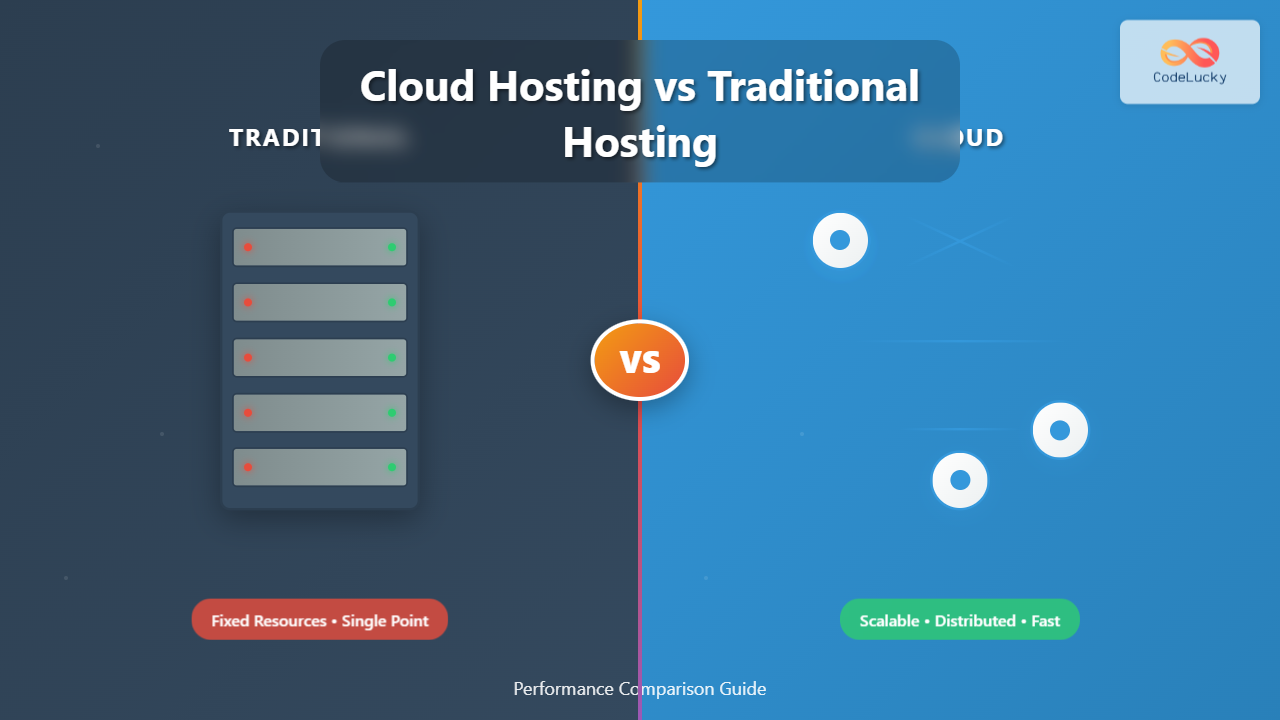
Understanding the Hosting Landscape in 2025
The web hosting industry has undergone a dramatic transformation over the past decade. As businesses increasingly rely on digital presence, the choice between cloud hosting and traditional hosting has become crucial for website performance and business success. This comprehensive guide examines the performance differences between these two hosting paradigms to help you make an informed decision.

Traditional Hosting: The Foundation
Traditional hosting relies on physical servers housed in data centers, where websites are allocated specific portions of server resources. This model has been the backbone of web hosting for decades and includes several variations:
Types of Traditional Hosting
- Shared Hosting: Multiple websites share resources on a single physical server
- VPS (Virtual Private Server): Virtualized environments on physical servers with dedicated resources
- Dedicated Servers: Entire physical servers dedicated to single clients
- Colocation: Client-owned hardware housed in provider facilities
Performance Characteristics of Traditional Hosting
Traditional hosting operates on a fixed resource model where performance capabilities are predetermined by the physical hardware limitations. Key performance aspects include:
Resource Allocation: Fixed CPU, RAM, and storage capacity based on chosen plan
Scalability: Limited to hardware constraints, requiring manual upgrades
Reliability: Single point of failure risk with individual server dependency
Cloud Hosting: The Modern Approach
Cloud hosting leverages distributed computing resources across multiple servers and data centers, creating a virtual hosting environment that can dynamically allocate resources based on demand.

Cloud Hosting Architecture Benefits
The distributed nature of cloud hosting provides several performance advantages:
- Resource Pooling: Access to vast shared computing resources
- Auto-scaling: Automatic resource adjustment based on traffic demands
- Geographic Distribution: Multiple data center locations for reduced latency
- Redundancy: Built-in failover mechanisms across multiple servers
Performance Comparison: Key Metrics
Speed and Response Time
Traditional Hosting Speed:
Response times in traditional hosting depend heavily on the physical server’s proximity to users and current resource utilization. Typical performance metrics include:
- Average response time: 200-800ms depending on server load
- Time to First Byte (TTFB): 100-400ms
- Limited by single server processing capacity
Cloud Hosting Speed:
Cloud hosting leverages multiple servers and CDN integration for superior speed performance:
- Average response time: 50-200ms with proper configuration
- TTFB: 50-150ms through optimized routing
- Geographic edge server deployment reduces latency
| Performance Metric | Traditional Hosting | Cloud Hosting |
|---|---|---|
| Average Response Time | 200-800ms | 50-200ms |
| Time to First Byte | 100-400ms | 50-150ms |
| Uptime Guarantee | 99.5-99.9% | 99.9-99.99% |
| Scalability Response | Manual (Hours-Days) | Automatic (Seconds-Minutes) |
Scalability Performance

Traditional Hosting Scalability Limitations:
Traditional hosting faces significant scalability challenges:
Vertical Scaling Only: Limited to upgrading existing server hardware
Manual Process: Requires human intervention and planning
Downtime Risk: Server migrations often require service interruption
Resource Waste: Over-provisioning necessary for traffic spikes
Cloud Hosting Scalability Advantages:
Cloud hosting excels in handling varying traffic demands:
- Horizontal Scaling: Add multiple servers automatically
- Elastic Resources: Scale up during peaks, scale down during lulls
- Pay-per-use: Only pay for resources actually consumed
- Instant Provisioning: New resources available within minutes
Reliability and Uptime
Traditional Hosting Reliability Factors:
Traditional hosting reliability depends on single points of failure:
- Hardware failure risk affects entire hosting environment
- Power outages can cause extended downtime
- Network connectivity issues impact all hosted sites
- Maintenance windows require scheduled downtime
Cloud Hosting Reliability Benefits:
Cloud infrastructure provides superior reliability through redundancy:
- Multi-server Architecture: Failure of one server doesn’t affect service
- Data Replication: Multiple copies across different locations
- Automatic Failover: Seamless switching between healthy servers
- Geographic Distribution: Regional outages don’t impact global availability
Cost-Performance Analysis

Traditional Hosting Cost Structure
Traditional hosting typically involves predictable but potentially wasteful cost structures:
- Fixed monthly/annual fees regardless of actual usage
- Over-provisioning costs to handle traffic spikes
- Hardware upgrade expenses for scaling requirements
- Maintenance and support fees for server management
Cloud Hosting Cost Benefits
Cloud hosting offers more flexible and often cost-effective pricing:
- Pay-per-use model aligns costs with actual resource consumption
- No upfront hardware investment reduces initial costs
- Automatic optimization prevents resource waste
- Included management services reduce operational overhead
Real-World Performance Scenarios
E-commerce Website During Black Friday
Traditional Hosting Response:
An e-commerce site on traditional hosting experiencing a 10x traffic surge would likely:
- Suffer from slow page load times (3-8 seconds)
- Experience potential server crashes during peak hours
- Require emergency server upgrades with associated downtime
- Lost sales due to poor user experience
Cloud Hosting Response:
The same scenario on cloud hosting would result in:
- Automatic resource scaling to handle increased demand
- Maintained fast page load times (under 2 seconds)
- No service interruption or crashes
- Optimized costs through elastic scaling
Content-Heavy Blog with Global Audience
Performance Comparison:
| Aspect | Traditional Hosting | Cloud Hosting |
|---|---|---|
| Global Load Time | 2-5 seconds (varies by location) | 0.8-1.5 seconds (CDN optimized) |
| Content Delivery | Single server location | Multiple edge locations |
| Image Optimization | Manual compression needed | Automatic optimization |
| Bandwidth Costs | Fixed limits with overage fees | Scalable with usage-based pricing |
Choosing the Right Hosting Solution
When Traditional Hosting Makes Sense
Traditional hosting remains suitable for specific scenarios:
- Predictable, stable traffic with minimal fluctuations
- Budget constraints requiring fixed, predictable costs
- Simple websites with basic hosting requirements
- Regulatory compliance requiring specific hardware control
- Legacy applications not designed for cloud environments
When Cloud Hosting is Superior
Cloud hosting excels in modern web application scenarios:
- Variable traffic patterns with significant peaks and valleys
- Growing businesses requiring flexible scalability
- Global audience needing worldwide content delivery
- High availability requirements demanding 99.9%+ uptime
- Modern applications built for cloud-native architecture
Performance Optimization Strategies
Traditional Hosting Optimization
To maximize traditional hosting performance:
Server-level Optimizations:
• Implement caching mechanisms (Varnish, Redis)
• Optimize database queries and indexing
• Use content compression (Gzip)
• Configure proper server software (Nginx, Apache)
Application-level Improvements:
• Minify CSS and JavaScript files
• Optimize image sizes and formats
• Implement lazy loading for content
• Use efficient coding practices
Cloud Hosting Optimization
Cloud hosting optimization leverages platform-specific features:
- Auto-scaling Configuration: Set proper scaling thresholds and metrics
- CDN Integration: Utilize built-in content delivery networks
- Database Optimization: Implement managed database services
- Monitoring and Analytics: Use cloud-native performance monitoring
Future Considerations
The hosting landscape continues evolving with emerging technologies:
Edge Computing Integration
Both hosting types are incorporating edge computing, but cloud hosting has a significant advantage:
- Serverless Functions: Execute code closer to users
- Edge Storage: Distribute data globally for faster access
- Real-time Processing: Reduce latency for dynamic content
AI-Powered Performance Optimization
Cloud hosting platforms increasingly use AI for:
- Predictive scaling based on traffic patterns
- Automatic resource optimization
- Security threat detection and mitigation
- Performance bottleneck identification
Making the Decision: Performance vs Requirements
The choice between cloud and traditional hosting ultimately depends on balancing performance needs with business requirements:
Choose Traditional Hosting If:
- You have consistent, predictable traffic
- Budget predictability is more important than peak performance
- Your application has specific hardware or compliance requirements
- You have in-house server management expertise
Choose Cloud Hosting If:
- Performance and scalability are critical to your business
- You experience variable or growing traffic patterns
- Global reach and fast content delivery are important
- You want to focus on application development rather than infrastructure management
The performance advantages of cloud hosting are clear in most modern web application scenarios. With superior speed, scalability, reliability, and cost-effectiveness for dynamic workloads, cloud hosting represents the future of web hosting. However, traditional hosting still serves specific use cases where simplicity, predictability, and cost control are paramount.
As web applications become increasingly complex and user expectations for performance continue to rise, cloud hosting’s architectural advantages make it the preferred choice for businesses serious about delivering exceptional online experiences.