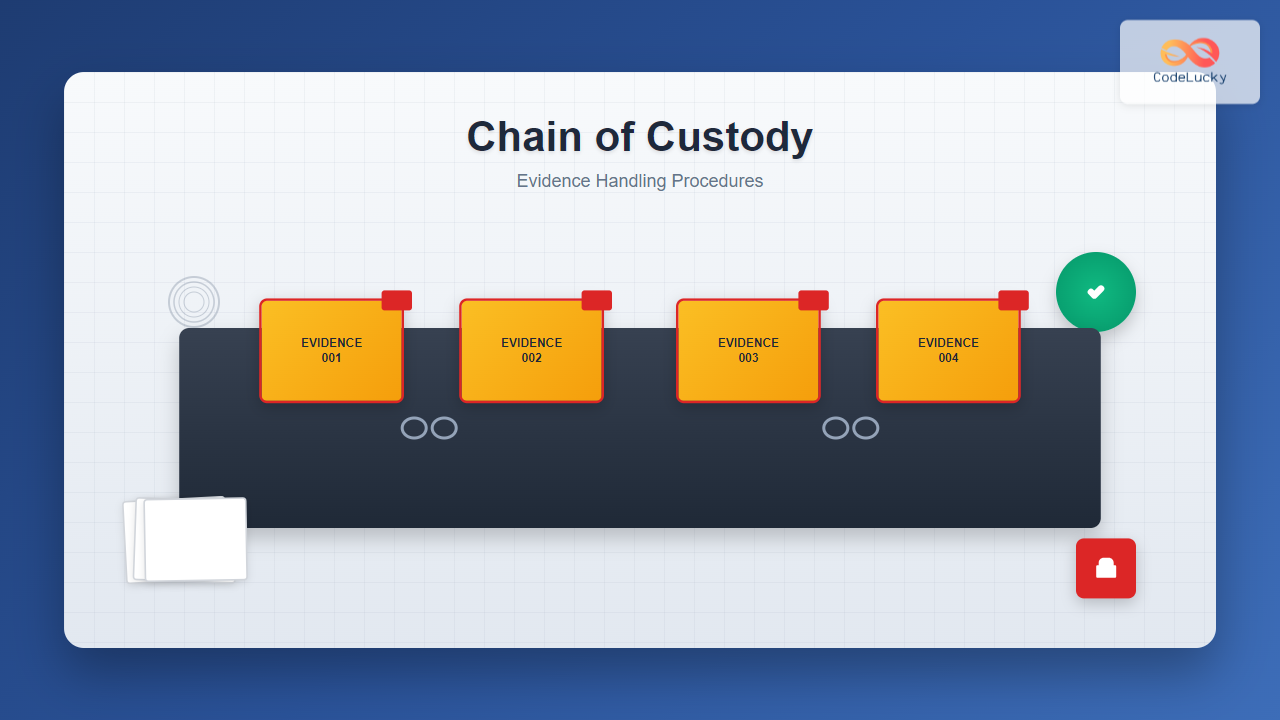
Chain of custody represents the critical backbone of digital forensics investigations, ensuring the integrity, authenticity, and admissibility of digital evidence in legal proceedings. This comprehensive procedure documents every interaction with evidence from initial collection through final disposition.
Understanding Chain of Custody Fundamentals
Chain of custody refers to the chronological documentation that records the seizure, custody, control, transfer, analysis, and disposition of physical or digital evidence. In digital forensics, this process becomes even more critical due to the volatile nature of electronic data and the ease with which it can be altered or corrupted.

Core Principles
The chain of custody operates on several fundamental principles that ensure evidence integrity:
- Continuity: Unbroken documentation from collection to presentation
- Accountability: Clear identification of every person handling evidence
- Security: Protection against tampering, loss, or contamination
- Traceability: Complete audit trail of all evidence interactions
Evidence Collection Procedures
Initial Assessment and Documentation
Before collecting any digital evidence, investigators must conduct a thorough initial assessment. This includes photographing the crime scene, documenting the state of all electronic devices, and noting any visible damage or unusual conditions.
Evidence Collection Checklist:
□ Scene photography (wide, medium, close-up shots)
□ Device inventory with serial numbers
□ Power state documentation
□ Network connection status
□ Visible damage assessment
□ Environmental conditions record
Physical Evidence Handling
Physical handling of digital devices requires specific protocols to prevent data loss or corruption:
- Power Considerations: Document whether devices are powered on or off
- Network Isolation: Disconnect network connections to prevent remote wiping
- Static Protection: Use anti-static bags and grounding straps
- Temperature Control: Maintain appropriate storage temperatures

Documentation Requirements
Essential Documentation Elements
Proper documentation forms the foundation of a defensible chain of custody. Each piece of evidence must be accompanied by detailed records that include:
| Document Type | Required Information | Purpose |
|---|---|---|
| Evidence Tag | Unique identifier, date, time, location, collector name | Primary identification and initial custody record |
| Chain of Custody Form | Transfer details, custodian signatures, dates/times | Track all custody changes |
| Forensic Report | Analysis methods, findings, examiner credentials | Document examination process and results |
| Storage Log | Storage conditions, access records, security measures | Maintain evidence integrity during storage |
Digital Documentation Standards
Digital evidence requires additional documentation layers to establish authenticity:
- Hash Values: MD5, SHA-1, and SHA-256 checksums
- Imaging Logs: Complete records of forensic imaging process
- Tool Validation: Documentation of forensic tool reliability
- Environmental Data: System time, timezone, and configuration details
Transfer and Storage Protocols
Secure Transfer Procedures
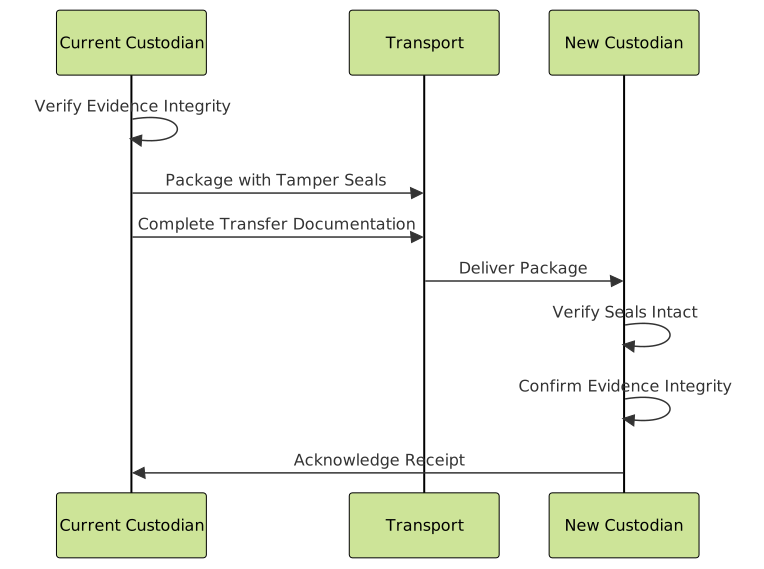
When evidence must be transferred between locations or personnel, strict protocols ensure custody integrity:
- Pre-transfer Verification: Confirm evidence integrity and documentation completeness
- Secure Packaging: Use tamper-evident seals and appropriate containers
- Transport Documentation: Complete transfer forms with detailed information
- Recipient Verification: Confirm authorized recipient identity
- Post-transfer Verification: Verify evidence integrity upon receipt
Storage Requirements
Proper storage facilities must provide multiple layers of security and environmental protection:
Physical Security
- Access-controlled evidence rooms
- Surveillance monitoring
- Visitor logging systems
- Alarm systems
Environmental Controls
- Temperature regulation (68-72°F recommended)
- Humidity control (45-55% relative humidity)
- Protection from magnetic fields
- Clean room standards when necessary
Legal Admissibility Standards
Federal Rules of Evidence
In the United States, digital evidence must meet specific criteria under the Federal Rules of Evidence, particularly Rule 901 (Authentication and Identification) and Rule 902 (Evidence That Is Self-Authenticating).
Authentication Requirements
To authenticate digital evidence, the proponent must demonstrate:
- The evidence is what it purports to be
- The evidence has not been altered
- The collection and preservation methods were sound
- The chain of custody was properly maintained
International Standards
Different jurisdictions may have varying requirements for digital evidence handling:
- ISO 27037: Guidelines for identification, collection, acquisition, and preservation of digital evidence
- NIST SP 800-86: Guide to Integrating Forensic Techniques into Incident Response
- ACPO Guidelines: Good Practice Guide for Digital Evidence (UK)
Digital Forensic Imaging Process
Forensic Imaging Best Practices
Creating forensic images is a critical step in preserving digital evidence while maintaining its integrity:

Imaging Tools and Techniques
Professional forensic imaging requires specialized tools and methodologies:
- Hardware Write Blockers: Prevent accidental modification of source media
- Software Write Blockers: Software-based protection mechanisms
- Imaging Software: Tools like dd, FTK Imager, or EnCase
- Verification Tools: Hash comparison utilities
Hash Verification Process
Hash values serve as digital fingerprints, ensuring evidence integrity throughout the investigation:
Example Hash Verification:
Source Drive MD5: 5d41402abc4b2a76b9719d911017c592
Image File MD5:   5d41402abc4b2a76b9719d911017c592
Status: MATCH ✓

Source Drive SHA-1: aaf4c61ddcc5e8a2dabede0f3b482cd9aea9434d
Image File SHA-1:   aaf4c61ddcc5e8a2dabede0f3b482cd9aea9434d
Status: MATCH ✓
Quality Assurance and Validation
Process Validation
Regular validation ensures that forensic procedures maintain their reliability and accuracy:
- Tool Testing: Regular validation of forensic software and hardware
- Procedure Review: Periodic assessment of handling protocols
- Training Verification: Ensuring personnel competency
- Documentation Audits: Regular review of chain of custody records
Common Challenges and Solutions
| Challenge | Impact | Solution |
|---|---|---|
| Incomplete Documentation | Evidence inadmissibility | Standardized checklists and training |
| Custody Gaps | Chain of custody breaks | Real-time tracking systems |
| Storage Degradation | Evidence corruption | Environmental monitoring and backup systems |
| Personnel Turnover | Knowledge loss | Comprehensive documentation and cross-training |
Technology Integration
Modern Chain of Custody Systems
Contemporary investigations benefit from advanced technology integration:
- RFID Tracking: Automated location and movement tracking
- Blockchain Technology: Immutable custody records
- Digital Signatures: Cryptographic authentication of documents
- Cloud Storage: Secure, redundant evidence storage

Automated Documentation Systems
Automation reduces human error and improves consistency in chain of custody maintenance:
- Barcode scanning for evidence tracking
- Automated hash calculation and verification
- Time-stamped digital signatures
- Integrated evidence management platforms
Practical Implementation Guidelines
Organizational Readiness
Successful chain of custody implementation requires comprehensive organizational preparation:
- Policy Development: Create detailed procedures and protocols
- Staff Training: Ensure all personnel understand requirements
- Infrastructure Setup: Establish secure storage and handling facilities
- Technology Deployment: Implement tracking and documentation systems
- Regular Auditing: Conduct periodic compliance reviews
Cost Considerations
Organizations must budget for various chain of custody components:
- Secure storage facilities and equipment
- Forensic tools and software licenses
- Staff training and certification
- Documentation and tracking systems
- Legal consultation and expert testimony
Future Trends and Developments
Emerging Technologies
The future of chain of custody procedures will be shaped by advancing technologies:
- Artificial Intelligence: Automated anomaly detection in evidence handling
- Internet of Things (IoT): Enhanced environmental monitoring
- Advanced Cryptography: Quantum-resistant security measures
- Virtual Reality: Immersive crime scene documentation
Regulatory Evolution
Legal frameworks continue evolving to address new technological challenges:
- Cloud evidence handling standards
- Cross-border evidence sharing protocols
- Privacy-preserving evidence collection
- Automated decision-making in evidence processing
Maintaining a robust chain of custody requires continuous attention to detail, adherence to established procedures, and adaptation to evolving technology and legal requirements. Organizations that prioritize proper evidence handling procedures not only ensure legal compliance but also contribute to the overall integrity of the justice system.
By implementing comprehensive chain of custody procedures, digital forensics professionals can confidently present evidence that meets the highest standards of legal admissibility while maintaining the trust and confidence of courts, clients, and the broader community they serve.
- Understanding Chain of Custody Fundamentals
- Evidence Collection Procedures
- Documentation Requirements
- Transfer and Storage Protocols
- Legal Admissibility Standards
- Digital Forensic Imaging Process
- Quality Assurance and Validation
- Technology Integration
- Practical Implementation Guidelines
- Future Trends and Developments