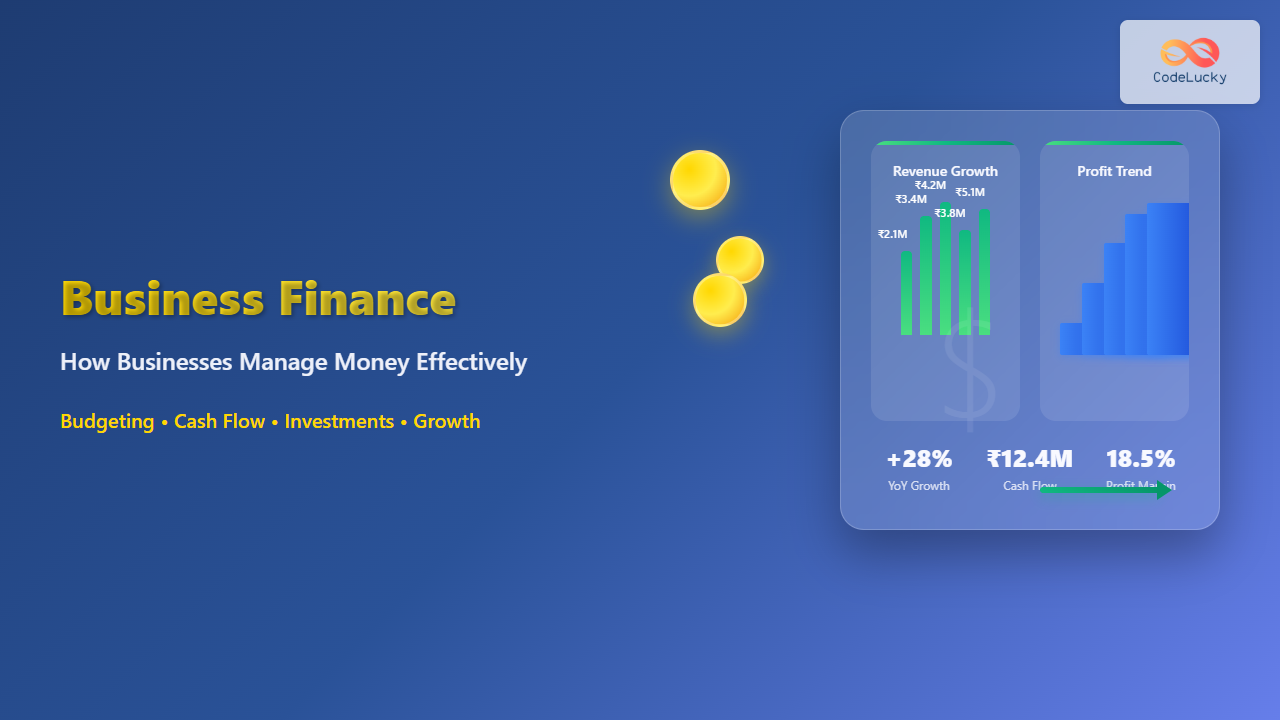
Business Finance is the backbone of every organization—whether it’s a small startup or a multinational corporation. It’s not just about counting cash; it’s about managing resources strategically to ensure growth, sustainability, and profitability. In this guide, we’ll explore how businesses manage money, control expenses, allocate funds, and make data-driven financial decisions.
What Is Business Finance?
Business finance refers to the process of planning, managing, and controlling financial activities such as raising funds, investing wisely, and ensuring profit optimization. It helps businesses maintain liquidity, reduce risk, and finance operations effectively.
Think of finance as the circulatory system of a company. Money flows from sales to investments, then back into operations. Without smooth financial flow, a company’s health deteriorates.

Core Components of Business Finance
Every business deals with three core aspects:
- Financial Planning: Estimating future income and expenses to set achievable goals.
- Financial Control: Monitoring cash flow and ensuring funds are used efficiently.
- Financial Decision-Making: Balancing risk and reward when allocating resources.
Budgeting: The Blueprint of Financial Health
A business budget outlines expected revenues and expenditures. It acts as a financial blueprint guiding spending habits and profitability goals. Most businesses use operating budgets to manage day-to-day activities, capital budgets for investments, and cash budgets for liquidity management.
For example, let’s say a coffee shop allocates ₹2,00,000 for monthly operations:
| Category | Budget (₹) | Actual (₹) |
|---|---|---|
| Rent | 50,000 | 48,000 |
| Inventory | 70,000 | 75,000 |
| Salaries | 60,000 | 60,000 |
| Utilities | 20,000 | 22,000 |
This simple comparison allows the owner to identify overspending areas and adjust future budgets accordingly.
Cash Flow Management: The Lifeline
Cash flow management ensures the business always has enough liquid assets to meet obligations. It’s different from profit; a business can be profitable yet run out of cash if collections are delayed.

Good cash management means aligning incoming and outgoing funds at the right time. Many firms use digital dashboards to forecast flow visually and respond quickly.
Sources of Business Finance
Businesses can access funds through various internal and external sources:
- Internal Sources: Retained earnings, depreciation funds, asset sales.
- External Sources: Bank loans, equity capital, venture investments, and government grants.

Investment Decisions and Risk Management
Once a business has capital, it decides how to invest it. Financial managers analyze risk vs. return for every opportunity. Common tools include NPV (Net Present Value), IRR (Internal Rate of Return), and payback period analysis.
Example: A manufacturing firm must decide between upgrading machinery or expanding marketing efforts. Using ROI analysis, the company quantifies expected gains and chooses the higher-return option.
Financial Reporting and Analysis
Financial reports help stakeholders understand performance. Key statements include the Balance Sheet, Income Statement, and Cash Flow Statement. These allow comparison between periods, departments, and industry benchmarks.
Interactive financial dashboards (like those built in BI tools) visualize performance trends using charts and KPIs. This empowers decision-makers to react faster to market shifts.

Example: Interactive Financial Simulation
Try this simple thought experiment:
Revenue: ₹10,00,000
Expenses: ₹6,50,000
Profit Margin = (Revenue - Expenses) / Revenue = 35%
If next month, expenses rise by 10%, the margin drops to 31.5%. Such simulations help visualize the impact of operational changes before real-world decisions.
Conclusion
Business finance isn’t just number-crunching—it’s the art of sustaining growth while staying resilient to risk. By mastering budgeting, maintaining steady cash flow, evaluating investments wisely, and analyzing reports rigorously, businesses can ensure they don’t just survive—but thrive. Every rupee well managed today safeguards future financial independence.