Business budgeting and forecasting are the backbone of efficient financial management. Whether you’re running a startup or managing a large enterprise, understanding where your money goes—and predicting where it’s heading—empowers data-driven business decisions. This detailed guide explains budgeting and forecasting fundamentals, strategic approaches, real-world examples, and visualization diagrams to make concepts crystal clear.
What is Business Budgeting?
Business budgeting is the systematic process of allocating financial resources to meet organizational goals. It’s essentially a financial roadmap that helps ensure you spend wisely and invest efficiently.
Key Objectives of Business Budgeting
- Expenditure Control: Prevents overspending by setting predefined spending limits.
- Goal Alignment: Ensures financial resources align with strategic business objectives.
- Performance Evaluation: Compares actual outcomes with budgeted figures to assess efficiency.
- Cash Flow Management: Maintains liquidity and prevents fund shortages.
Types of Business Budgets
- Operating Budget: Includes revenues and expenses for daily operations.
- Cash Flow Budget: Tracks the inflow and outflow of cash to monitor liquidity.
- Capital Budget: Allocates funds for long-term investments like equipment or property.
- Static vs. Flexible Budget: Static remains fixed; flexible adjusts to performance or sales variations.
Business Budget Example
Here’s a simple example of a monthly operating budget for a small business:
| Category | Planned (₹) | Actual (₹) | Variance (₹) |
|---|---|---|---|
| Sales Revenue | 3,00,000 | 2,80,000 | -20,000 |
| Operating Expenses | 1,50,000 | 1,40,000 | +10,000 |
| Marketing | 50,000 | 60,000 | -10,000 |
| Net Profit | 1,00,000 | 80,000 | -20,000 |
From the example above, the company can quickly identify variance and take corrective actions—perhaps by adjusting marketing strategies or re-evaluating revenue projections.
Visual Workflow of Business Budgeting

What is Financial Forecasting?
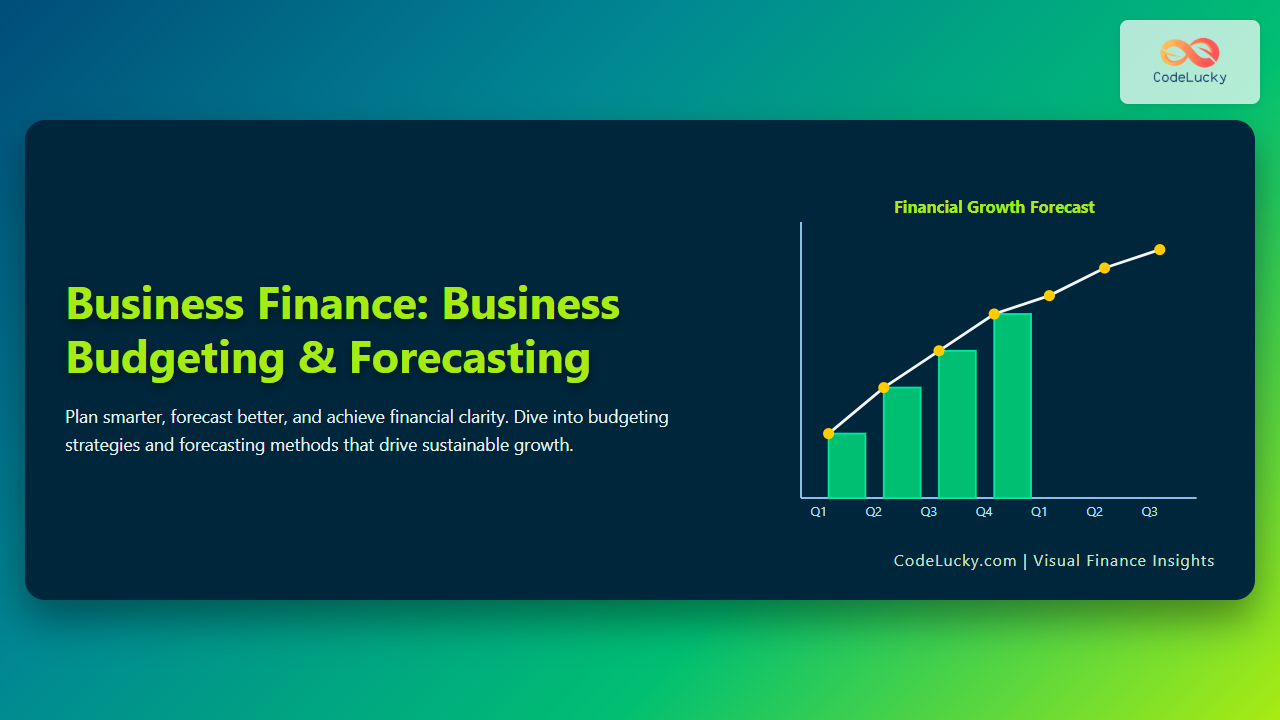
Financial forecasting is the process of estimating future financial outcomes based on historical data, market trends, and management assumptions. It complements budgeting by projecting revenue, expenses, and cash flow to guide future decisions.
Why Forecasting Matters?
- Predicts future earnings and growth potential.
- Helps manage seasonal trends and demand fluctuations.
- Improves investment and hiring decisions.
- Enables proactive risk mitigation and scenario planning.
Main Forecasting Techniques
- Qualitative Forecasting: Based on expert judgment and market research (useful for startups).
- Quantitative Forecasting: Relies on numerical analysis and historical data using statistical models.
- Time Series Forecasting: Uses past trends to predict future performance (e.g., ARIMA models).
- Causal Models: Examines cause-effect variables, such as marketing spend and revenue changes.
Visual Forecasting Timeline Example

Integration of Budgeting and Forecasting
While budgeting defines the plan, forecasting provides the prediction. Together, they create a synchronized feedback loop where real-world performance reshapes projections dynamically.

Example: Integrating Both for Actionable Insights
Suppose a company forecasts sales growth of 15% next quarter but marketing trends show saturation. The forecast can trigger a budget reallocation—moving funds from advertising to product innovation. This synergy improves profitability and reduces waste.
Budget vs. Forecast: Key Differences
| Aspect | Budget | Forecast |
|---|---|---|
| Purpose | Sets financial goals | Predicts financial outcomes |
| Nature | Static or fixed | Dynamic and updated frequently |
| Timeframe | Usually annual | Monthly or quarterly |
| Data Source | Internal projections | Historical and market data |
Steps to Create a Business Budget and Forecast

Interactive Example: Simple Forecast Model
Try this easy example to simulate cash flow projection (you can convert this logic into a small web-based calculator):
Projected Cash Flow = Opening Cash + (Expected Sales × Growth Rate) - ExpensesExample: If your current cash is ₹1,00,000, sales are ₹2,00,000 with 10% growth rate, and expenses are ₹2,50,000, then:
Projected Cash Flow = 1,00,000 + (2,00,000 × 1.10) - 2,50,000 = ₹70,000Best Practices for Efficient Budgeting and Forecasting
- Adopt rolling forecasts for flexibility.
- Use variance analysis to track deviations and act fast.
- Collaborate across departments for realistic projections.
- Leverage software tools like Excel, Power BI, or ERP systems for automation.
- Regularly review market trends to adjust financial assumptions.
Conclusion
Effective business budgeting and forecasting aren’t just about numbers—they’re about strategy and insight. By embracing a data-driven approach, analyzing variances, and updating models proactively, organizations can stay agile in changing markets and ensure steady financial health.
CodeLucky.com recommends pairing robust budgeting frameworks with smart forecasting analytics for truly future-ready business finance management.