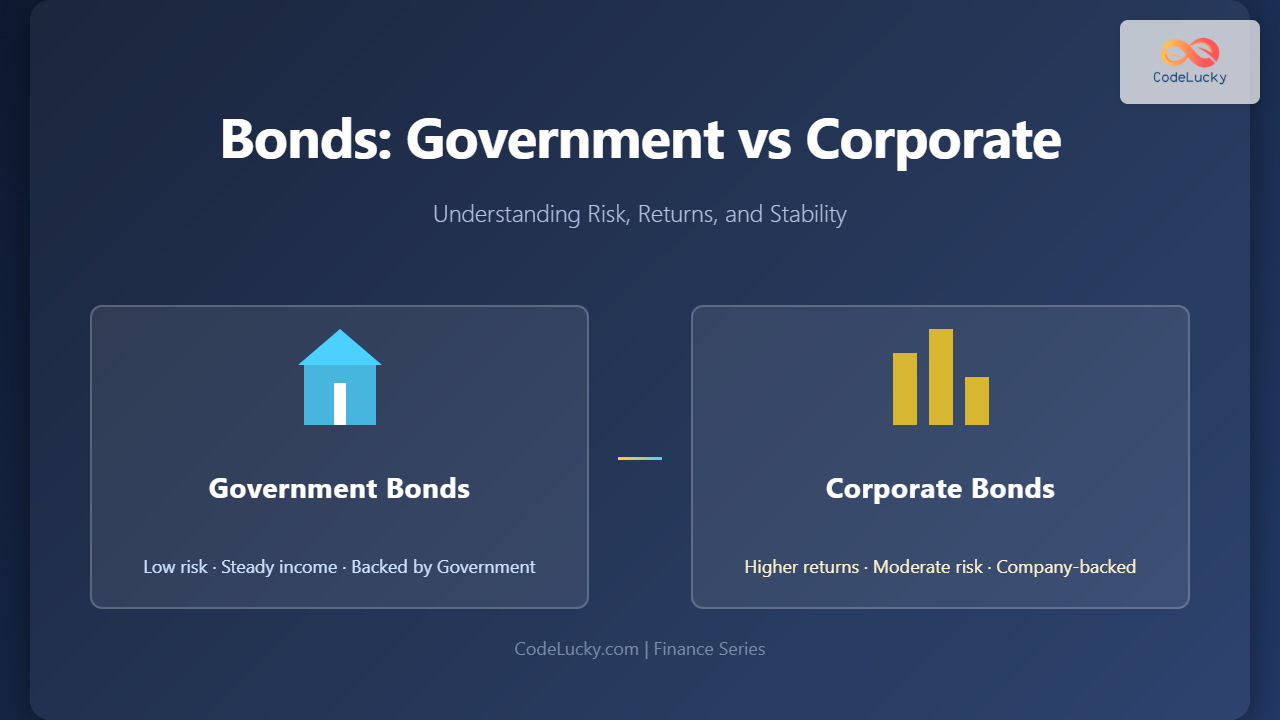
Bonds are one of the most dependable investment instruments for individuals and institutions seeking stable returns and predictable income. When you hear terms like government bonds or corporate bonds, they both fall under the umbrella of debt securities—but with notable differences in risk, return, and purpose. In this article, we’ll explore the differences between the two, backed by clear examples, diagrams, and structured explanations to help you make informed investment decisions.
What Are Bonds?
A bond is essentially a loan from an investor to an issuer (such as a government or corporation). The issuer borrows money and promises to pay regular interest (coupon payments) and repay the principal at maturity. Bonds serve as critical tools for financing projects and managing long-term capital needs.

Types of Bonds
While there are many categories—like municipal, junk, or tax-free bonds—two types dominate the financial landscape: Government Bonds and Corporate Bonds.
1. Government Bonds
Government Bonds are issued by a national government, such as India’s RBI-backed securities or U.S. Treasuries. These are considered low-risk because they are backed by the sovereign guarantee of the issuing government.
Examples:
- India: Government of India Bonds (G-Secs), RBI Savings Bonds.
- USA: Treasury Bills (T-Bills), Treasury Notes (T-Notes), and Treasury Bonds (T-Bonds).
Key Features:
- Low default risk due to government backing.
- Lower interest rates (since risk is minimal).
- Ideal for conservative investors seeking stability.
- Often come with tax benefits.
2. Corporate Bonds
Corporate Bonds are issued by companies to raise capital for expansion, acquisitions, or general operations. These bonds carry higher risk compared to government bonds, but they also offer higher returns to compensate for that risk.
Examples:
- Infosys Limited debentures.
- Tata Motors and Reliance Industries corporate bonds.
Key Features:
- Higher interest (coupon) rates.
- Issued by private or public corporations.
- Varying credit ratings depending on issuer’s financial health.
- Suitable for moderate to high-risk investors seeking better returns.
Comparison: Government Bonds vs Corporate Bonds

| Feature | Government Bonds | Corporate Bonds |
|---|---|---|
| Issuer | Issued by national or state governments | Issued by companies or corporations |
| Risk Level | Very low (backed by government) | Medium to high (depends on issuer’s credit rating) |
| Return | Lower interest rates | Higher interest rates |
| Liquidity | High—easily tradable in bond markets | Varies—depends on company and demand |
| Tax Benefits | Often have exemptions or benefits | Generally taxable interest income |
| Ideal For | Conservative investors | Aggressive investors |
How to Evaluate Bond Risk and Return
When choosing between these two, investors consider credit rating—an indicator of the issuer’s ability to meet debt obligations. Credit rating agencies like CRISIL, Moody’s, and S&P assign ratings such as AAA, AA, BBB, or below.
Example:
- A Government of India security rated AAA is extremely safe with about 6.5% yield.
- A private corporate bond rated BBB might offer 9% yield but carries higher repayment risk.

Interest (Coupon) Payments Explained
Bonds pay regular interest known as coupon payments. The frequency could be annual, semi-annual, or quarterly depending on the issuer. The formula to calculate annual interest income is:
Coupon Income Formula:
Annual Coupon Income = (Face Value × Coupon Rate)Example Calculation:
- If you invest ₹1,00,000 in a government bond with a 7% annual coupon, your yearly income = ₹7,000.
- If a corporate bond offers 9%, income = ₹9,000.

Visual Timeline: How Bonds Work Over Time

Choosing the Right Type of Bond
The choice between government and corporate bonds depends on your risk tolerance, return expectation, and portfolio objectives. Here’s a quick guide:
- Choose Government Bonds if you’re risk-averse, retired, or want guaranteed returns.
- Choose Corporate Bonds if you can handle moderate risk for higher income potential.
- A mixed bond portfolio often works best to balance safety and reward.
Interactive Example: Estimate Your Bond Returns
Try this simple example to understand your return potential. Adjust the numbers to see how yield changes:
Principal = 100000
Coupon Rate (%) = 8
Holding Years = 5
Total Interest = Principal * (Coupon Rate/100) * Holding Years
Result: ₹40,000 total interest over 5 years from an 8% corporate bond investment.
Final Thoughts
Both Government Bonds and Corporate Bonds are essential tools in any balanced portfolio. While government bonds provide unmatched safety, corporate bonds compensate investors with higher yield potential. Understanding their distinctions helps investors match their financial strategies with the right balance of risk and return.
Whether you’re building a secure income stream or chasing higher gains, your bond choices can define the financial trajectory of your portfolio. Stay informed, assess credit ratings, and diversify intelligently.