What is Behavior-Driven Development (BDD)?
Behavior-Driven Development (BDD) is an Agile software development methodology that extends Test-Driven Development (TDD) by focusing on the collaborative specification of an application’s behavior. Unlike traditional development approaches, BDD emphasizes communication between stakeholders, developers, and testers through a shared understanding of system requirements expressed in natural language.
At its core, BDD is about specification by example – a practice where requirements are captured as concrete examples that illustrate how the system should behave in specific scenarios. This approach transforms abstract requirements into executable specifications that serve as both documentation and automated tests.
The Evolution from TDD to BDD
While Test-Driven Development revolutionized software quality by advocating for writing tests before code, it often fell short in bridging the communication gap between technical and non-technical stakeholders. BDD emerged to address these limitations by:
- Shifting focus from testing to behavior: Instead of asking “what should I test?”, BDD asks “what should the system do?”
- Using ubiquitous language: Technical jargon is replaced with domain-specific terminology that all stakeholders understand
- Collaborative specification: Requirements are defined collectively through examples and scenarios
- Living documentation: Specifications remain current and serve as both requirements and test cases
Core Principles of BDD
1. Outside-In Development
BDD follows an outside-in approach, starting with user-facing features and working inward to the implementation details. This ensures that development efforts align with actual user needs and business value.
2. Collaborative Specification
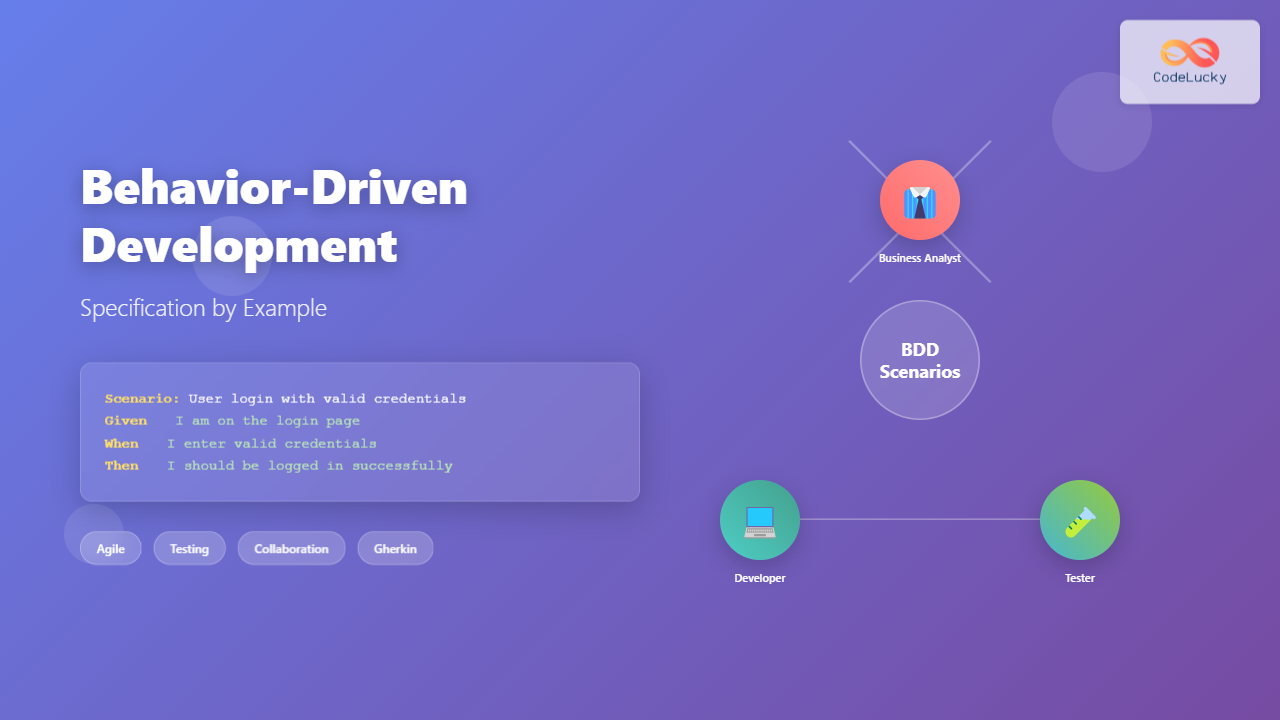
The Three Amigos concept brings together business analysts, developers, and testers to collaboratively define requirements. This cross-functional collaboration ensures shared understanding and reduces miscommunication.
3. Executable Specifications
BDD specifications are written in a format that can be executed as automated tests. This creates a feedback loop where specifications drive development and validate implementation.
4. Ubiquitous Language
All stakeholders use consistent terminology throughout the project. This shared vocabulary eliminates ambiguity and ensures everyone has the same understanding of requirements.
Understanding Specification by Example
Specification by Example is the heart of BDD. Instead of writing abstract requirements, teams create concrete examples that illustrate system behavior. These examples serve multiple purposes:
Benefits of Specification by Example
- Clarity: Concrete examples are easier to understand than abstract descriptions
- Testability: Examples can be directly converted into automated tests
- Completeness: Examples reveal edge cases and missing requirements
- Communication: Shared examples facilitate discussion and understanding
Example Transformation Process
Consider a simple e-commerce requirement: “Users should receive discounts based on their membership level.” This abstract requirement becomes concrete through examples:
Example 1: A premium member purchasing $100 worth of items receives a 15% discount
Example 2: A regular member purchasing $100 worth of items receives a 5% discount
Example 3: A guest user purchasing $100 worth of items receives no discount
The Gherkin Language: Structuring BDD Scenarios
Gherkin is the structured language used to write BDD scenarios. It provides a common format that is both human-readable and machine-executable. The syntax follows a simple pattern:
Given-When-Then Structure
- Given: Establishes the initial context or preconditions
- When: Describes the action or event that triggers the behavior
- Then: Specifies the expected outcome or result
Sample Gherkin Scenario
Feature: User Login
  As a registered user
  I want to log into my account
  So that I can access my personal dashboard

Scenario: Successful login with valid credentials
  Given I am on the login page
  And I have a valid account with username "[email protected]"
  When I enter my username and password
  And I click the login button
  Then I should be redirected to my dashboard
  And I should see a welcome message "Welcome back, John!"

Scenario: Login failure with invalid credentials
  Given I am on the login page
  When I enter an invalid username "[email protected]"
  And I enter an incorrect password
  And I click the login button
  Then I should see an error message "Invalid credentials"
  And I should remain on the login page
BDD Tools and Frameworks
Popular BDD Frameworks
Cucumber
Cucumber is the most widely used BDD framework, supporting multiple programming languages including Java, Ruby, JavaScript, and Python. It executes Gherkin scenarios and provides detailed reporting.
SpecFlow (.NET)
SpecFlow brings BDD to the .NET ecosystem, integrating seamlessly with Visual Studio and providing excellent tooling support for C# developers.
Behave (Python)
Behave is a Python-based BDD framework that follows the Gherkin syntax and integrates well with existing Python testing tools.
JBehave (Java)
JBehave is a Java framework for BDD that emphasizes plain text stories and provides flexible story execution capabilities.
Supporting Tools
- JIRA with BDD plugins: Integrate BDD scenarios with project management
- Confluence: Document and share living specifications
- IDE plugins: Syntax highlighting and auto-completion for Gherkin
- Reporting tools: Generate comprehensive test execution reports
Implementing BDD in Your Agile Process
Step 1: Discovery and Collaboration
Begin with collaborative discovery sessions involving the Three Amigos. Use techniques like:
- Example mapping: Visually organize rules and examples on index cards
- Story workshops: Detailed discussion sessions for each user story
- Specification by Example workshops: Focused sessions to create concrete examples
Step 2: Scenario Writing
Transform discovered examples into well-structured Gherkin scenarios. Follow these best practices:
- Use business language, not technical jargon
- Keep scenarios focused and independent
- Avoid implementation details
- Use descriptive scenario names
Step 3: Automation
Implement step definitions that connect Gherkin scenarios to your application code. This creates executable specifications that validate system behavior.
Step 4: Integration with CI/CD
Integrate BDD tests into your continuous integration pipeline to ensure specifications remain valid as the system evolves.
Best Practices for Effective BDD
Writing Quality Scenarios
- Focus on behavior, not implementation: Describe what the system should do, not how it does it
- Use real data: Include realistic examples that reflect actual usage patterns
- Keep scenarios independent: Each scenario should be able to run in isolation
- Use the imperative mood: Write steps as commands or actions
Collaboration Guidelines
- Include all perspectives: Ensure business, development, and testing viewpoints are represented
- Regular refinement: Continuously review and improve scenarios
- Shared ownership: All team members should contribute to and maintain scenarios
Technical Implementation
- Layered automation: Implement tests at appropriate levels (unit, integration, UI)
- Page Object Model: Use design patterns to maintain test code
- Data management: Implement strategies for test data setup and cleanup
Common BDD Challenges and Solutions
Challenge 1: Over-Specification
Problem: Teams write too many detailed scenarios, leading to maintenance overhead.
Solution: Focus on high-value scenarios that represent core business functionality. Use the 80/20 rule to prioritize scenario coverage.
Challenge 2: Technical Language Creep
Problem: Scenarios become too technical, losing their business value.
Solution: Regular review sessions with business stakeholders to ensure scenarios remain business-focused.
Challenge 3: Slow Execution
Problem: BDD tests become slow, impacting development velocity.
Solution: Implement a test pyramid approach with fast unit tests supporting slower integration and UI tests.
Challenge 4: Maintenance Burden
Problem: Scenarios become outdated as requirements change.
Solution: Treat scenarios as living documentation that evolves with the system. Regular grooming sessions keep scenarios current.
Measuring BDD Success
Quality Metrics
- Scenario coverage: Percentage of features covered by BDD scenarios
- Scenario pass rate: How often scenarios execute successfully
- Defect detection rate: Number of bugs caught by BDD tests vs. production issues
Collaboration Metrics
- Three Amigos participation: Frequency and quality of collaborative sessions
- Requirement clarity: Reduction in requirement-related questions and clarifications
- Stakeholder satisfaction: Feedback from business stakeholders on requirement understanding
Process Metrics
- Time to scenario creation: Speed of converting requirements to executable scenarios
- Automation rate: Percentage of scenarios that are automated
- Feedback cycle time: Time from scenario failure to resolution
BDD vs. Other Development Approaches
BDD vs. TDD
| Aspect | TDD | BDD |
|---|---|---|
| Focus | Code quality and design | Business behavior and collaboration |
| Language | Technical (code-based) | Business (natural language) |
| Participants | Primarily developers | Cross-functional teams |
| Scope | Unit level | Feature/scenario level |
BDD vs. ATDD
Acceptance Test-Driven Development (ATDD) and BDD share similar goals but differ in approach:
- ATDD: Focuses on acceptance criteria and often uses more technical language
- BDD: Emphasizes behavior specification using business language and concrete examples
Real-World BDD Implementation Example
Let’s examine a complete BDD implementation for an online banking system:
Feature: Money Transfer
Feature: Transfer money between accounts
  As a bank customer
  I want to transfer money between my accounts
  So that I can manage my finances effectively

Background:
  Given I am logged into my online banking account
  And I have a checking account with balance $1000
  And I have a savings account with balance $500

Scenario: Successful transfer within account limits
  Given I am on the transfer money page
  When I select my checking account as the source
  And I select my savings account as the destination
  And I enter $200 as the transfer amount
  And I click the transfer button
  Then the transfer should be completed successfully
  And my checking account balance should be $800
  And my savings account balance should be $700
  And I should see a confirmation message "Transfer completed successfully"

Scenario: Transfer exceeding available balance
  Given I am on the transfer money page
  When I select my checking account as the source
  And I select my savings account as the destination
  And I enter $1200 as the transfer amount
  And I click the transfer button
  Then I should see an error message "Insufficient funds"
  And my checking account balance should remain $1000
  And my savings account balance should remain $500

Scenario: Transfer with invalid amount
  Given I am on the transfer money page
  When I select my checking account as the source
  And I select my savings account as the destination
  And I enter $0 as the transfer amount
  And I click the transfer button
  Then I should see an error message "Transfer amount must be greater than $0"
  And no transfer should be processed
Advanced BDD Techniques
Scenario Outlines and Data Tables
For scenarios with multiple similar examples, use Scenario Outlines to avoid repetition:
Scenario Outline: Apply membership discounts
  Given I am a <membership> member
  When I purchase items worth $<amount>
  Then I should receive a <discount>% discount
  And my total should be $<total>

Examples:
  | membership | amount | discount | total |
  | Premium    | 100    | 15       | 85    |
  | Regular    | 100    | 5        | 95    |
  | Guest      | 100    | 0        | 100   |
Background Steps
Use Background sections to set up common preconditions for multiple scenarios within a feature.
Tags and Organization
Organize scenarios using tags for better test execution control:
@smoke @login
Scenario: User login with valid credentials

@regression @payment
Scenario: Process credit card payment
BDD in Different Domains
Web Applications
BDD excels in web application development by capturing user interactions and system responses through browser automation tools like Selenium.
API Development
For API-focused projects, BDD scenarios can describe request-response patterns and data validation rules.
Mobile Applications
Mobile BDD implementations use tools like Appium to automate scenarios across different devices and platforms.
Microservices
In microservices architectures, BDD helps define service contracts and integration behaviors between components.
Future of BDD and Specification by Example
The BDD landscape continues evolving with trends like:
- AI-assisted scenario generation: Machine learning tools that help create comprehensive test scenarios
- Visual BDD: Tools that use flowcharts and diagrams alongside text-based scenarios
- Continuous specification: Real-time updating of specifications based on user behavior analytics
- Cloud-native BDD: BDD implementations optimized for containerized and cloud environments
Getting Started with BDD
Preparation Steps
- Team training: Ensure all team members understand BDD principles and practices
- Tool selection: Choose appropriate BDD frameworks and supporting tools
- Process definition: Establish workflows for scenario creation, review, and maintenance
- Pilot project: Start with a small, well-defined feature to gain experience
Success Factors
- Management support: Ensure leadership understands and supports the BDD approach
- Cultural change: Foster a collaborative culture that values shared understanding
- Continuous improvement: Regularly retrospect and refine BDD practices
- Tool integration: Seamlessly integrate BDD tools with existing development workflows
Conclusion
Behavior-Driven Development and Specification by Example represent a paradigm shift in how we approach software development. By focusing on behavior rather than implementation, fostering collaboration between stakeholders, and creating executable specifications, BDD bridges the gap between business requirements and technical implementation.
The journey to successful BDD adoption requires commitment, practice, and continuous refinement. However, organizations that embrace BDD often experience improved communication, higher-quality software, and better alignment between development efforts and business value.
As Agile methodologies continue to evolve, BDD remains a powerful approach for teams seeking to deliver software that truly meets user needs while maintaining high quality and reducing development risks. The combination of collaborative specification, executable documentation, and automated validation makes BDD an invaluable practice for modern software development teams.
Start your BDD journey today by identifying a suitable pilot project, assembling your Three Amigos team, and writing your first executable specification. The investment in learning and implementing BDD will pay dividends in improved software quality, team collaboration, and customer satisfaction.
Related Posts
Test-Driven Development (TDD): Master the Red-Green-Refactor Cycle for Better Code Quality
Test-Driven Development (TDD) revolutionizes how developers approach software creation by flipping the traditional coding process upside down. Instead of writing...

PHP Behavior-Driven Development: Using Behat for Testing
In the ever-evolving world of software development, ensuring the quality and reliability of your PHP applications is paramount. Enter Behavior-Driven...

Unit Testing: Best Practices for Agile Development Teams
Unit testing forms the backbone of quality assurance in Agile development environments. As teams embrace rapid iteration cycles and continuous...
Feature Driven Development (FDD): Complete Guide to Model-Driven Agile Methodology
Feature Driven Development (FDD) stands as one of the most structured and model-centric approaches within the agile methodology family. Unlike...
Acceptance Testing: Complete Guide to Validating User Requirements in Agile Development
Acceptance testing stands as the final gatekeeper between development and production, ensuring that software meets user expectations and business requirements....

Value-Driven Development: Complete Guide to Maximizing Customer Value in Agile Projects
What is Value-Driven Development? Value-driven development is a software development approach that prioritizes delivering maximum customer value with every iteration,...
Continuous Testing: Quality at Speed in Modern Agile Development
Understanding Continuous Testing in the Agile Era Continuous testing has emerged as a cornerstone of modern Agile development, fundamentally transforming...
User Stories: Complete Writing Guide with Examples for Agile Teams
User stories are the backbone of Agile development, serving as simple yet powerful tools that bridge the gap between technical...
Dynamic Systems Development Method (DSDM): Complete Guide to Business-Focused Agile Framework
Dynamic Systems Development Method (DSDM) stands as one of the most business-focused agile methodologies, emphasizing collaboration between technical teams and...
Automated Testing: Complete Strategy Guide for Agile Development Teams
Understanding Automated Testing in Agile Context Automated testing serves as the backbone of successful Agile development, enabling teams to deliver...
Exploratory Testing: Complete Guide to Unscripted Testing Methods in Agile
Exploratory testing represents one of the most dynamic and investigative approaches to software quality assurance. Unlike traditional scripted testing, this...
Agile vs DevOps: Understanding the Relationship Between Two Powerful Software Development Methodologies
In today's fast-paced software development landscape, organizations are constantly seeking methodologies that can accelerate delivery while maintaining quality. Two prominent...