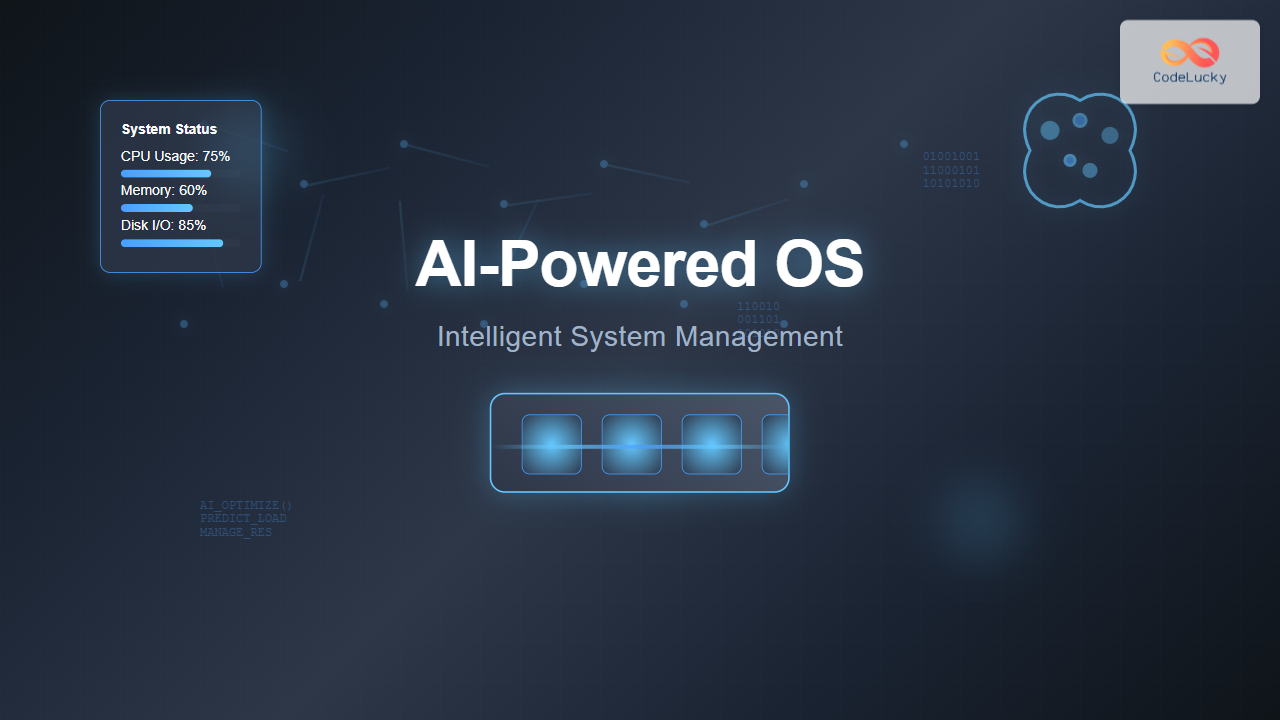
Introduction to AI-Powered Operating Systems
Modern operating systems are evolving beyond traditional static management approaches. AI-powered system management represents a paradigm shift where machine learning algorithms and artificial intelligence techniques are integrated directly into the OS kernel and system services to provide intelligent, adaptive, and predictive system administration.
This revolutionary approach enables operating systems to learn from usage patterns, predict system failures, optimize resource allocation dynamically, and automate complex administrative tasks that previously required manual intervention.
Core Components of AI-Driven OS Management

Predictive Analytics Engine
The predictive analytics engine serves as the brain of AI-powered system management. It continuously monitors system metrics, analyzes historical data, and uses machine learning models to forecast potential issues before they occur.
Key capabilities include:
- Hardware failure prediction based on temperature, usage patterns, and performance degradation
- Storage capacity forecasting to prevent disk space issues
- Network congestion prediction and preemptive load balancing
- Application crash prediction through behavior analysis
Intelligent Resource Manager
Traditional resource management relies on static allocation rules. AI-powered systems use dynamic resource allocation based on real-time analysis and predictive modeling.
Example implementation:
class AIResourceManager:
    def __init__(self):
        self.ml_model = load_trained_model('resource_predictor.pkl')
        self.system_metrics = SystemMetricsCollector()

    def optimize_cpu_allocation(self):
        current_load = self.system_metrics.get_cpu_metrics()
        predicted_demand = self.ml_model.predict_cpu_demand(current_load)

        # Dynamic CPU scheduling based on AI predictions
        for process in active_processes:
            priority = self.calculate_ai_priority(process, predicted_demand)
            self.adjust_process_priority(process, priority)

    def intelligent_memory_management(self):
        memory_usage_pattern = self.analyze_memory_patterns()
        predicted_memory_need = self.ml_model.predict_memory_demand()

        # Preemptive memory allocation and garbage collection
        if predicted_memory_need > available_memory * 0.8:
            self.trigger_intelligent_cleanup()
            self.preload_frequently_used_data()
Machine Learning Algorithms in System Management
Reinforcement Learning for Process Scheduling
Reinforcement learning enables operating systems to learn optimal process scheduling strategies through trial and error, continuously improving performance based on system feedback.

Implementation example:
class RLProcessScheduler:
    def __init__(self):
        self.q_table = initialize_q_table()
        self.learning_rate = 0.1
        self.discount_factor = 0.95

    def schedule_processes(self, process_queue):
        current_state = self.get_system_state()

        # Choose action using epsilon-greedy strategy
        action = self.epsilon_greedy_action(current_state)

        # Execute scheduling decision
        scheduled_process = self.execute_scheduling_action(action, process_queue)

        # Observe reward (system performance improvement)
        reward = self.calculate_performance_reward()

        # Update Q-learning model
        self.update_q_table(current_state, action, reward)

        return scheduled_process

    def calculate_performance_reward(self):
        # Reward based on throughput, response time, and resource utilization
        throughput_score = self.measure_throughput()
        response_time_score = self.measure_response_time()
        resource_efficiency = self.measure_resource_utilization()

        return (throughput_score + response_time_score + resource_efficiency) / 3
Neural Networks for Anomaly Detection
Deep learning models excel at identifying unusual patterns in system behavior that might indicate security threats, hardware failures, or performance issues.
Anomaly detection workflow:
- Data Collection: Continuous monitoring of system metrics, log files, and user activities
- Feature Engineering: Extraction of relevant features from raw system data
- Model Training: Training neural networks on normal system behavior patterns
- Real-time Detection: Identifying deviations from learned normal patterns
- Automated Response: Triggering appropriate countermeasures for detected anomalies
Practical Applications and Use Cases
1. Intelligent Power Management
AI-powered operating systems can optimize power consumption by learning user behavior patterns and predicting when different system components will be needed.
Example scenario:
class AIPowerManager:
    def __init__(self):
        self.usage_predictor = UsagePatternPredictor()
        self.power_optimizer = PowerOptimizer()

    def dynamic_power_scaling(self):
        # Predict next hour's usage based on historical patterns
        predicted_usage = self.usage_predictor.predict_hourly_usage()

        # Adjust CPU frequency and core activation
        if predicted_usage['cpu_demand'] < 0.3:
            self.power_optimizer.enable_low_power_mode()
            self.power_optimizer.disable_unused_cores()

        # Predictive disk spin-down
        if predicted_usage['disk_access'] < 0.1:
            self.power_optimizer.schedule_disk_spindown(delay=300)

        # Intelligent display brightness adjustment
        ambient_light = self.get_ambient_light_sensor()
        user_preference = self.learn_brightness_preference()
        optimal_brightness = self.calculate_optimal_brightness(
            ambient_light, user_preference
        )
        self.adjust_display_brightness(optimal_brightness)
2. Predictive Maintenance
AI systems can analyze hardware sensor data to predict component failures before they occur, enabling proactive maintenance and preventing unexpected system downtime.

3. Adaptive Security Management
Machine learning algorithms can continuously adapt security policies based on emerging threats and user behavior patterns.
Implementation example:
class AdaptiveSecurityManager:
    def __init__(self):
        self.threat_detector = ThreatDetectionML()
        self.behavior_analyzer = UserBehaviorAnalyzer()
        self.policy_engine = SecurityPolicyEngine()

    def continuous_threat_assessment(self):
        # Analyze network traffic patterns
        network_anomalies = self.threat_detector.detect_network_anomalies()

        # Monitor user behavior deviations
        behavior_anomalies = self.behavior_analyzer.detect_unusual_behavior()

        # Dynamic policy adjustment
        if network_anomalies['risk_level'] > 0.7:
            self.policy_engine.increase_security_level()
            self.enable_enhanced_monitoring()

        # Adaptive access control
        user_risk_score = self.calculate_user_risk_score()
        if user_risk_score > threshold:
            self.require_additional_authentication()

    def ml_based_malware_detection(self):
        # Real-time file behavior analysis
        suspicious_files = self.analyze_file_behavior_patterns()

        for file in suspicious_files:
            malware_probability = self.threat_detector.predict_malware(file)
            if malware_probability > 0.8:
                self.quarantine_file(file)
                self.update_threat_signatures(file)
Benefits of AI-Powered System Management
Performance Benefits
- Improved System Responsiveness: AI algorithms optimize resource allocation in real-time, reducing application launch times and improving overall system responsiveness
- Enhanced Resource Utilization: Intelligent scheduling and resource management lead to better utilization of CPU, memory, and storage resources
- Reduced System Latency: Predictive caching and preloading minimize wait times for frequently accessed data
Reliability and Maintenance Benefits
- Proactive Issue Resolution: Predictive analytics identify potential problems before they cause system failures
- Automated Recovery: AI systems can automatically implement recovery procedures for common issues
- Reduced Downtime: Predictive maintenance and early warning systems minimize unexpected system outages
Security Enhancements
- Advanced Threat Detection: Machine learning models can identify zero-day attacks and novel security threats
- Behavioral Analysis: AI systems learn normal user behavior patterns to detect potential security breaches
- Adaptive Defense: Security policies automatically adjust based on current threat landscapes
Implementation Challenges and Solutions

Addressing Computational Overhead
AI algorithms require significant computational resources. Modern implementations address this through:
- Model Optimization: Using lightweight neural networks and efficient algorithms designed for real-time processing
- Hardware Acceleration: Leveraging dedicated AI chips and GPU acceleration for machine learning tasks
- Distributed Computing: Offloading complex computations to cloud services while maintaining core functionality locally
Ensuring Data Privacy
AI-powered systems must balance intelligence with privacy protection:
class PrivacyPreservingAI:
    def __init__(self):
        self.federated_learning = FederatedLearningManager()
        self.differential_privacy = DifferentialPrivacyEngine()

    def train_with_privacy_protection(self, local_data):
        # Apply differential privacy to training data
        privatized_data = self.differential_privacy.add_noise(local_data)

        # Train local model without sending raw data
        local_model = self.train_local_model(privatized_data)

        # Participate in federated learning
        global_model_update = self.federated_learning.contribute_update(
            local_model
        )

        return global_model_update

    def secure_inference(self, input_data):
        # Homomorphic encryption for secure computation
        encrypted_input = self.encrypt_data(input_data)
        encrypted_result = self.model.predict(encrypted_input)
        return self.decrypt_result(encrypted_result)
Future Trends and Developments
Quantum-Enhanced AI Systems
Quantum computing will revolutionize AI-powered operating systems by enabling:
- Exponential Speed Improvements: Quantum algorithms for optimization and machine learning tasks
- Advanced Cryptography: Quantum-resistant security algorithms and quantum key distribution
- Complex Problem Solving: Quantum machine learning for previously intractable system optimization problems
Self-Healing Operating Systems
Future AI-powered operating systems will feature autonomous self-repair capabilities:

Edge AI Integration
The integration of AI processing capabilities directly into system hardware will enable:
- Real-time Decision Making: Immediate responses to system events without cloud dependency
- Reduced Latency: Local AI processing eliminates network communication delays
- Enhanced Privacy: Sensitive data processing remains on-device
Best Practices for Implementation
Development Guidelines
1. Start with Simple Models: Begin with basic machine learning algorithms before implementing complex deep learning systems.
2. Implement Gradual Learning: Design systems that can learn and improve over time without requiring complete retraining.
class IncrementalLearningSystem:
    def __init__(self):
        self.online_model = SGDRegressor()  # Supports incremental learning
        self.performance_tracker = PerformanceTracker()

    def continuous_learning(self, new_data, new_labels):
        # Validate new data quality
        if self.validate_data_quality(new_data):
            # Incremental model update
            self.online_model.partial_fit(new_data, new_labels)

            # Track performance changes
            performance_change = self.performance_tracker.evaluate_update()

            # Rollback if performance degrades significantly
            if performance_change < -0.1:  # 10% performance drop threshold
                self.rollback_model_update()
3. Design for Interpretability: Ensure AI decisions can be explained and audited, especially for critical system operations.
4. Implement Robust Fallback Mechanisms: Always provide traditional non-AI alternatives when AI systems fail or produce unreliable results.
Testing and Validation Strategies
- Synthetic Workload Testing: Create diverse test scenarios to validate AI performance across different system conditions
- A/B Testing: Compare AI-powered and traditional management approaches to measure improvement
- Stress Testing: Ensure AI systems maintain performance under extreme load conditions
- Security Testing: Validate that AI components don’t introduce new security vulnerabilities
Conclusion
AI-powered system management represents a fundamental shift in how operating systems handle resource allocation, security, and maintenance. By leveraging machine learning algorithms, predictive analytics, and intelligent automation, modern operating systems can provide unprecedented levels of performance, reliability, and security.
The integration of artificial intelligence into operating system management is not just a technological advancement—it’s a necessity for handling the complexity of modern computing environments. As systems become more distributed, security threats more sophisticated, and user expectations higher, AI-powered management becomes essential for maintaining optimal system performance.
Organizations implementing AI-powered system management should focus on gradual adoption, starting with non-critical systems and expanding as expertise and confidence grow. The future of operating systems lies in intelligent, adaptive, and self-managing systems that can learn, predict, and optimize without human intervention while maintaining the reliability and security that users depend on.
As quantum computing, edge AI, and advanced machine learning techniques continue to evolve, we can expect even more sophisticated AI-powered operating systems that will fundamentally transform how we interact with and manage computing resources.