Understanding the Arrow Operator (->) in C
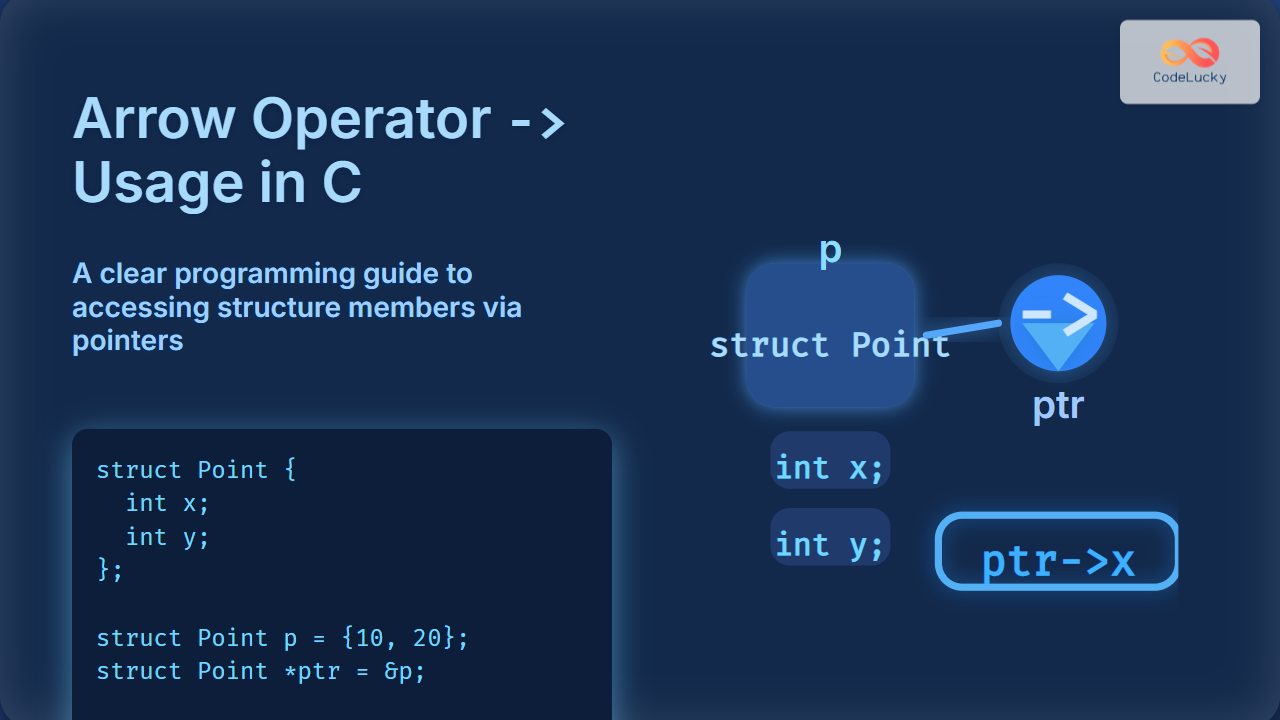
The arrow operator -> is a fundamental construct in C programming used to access members of a structure through a pointer. It provides a shorthand way to dereference a pointer to a structure and directly access its fields.
Unlike the dot operator ., which accesses members of a structure variable, the arrow operator combines dereferencing and member access in one concise step, making code easier to read and write when dealing with pointers to structures.
When and Why to Use the Arrow Operator
You use the arrow operator when you have a pointer to a structure (or union) and want to access members inside that structure. The syntax is:
pointer_variable->member_name;This is equivalent to:
(*pointer_variable).member_name;Here the parentheses are crucial because the dot operator has higher precedence than the dereference * operator, so without parentheses the expression would be invalid.
Basic Example of Arrow Operator Usage
#include <stdio.h>

struct Point {
    int x;
    int y;
};

int main() {
    struct Point p = {10, 20};
    struct Point *ptr = &p

    // Access members using arrow operator
    printf("X: %d\n", ptr->x);
    printf("Y: %d\n", ptr->y);

    return 0;
}
Output:
X: 10
Y: 20
In this example, the pointer ptr points to the structure p. Accessing the members x and y via ptr->x and ptr->y is clearer than writing (*ptr).x and (*ptr).y.
Visualizing Arrow Operator with Mermaid Diagram

Difference Between Dot (.) and Arrow (->) Operator
Both . and -> are used to access members of structs/unions but differ in usage context:
| Operator | Usage | Example |
|---|---|---|
. (Dot) |
Used when working directly with structure variables | p.x (if p is a struct variable) |
-> (Arrow) |
Used when working with pointers to structures | ptr->x (if ptr points to a struct) |
How the Arrow Operator Works Under the Hood
The arrow operator a->b is essentially an abbreviation for (*a).b. Let’s break this down:
ais a pointer to a struct.*adereferencesato get the struct object it points to.(*a).baccesses memberbfrom that struct.
The arrow operator saves the extra dereference step visually and reduces chances of mistakes in complex expressions.
Example: Modifying Structure Members via Pointer
#include <stdio.h>

struct Rectangle {
    int width;
    int height;
};

int main() {
    struct Rectangle rect = {5, 10};
    struct Rectangle *ptr = ▭

    // Modify using arrow operator
    ptr->width = 15;
    ptr->height = 20;

    printf("Width: %d, Height: %d\n", rect.width, rect.height);

    return 0;
}
Output:
Width: 15, Height: 20
Using the arrow operator on ptr, the structure members are updated successfully.
Interactive Concept: Pointer and Arrow Operator
Consider this interactive snippet (conceptual example as HTML, run locally or in an online editor):
<script>
let structObj = {x: 100, y: 200};
let ptr = structObj; // Conceptually pointer referencing the object

function getX() {
  return ptr.x; // Equivalent to ptr->x in C
}

function setX(newX) {
  ptr.x = newX;
}

console.log("Original X:", getX());
setX(300);
console.log("Modified X:", getX());
</script>
This illustrates accessing and modifying object members via a reference, akin to pointer usage in C with arrow operator.
Usage with Pointers to Pointers
When dealing with pointers to pointers of structs, multiple dereferences are required. The arrow operator only works on a pointer to a struct directly, so:
struct Point p = {1, 2};
struct Point *ptr = &p
struct Point **pptr = &ptr

// Correct usage
printf("%d\n", pptr[0]->x);  // Equivalent to (*pptr)->x
Remember that pptr is a pointer to pointer, so to access the struct member, first dereference once to get the struct pointer, then use arrow operator.
Mermaid Diagram: Pointer to Pointer Access

Common Mistakes to Avoid
- Trying to use arrow operator on a non-pointer variable: This leads to compilation error.
- Forgetting parentheses when using the dot operator on dereferenced pointer:
*ptr.memberis invalid; use(*ptr).memberinstead. - Mixing pointer types: Use arrow only for pointers to structs/unions.
Summary
The arrow operator (->) in C simplifies accessing members of structs or unions when working with pointers. It is a critical part of pointer-based programming in C, especially when dealing with dynamic data structures like linked lists, trees, or complex memory management. Using ptr->member is cleaner and less error-prone than explicit dereferencing.
Additional Resources
- Understanding Pointers in C
- Structures in C Programming
- Pointers to Structures Examples
- Understanding the Arrow Operator (->) in C
- When and Why to Use the Arrow Operator
- Basic Example of Arrow Operator Usage
- Visualizing Arrow Operator with Mermaid Diagram
- Difference Between Dot (.) and Arrow (->) Operator
- How the Arrow Operator Works Under the Hood
- Example: Modifying Structure Members via Pointer
- Interactive Concept: Pointer and Arrow Operator
- Usage with Pointers to Pointers
- Mermaid Diagram: Pointer to Pointer Access
- Common Mistakes to Avoid
- Summary
- Additional Resources