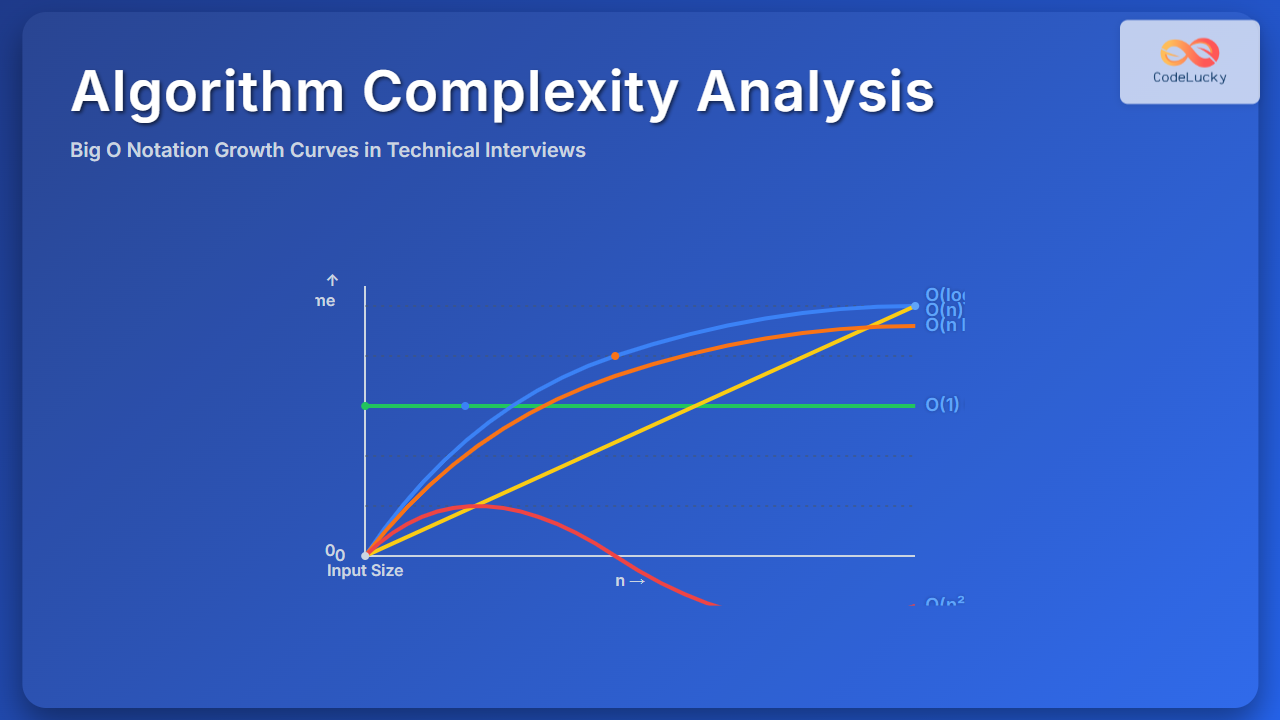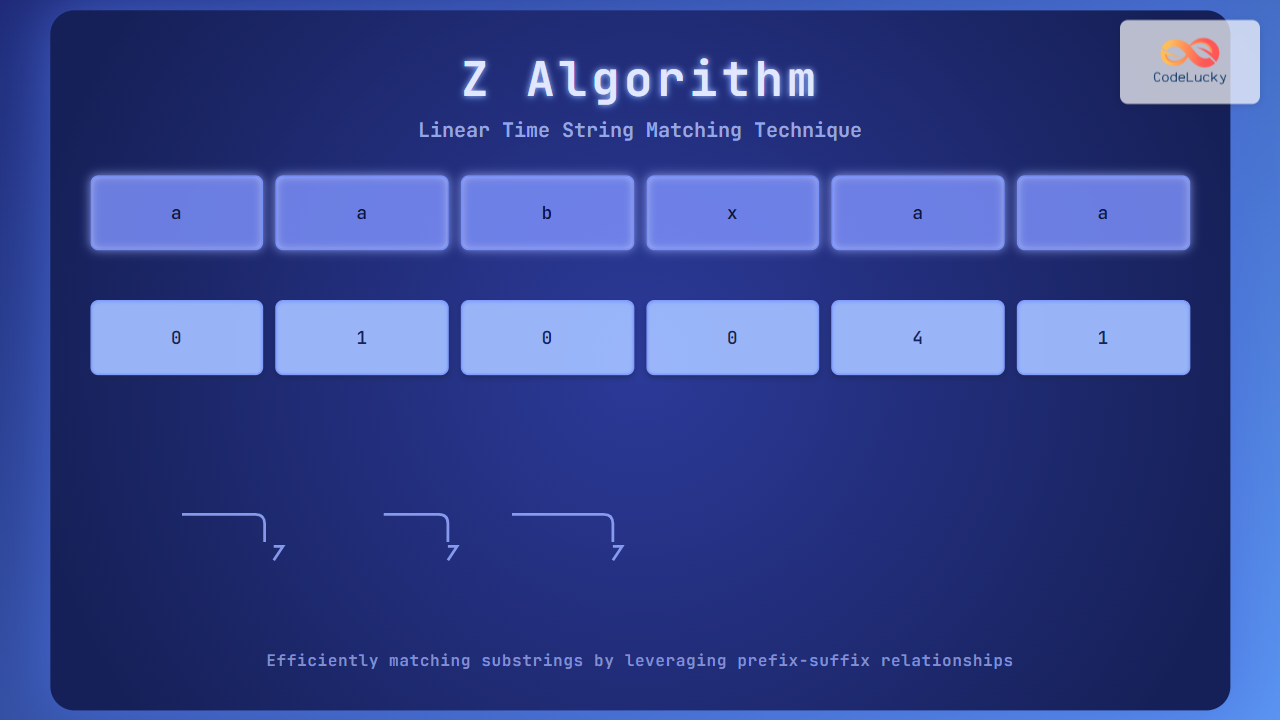
The Z Algorithm is a powerful and efficient technique for pattern matching in strings. It runs in O(n) time complexity, making it one of the most optimal ways to find occurrences of a pattern inside a text. Compared to brute-force methods that run in O(n * m), where n is the length of the text and m the length of the pattern, the Z Algorithm significantly speeds up search operations.
This article explains the working of the Z Algorithm step by step, visual illustrations, and Python implementations. We’ll also analyze complexity, use cases, and compare it against other string matching algorithms like Knuth-Morris-Pratt (KMP).
What is the Z Algorithm?
The Z Algorithm processes a string and creates an array called the Z-array, where the value at index i (denoted as Z[i]) represents the length of the longest substring starting from i that matches the prefix of the string.
This Z-array construction allows us to efficiently check where a given pattern matches in a text by simply searching for occurrences of the pattern length in the array.
Z Algorithm Example
Suppose we want to find the pattern P = "abc" inside the text T = "xabcabcabc". We concatenate the pattern, a special delimiter ($), and the text:
P + "$" + T = "abc$xabcabcabc"
Now, we compute the Z-array for this combined string. When we see a value equal to the pattern length (3 in this case), it indicates an occurrence of the pattern in the text.
Step-by-Step Visualization of Z Array
For our example, positions where Z[i] = 3 correspond to exact matches of "abc" inside the text. This helps avoid character-by-character re-checking.
Detailed Walkthrough of Z-Array Calculation
The Z Algorithm maintains a window [L, R] representing the rightmost substring matching the prefix:
- Initially,
L = R = 0. - For each index
i, ifi > R, expand manually by checking characters. - If
i ≤ R, use previously computed values to determineZ[i]efficiently. - Keep updating
[L, R]whenever a longer prefix match is found.

Example Computation of Z Array
Let’s compute the Z-array for S = "aabxaabxcaabxaabxay":
S = "aabxaabxcaabxaabxay"
Z = [0,1,0,0,4,1,0,0,9,1,0,0,5,1,0,0,2,1]
Notice the large value Z[8] = 9, which shows that at position 8, the substring matches the prefix of length 9.
Z Algorithm in Pattern Matching
To apply Z Algorithm for pattern matching:
- Create a new string:
P + "$" + T. - Compute its Z-array.
- For every
i, ifZ[i] = |P|→ match found at positioni - |P| - 1.
Code Implementation in Python
def calculate_z(S):
    n = len(S)
    Z = [0] * n
    L, R = 0, 0
    for i in range(1, n):
        if i > R:
            L, R = i, i
            while R < n and S[R-L] == S[R]:
                R += 1
            Z[i] = R - L
            R -= 1
        else:
            k = i - L
            if Z[k] < R - i + 1:
                Z[i] = Z[k]
            else:
                L = i
                while R < n and S[R-L] == S[R]:
                    R += 1
                Z[i] = R - L
                R -= 1
    return Z

def search_pattern(text, pattern):
    combined = pattern + "$" + text
    Z = calculate_z(combined)
    result = []
    for i in range(len(pattern)+1, len(Z)):
        if Z[i] == len(pattern):
            result.append(i - len(pattern) - 1)
    return result

# Example usage:
text = "xabcabcabc"
pattern = "abc"
print("Pattern found at indices:", search_pattern(text, pattern))
Output:
Pattern found at indices: [1, 4, 7]
Visual Example of Pattern Matching
Advantages of Z Algorithm
- Runs in
O(n)time for a string of lengthn. - Saves repeated comparisons by leveraging overlapping prefix matches.
- Efficient for multiple pattern searches within large text.
Z Algorithm vs Other String Matching Algorithms
| Algorithm | Time Complexity | Best For |
|---|---|---|
| Naive Search | O(n * m) | Small data |
| KMP Algorithm | O(n + m) | Pattern preprocessing |
| Z Algorithm | O(n + m) | Prefix based linear search |
Applications of Z Algorithm
- Pattern searching within documents.
- Detecting substrings in DNA sequencing.
- Autocomplete search engines.
- Plagiarism detection tools.
Conclusion
The Z Algorithm is one of the cleanest and most elegant string searching algorithms. By creating the Z-array and leveraging prefix matches, it reduces redundant checks and achieves linear time complexity. Its simplicity combined with efficiency makes it a must-know technique for algorithm enthusiasts, competitive programmers, and software engineers.