Writing Skills: Writing Simple Sentences is the foundation of effective communication. Whether you’re a student, a professional, or a content creator, writing clear and simple sentences helps you express ideas accurately and confidently. In this guide on CodeLucky.com, we’ll explore how to form simple sentences, understand their structure, and practice writing them effectively.
What is a Simple Sentence?
A simple sentence is a sentence that expresses one complete idea with a single independent clause. It always has a subject and a predicate (verb).
Example:
- The sun rises in the east.
- She writes every day.
Each of these examples expresses one complete thought—hence, they are simple sentences.
Basic Structure of a Simple Sentence
The usual pattern of a simple sentence in English follows this order:
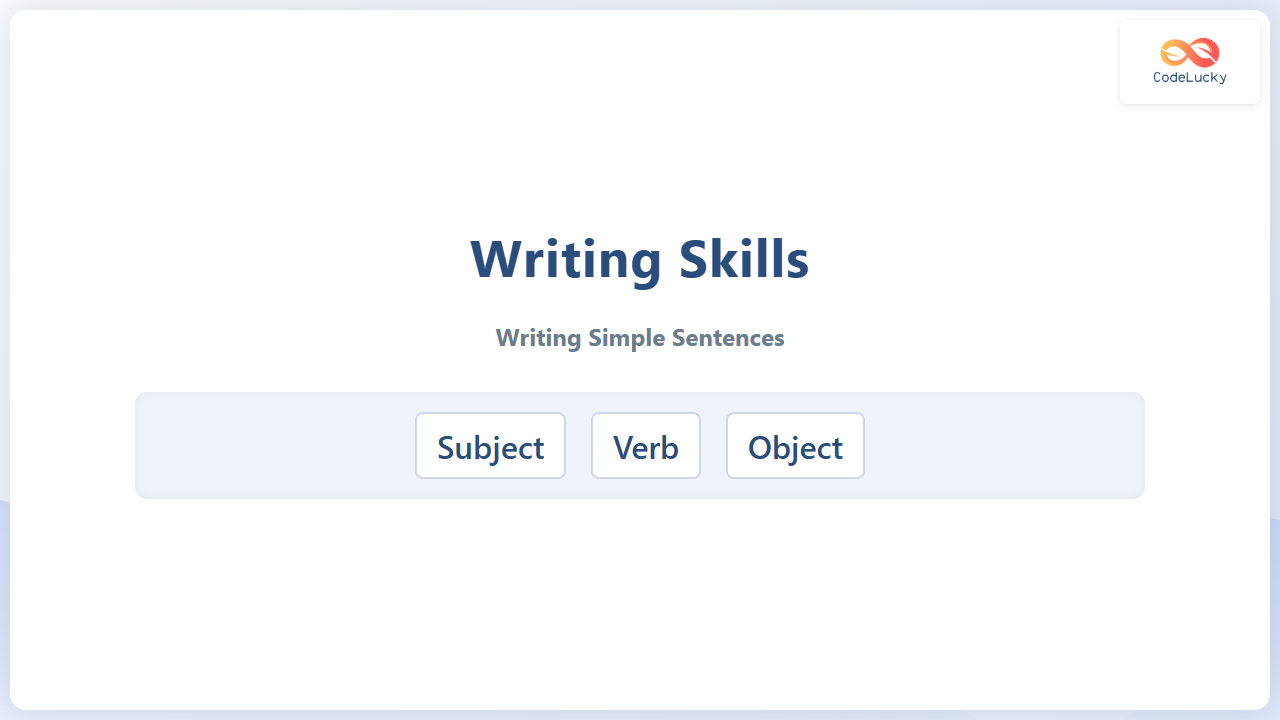
Subject + Verb + Object (SVO)
Example: Ravi (Subject) eats (Verb) apples (Object).
Let’s visualize the sentence structure:

This structure may also vary slightly depending on sentence type, but the SVO order is the most commonly used form in English.
Types of Simple Sentences
Simple sentences come in several patterns depending on how words combine around the verb:
- SV (Subject + Verb): Birds fly.
- SVO (Subject + Verb + Object): She reads books.
- SVC (Subject + Verb + Complement): He is happy.
- SVI (Subject + Verb + Indirect Object + Direct Object): I gave him a gift.
- SVA (Subject + Verb + Adverbial): They live here.

Rules for Writing Effective Simple Sentences
Follow these best practices when forming simple sentences:
- Use one main idea: Each sentence should express only one thought.
- Include both subject and verb: Avoid fragments like “Because of the rain”.
- Keep it clear and concise: Eliminate unnecessary words.
- Ensure correct punctuation: Start with a capital letter and end with a period, question mark, or exclamation mark.
- Use active voice: It makes your sentence more direct. Example: “She completed the work” rather than “The work was completed by her.”
Interactive Practice: Rearrange to Form Simple Sentences
Try these mini exercises to practice.
- am / I / teacher / a → I am a teacher.
- playing / children / are / the → The children are playing.
- loves / she / coffee → She loves coffee.
Interactive hint: You can turn such exercises into a fun drag-and-drop activity using small JavaScript quizzes, helping learners reconstruct correct sentences.
Common Mistakes to Avoid
- Missing subject or verb: Incorrect: “Running fast.” (Add subject: “He is running fast.”)
- Run-on sentences: Incorrect: “I like apples I eat them every day.” (Fix: “I like apples. I eat them every day.”)
- Incorrect verb tense: Keep tenses consistent with sentence meaning.
Using Simple Sentences for Better Communication
Simple sentences are not just for beginners—they are powerful tools even in professional writing. They help improve clarity, readability, and rhythm in documents, articles, and even web content.
Example in content writing:
Instead of saying: “Due to the fact that our product has multiple advanced features, users tend to experience an increase in efficiency.”
Write: “Our product’s advanced features make users more efficient.”
Expanding a Simple Sentence
After mastering basic structures, you can expand your writing by adding modifiers and phrases. For instance:
- Simple: The dog barked.
- Expanded: The big dog barked loudly at the stranger.
The core (dog + barked) remains, but we enrich meaning with descriptive words.

Summary
Writing simple sentences is the first step toward mastering written English. Remember the key: one idea, clear structure, and correct grammar. Regular practice through reading and rewriting helps you develop natural fluency over time.
Explore more English writing skills and sentence-building exercises on CodeLucky.com to level up your communication skills.