Writing in English is one of the most valuable skills for effective communication — whether you’re creating essays, emails, or blog posts. However, even strong learners often make subtle mistakes that can reduce clarity, professionalism, and reader engagement. In this article, we’ll explore common writing mistakes, how to fix them, and ways to strengthen your writing through structure, tone, and practice.
1. Grammar and Sentence Structure Errors
Incorrect sentence structures or grammar issues can confuse readers. These include subject-verb disagreement, incorrect tense usage, or sentence fragments.
Example:
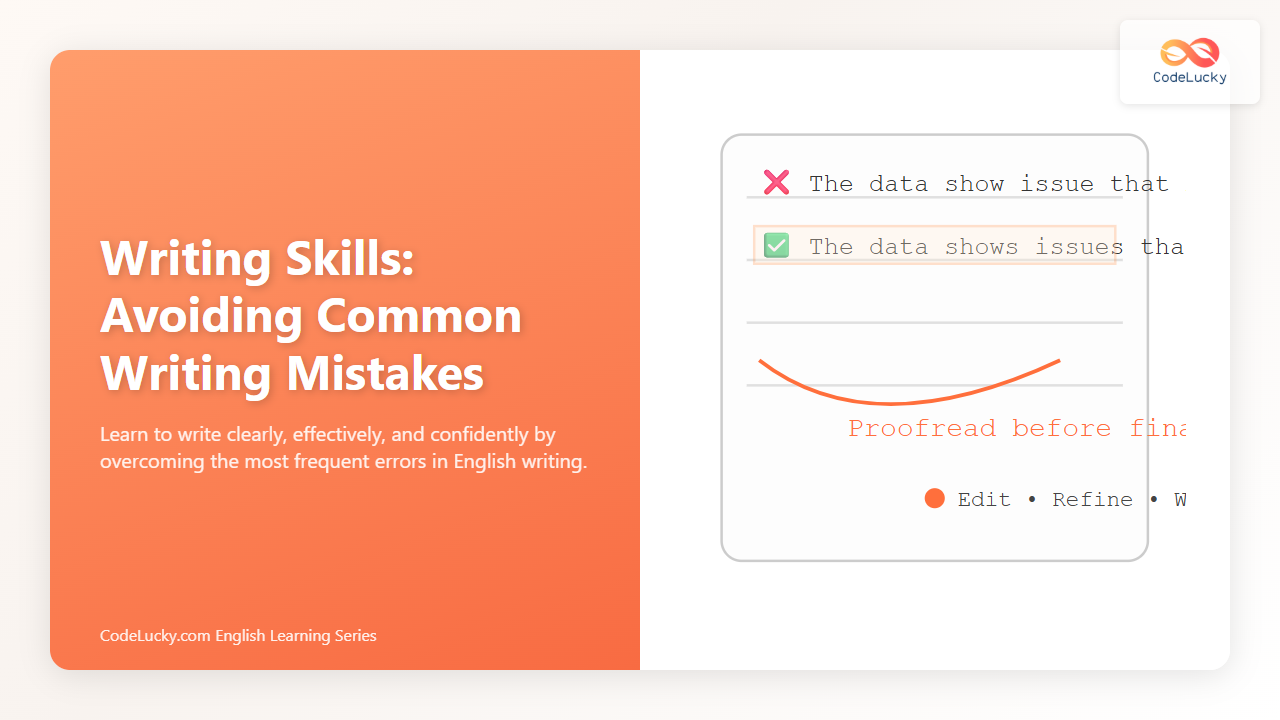
❌ The data shows several issue that needs correction.
✅ The data shows several issues that need correction.
Tip: Always ensure subject-verb agreement and consistent tense. Read your sentences aloud — if they sound awkward, they probably need fixing.

2. Overuse of Passive Voice
Passive voice hides the doer of the action and makes sentences longer. While not always wrong, excessive use weakens your tone.
Example:
❌ The project was completed by the team in two weeks.
✅ The team completed the project in two weeks.
Tip: Write in active voice whenever possible – it’s more direct and energetic.

3. Wordiness and Redundancy
Adding unnecessary words makes writing heavy and unclear. Concise writing saves readers’ time.
Example:
❌ In my personal opinion, I think that it is necessary to make a decision.
✅ I think it is necessary to decide.
Fix: Remove repeated ideas and redundant phrases like “each and every,” “in order to,” or “at this point in time.”

4. Poor Punctuation and Comma Misuse
Punctuation guides readers through your thoughts. A misplaced comma or missing period can change meaning entirely.
Example:
❌ Let’s eat kids!
✅ Let’s eat, kids!
Tip: Use commas to separate ideas, items, or clauses. Avoid comma splices — don’t join two full sentences with just a comma.

5. Repetition and Weak Word Choice
Using the same words repeatedly or relying on vague terms makes writing dull. Instead of saying “good” or “bad,” choose words that add precision.
Example:
❌ The movie was good. The acting was good. The story was good.
✅ The movie was impressive, with strong acting and a compelling story.
Tip: Use synonyms and adjectives carefully. Replace weak verbs like “do” or “make” with stronger actions.
6. Lack of Logical Flow
Good writing connects ideas smoothly. Jumps in logic or missing transitions can make the text confusing.
Example:
❌ I studied hard. I failed the exam. English is fun.
✅ I studied hard but still failed the exam. However, I enjoy learning English.
Fix: Use transition words like however, therefore, meanwhile, in contrast, or as a result to show relationships between ideas.

7. Ignoring Audience and Tone
Writing for the wrong audience can weaken your message. An academic essay should maintain a formal tone, while a blog can sound conversational.
Example:
❌ Hey guys, today we gonna discuss Shakespeare’s writing!
✅ This article explores the major writing techniques used by Shakespeare.
Tip: Always consider your reader’s expectations. Match tone, vocabulary, and sentence style accordingly.
8. Weak Paragraph Organization
Each paragraph should focus on one main idea. Mixing unrelated points confuses readers and weakens structure.
Tip for strong paragraphs:
- Start with a topic sentence.
- Support it with facts, examples, or reasoning.
- Conclude with a sentence linking to the next idea.
Example Structure:
Topic Sentence → Explanation → Example → Conclusion9. Forgetting to Proofread
Even great writers make mistakes in their first draft. Skipping proofreading leads to embarrassing errors.
Checklist Before Publishing:
- Check grammar and spelling.
- Read aloud for awkward phrasing.
- Confirm consistent tone and tense.
- Ask someone else to review if possible.
Interactive Writing Practice
Try this simple interactive exercise: Rewrite the following sentence to make it active, concise, and clear.
Original: The report was written by me in a very careful manner.
Your Rewrite: _____________________________
After practicing a few such rewrites daily, you’ll notice faster improvements in clarity and fluency.
Conclusion
Improving writing is a journey — not a one-day task. Focus on avoiding these common writing mistakes to make your English more effective, professional, and reader-friendly. Remember: good writing isn’t about using fancy words, but expressing ideas clearly and confidently.
Keep learning, keep writing — and let your words shine!