
Effective email introductions set the tone for your entire message and determine whether the recipient will read further. A strong introduction captures attention, establishes context, and builds rapport within the first 1-2 sentences. This guide covers everything from professional business emails to casual networking messages, with ready-to-use templates and common pitfalls to avoid.
Why Email Introductions Matter
Recipients spend an average of 28% of their workday reading and answering email, making your opening critical for standing out. Poor introductions lead to immediate deletion or misinterpretation, while well-crafted ones increase response rates by up to 30%. Focus on clarity, relevance, and personalization to create memorable first impressions.
- Time efficiency: Busy professionals scan emails in seconds
- Credibility building: Proper intros establish trust immediately
- Context provision: Helps recipients understand purpose instantly
Types of Email Introductions

| Type | When to Use | Example Template |
|---|---|---|
| Professional | Business colleagues, clients | Hi Sarah, I hope this email finds you well. I’m reaching out about our Q4 project timeline. |
| Cold Outreach | First contact, sales, networking | Hello Michael, [Mutual contact] recommended I connect with you regarding AI solutions for healthcare. |
| Follow-up | After meetings, previous emails | Hi team, Following up on our discussion from Tuesday’s meeting about the budget allocation. |
| Networking | Conferences, LinkedIn connections | Dear Professor Lee, I enjoyed your recent talk on sustainable architecture at TechConf 2025. |
Professional Email Introduction Formula
Use this proven 3-part formula for business emails: Greeting + Context + Purpose. This structure ensures clarity while remaining concise.
Example Implementation:
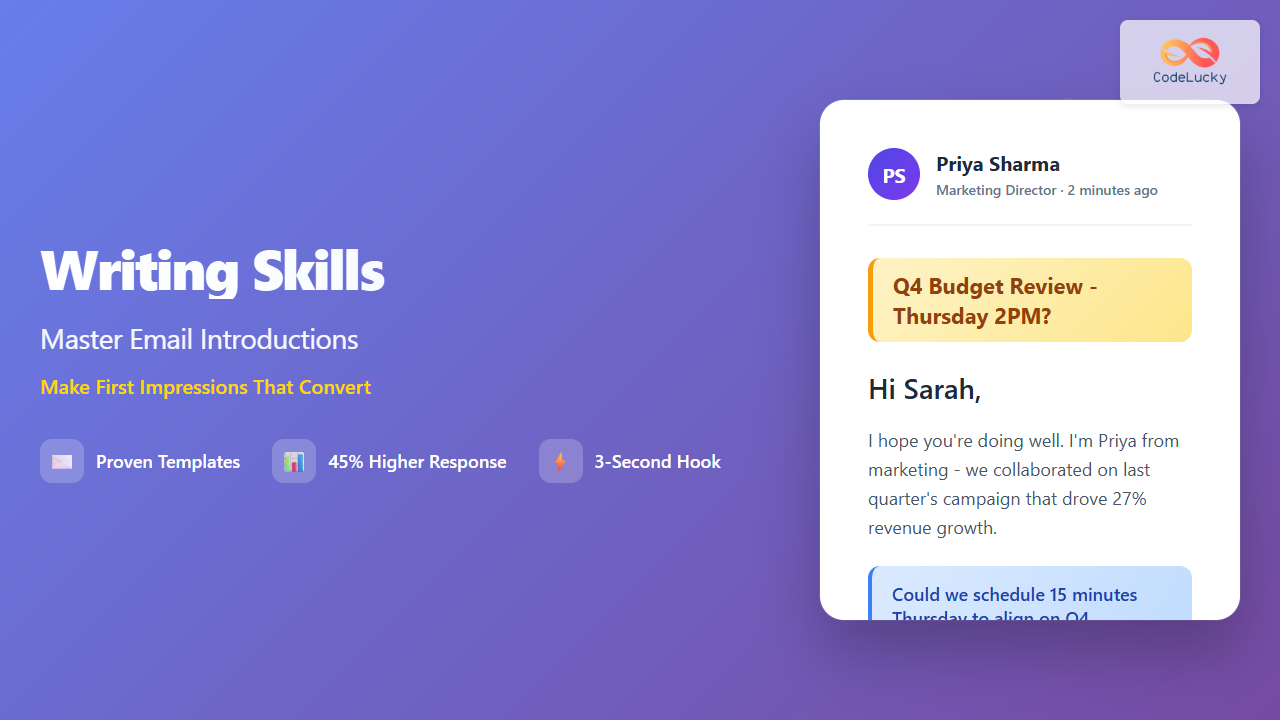
Subject: Q4 Marketing Budget Proposal

Hi David,

I'm Priya Sharma from the marketing team, and we collaborated on last quarter's campaign launch.

Could we schedule 15 minutes this week to discuss the Q4 budget allocation?

Best regards,
Priya
Cold Email Introduction Strategies
Cold emails have <10% response rates unless the introduction provides immediate value. Research your recipient thoroughly and lead with their interests or pain points rather than your agenda.

- Reference recent LinkedIn posts, articles, or company news
- Mention mutual connections (increases response by 45%)
- Keep introduction under 50 words
- End with specific call-to-action
Common Mistakes to Avoid
| Mistake | Why It Fails | Corrected Version |
|---|---|---|
| No personalization | Feels like spam | Hi Sarah → Hi Sarah, loved your recent post on React hooks |
| Too long | Loses attention | 3-paragraph intro → 2-sentence intro |
| No clear purpose | Recipient confused | “Just checking in” → “Scheduling our Q4 review call” |
| Generic subject | Never opened | “Meeting Request” → “Q4 Budget Review – This Thursday?” |
Cultural Considerations
Email etiquette varies globally. In the US/UK, directness works well. In Japan/China, more formal language and relationship-building precedes business discussion.
- US/Europe: First name + direct purpose
- Asia: Title + company + polite context
- India: Respectful + relationship reference
- Middle East: Personal inquiries + business
Interactive Email Introduction Generator
Copy this HTML into your editor to test different introduction styles interactively:
<!DOCTYPE html>
<html>
<head>
<style>
.select-style { padding:10px; margin:5px; }
.preview { background:#f5f5f5; padding:20px; margin:20px 0; border-left:4px solid #007cba; }
</style>
</head>
<body>
<h3>Email Introduction Generator</h3>
Relationship:
<select class="select-style" id="rel" onchange="generate()">
<option value="professional">Professional</option>
<option value="cold">Cold Outreach</option>
<option value="followup">Follow-up</option>
</select>

Recipient: <input type="text" id="name" value="Sarah" onkeyup="generate()">

Your Name: <input type="text" id="yourname" value="Priya" onkeyup="generate()">

<div id="preview" class="preview"></div>

<script>
function generate() {
    const rel = document.getElementById('rel').value;
    const name = document.getElementById('name').value;
    const yourname = document.getElementById('yourname').value;

    let intro = '';
    if (rel === 'professional') {
        intro = `Hi ${name},\n\nI hope you're doing well. I'm ${yourname} from [Your Team], reaching out about our upcoming project.`;
    } else if (rel === 'cold') {
        intro = `Hello ${name},\n\n[Mutual contact] suggested I connect regarding your work in [their field]. I'd love to share how we've helped similar companies.`;
    } else {
        intro = `Hi ${name},\n\nFollowing up on our Tuesday discussion about the Q4 deliverables. Here's the updated timeline.`;
    }

    document.getElementById('preview').textContent = intro;
}
generate();
</script>
</body>
</html>
Quick Reference Templates
- Job Application: “Dear Ms. Johnson, Your Software Engineer role posting caught my attention due to the emphasis on React development.”
- Sales Pitch: “Hi Alex, Noticed AcmeCorp’s recent expansion into e-commerce. We’ve helped similar retailers increase conversion 27%.”
- Meeting Request: “Hello team, Proposing Thursday 2 PM for our strategy alignment. Please confirm availability.”
- Thank You: “Dear Professor, Thank you for the insightful lecture on microservices yesterday.”
Master these patterns through practice. Review your sent emails weekly, A/B test subject lines, and track response rates to continuously improve your introduction skills.