Adjectives are the heart of descriptive writing. They give color, emotion, and depth to what might otherwise be plain text. Whether you are describing a place, a person, or an experience, using adjectives effectively transforms simple sentences into powerful imagery that readers can visualize and feel.
What Are Adjectives?
Adjectives are words that describe or modify nouns. They tell us more about size, color, shape, quality, emotion, or state. Think of them as “painting words” that make your writing come alive:
- The cat → The fluffy white cat.
- A building → A tall glass building.
- The day → The bright, sunny day.
Why Adjectives Matter in Writing
Without adjectives, writing can feel flat. With too many, it can feel overloaded. The magic lies in balance. The right adjectives add clarity and emotion, helping the reader picture what you mean instantly.
Compare these two examples:
Without adjectives: The boy entered the room.
With adjectives: The nervous young boy entered the dimly lit room.
The second sentence instantly builds a scene and mood — “nervous,” “young,” and “dimly lit” guide the reader’s imagination.
Types of Adjectives Explained
Adjectives come in various types, each serving a specific purpose:
| Type | Purpose | Examples |
|---|---|---|
| Descriptive Adjectives | Describe quality or appearance | beautiful, noisy, clever |
| Quantitative Adjectives | Show quantity or amount | many, few, some |
| Demonstrative Adjectives | Point out which one | this, that, these, those |
| Possessive Adjectives | Show ownership | my, your, their |
| Interrogative Adjectives | Used in questions | which, what, whose |
| Comparative & Superlative | Used to compare two or more things | taller, tallest; more beautiful, most beautiful |
Structure of a Descriptive Sentence
Descriptive writing often follows this pattern:

Example: “The old wooden bridge creaked gently under the soft evening breeze.”
Notice how adjectives “old,” “wooden,” “soft,” and “evening” create a full sensory image.
How to Choose the Right Adjective
Here’s a strategic way to decide which adjective fits best:
- Be specific: Instead of “good,” write “delightful,” “memorable,” or “exceptional.”
- Match the tone: For emotional writing, choose adjectives that evoke feeling (“lonely,” “heartwarming”).
- Use sensory words: Involve the five senses to deepen imagery (“crispy,” “fragrant,” “shimmering”).
- Avoid overload: Limit to two or three adjectives per noun for readability.
Interactive Practice: Fill in the Adjectives
Try this quick exercise. Fill in adjectives that make these sentences more descriptive:
- The _______ mountain glowed under the _______ sky.
- She wore a _______ dress that shimmered in the light.
- The coffee tasted _______ after the _______ morning run.
See Example Answers
- The snow-capped mountain glowed under the crimson sky.
- She wore a silky dress that shimmered in the light.
- The coffee tasted rich after the cold morning run.
Organizing Adjectives in Order
When using multiple adjectives, English usually follows a natural sequence:
- Opinion → Size → Age → Shape → Color → Origin → Material → Purpose
Example: “A beautiful small old round red Italian wooden dining table.”

Tip: You don’t always need all seven! Choose only the ones that add real value or relevance to your scene.
Common Mistakes to Avoid
- Too many adjectives: Makes writing clunky (“The big huge enormous house”).
- Repetition: Using words with similar meaning (“cold and freezing”).
- Clichés: Avoid predictable terms (“beautiful sunset” → try “golden twilight”).
- Incorrect order: Mixing natural adjective order confuses readers.
Example: Transforming a Paragraph with Adjectives
Let’s see how adjectives can upgrade a paragraph:
Before:
The park had trees and a river. Children played there. The sun was setting.

After:
The peaceful park had tall oak trees and a calm, flowing river. Cheerful children played under the glowing evening sky as the warm sun sank behind the hills.
Notice how adjectives like “peaceful,” “tall,” “calm,” “flowing,” and “glowing” bring movement and emotion.
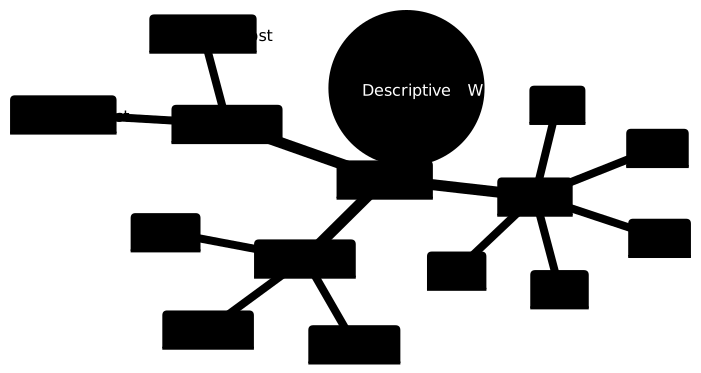
Visual Mind Map: Using Adjectives Effectively
Adjective Placement Rules
Adjectives appear in two main positions:
- Before a noun: “A blue car.”
- After a linking verb: “The car is blue.”
For compound adjectives (e.g., “sky-blue eyes”), use a hyphen when two or more words work together to describe one noun.
How to Build Emotion with Adjectives
The emotional tone of your writing heavily depends on your adjective selection. Consider how changing one word shifts the mood:
Happy tone: She walked through the bright, cheerful garden.
Dark tone: She walked through the eerie, silent garden.
Interactive Challenge: Adjective Swap
Rewrite the following with a different mood by swapping adjectives:
The calm sea reflected the golden sky.
Try a dramatic version:
The stormy sea reflected the blood-red sky.
Final Tips for Writing Descriptions with Adjectives
- Use adjectives to appeal to the senses and emotions.
- Prioritize clarity over complexity.
- Vary your adjectives to avoid repetition.
- Test by reading aloud — natural rhythm often reveals excess words.
Conclusion
Adjectives are powerful tools when writing descriptions. They give readers a window into your imagination and paint scenes with color, emotion, and clarity. Whether you’re composing essays, stories, or professional content, mastering adjective use will make your writing stand out and stay memorable.