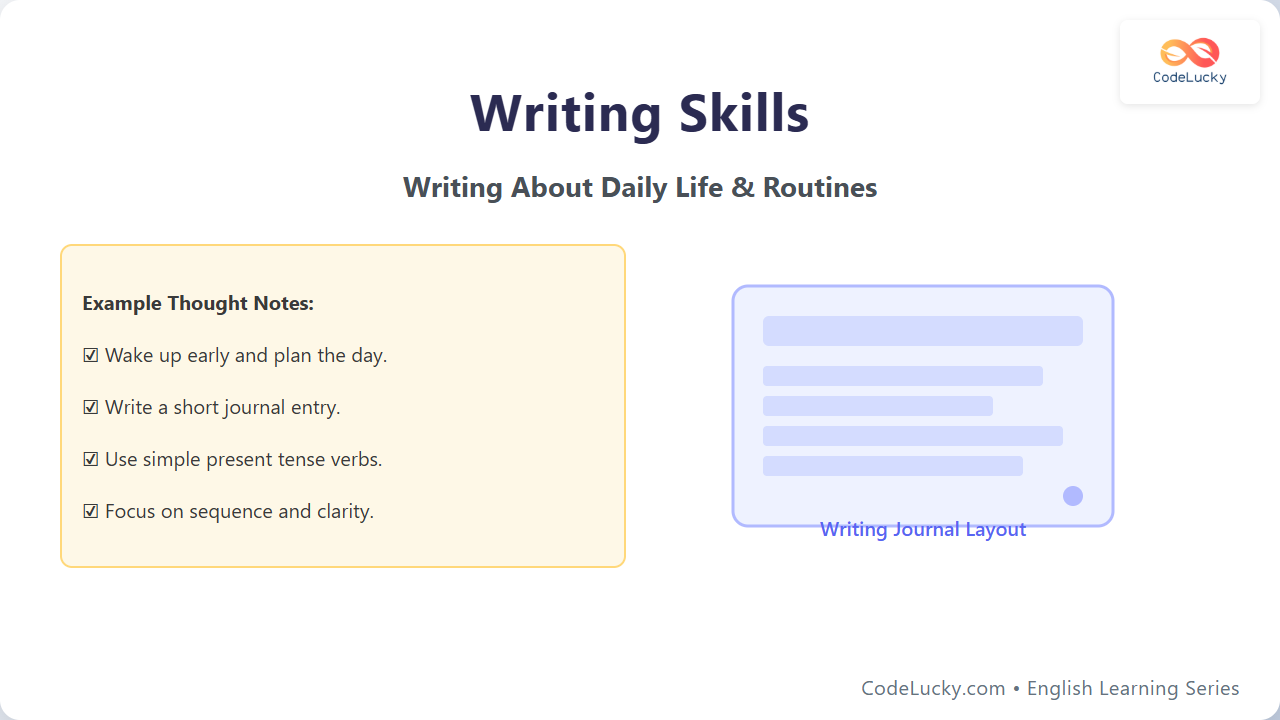
Writing about daily life and routines is one of the most effective ways to develop your English writing skills. It helps learners practice sentence structure, use common verbs, and express ideas clearly. In this guide, we’ll explore how to describe your everyday life, form good writing habits, and add variety to your paragraphs with practical examples and exercises.
Why Focus on Writing About Daily Life?
Describing your daily activities builds confidence and vocabulary. You use common verbs like wake up, go, work, eat, and sleep—the foundation of English communication. When practiced regularly, this type of writing helps you:
- Improve your grammar through repeated structures.
- Use time expressions like “in the morning” or “before dinner.”
- Learn how to connect ideas logically.
- Develop fluency for speaking and journaling.
Structuring a Paragraph About Your Daily Routine
Every good paragraph has a pattern. A daily routine paragraph usually follows the sequence of time from morning to night. Here’s a simple structure you can follow:
- Topic sentence: Introduce your general routine.
- Supporting details: Describe activities in order using connectors.
- Closing sentence: Summarize your feeling or preference about the routine.

This logical flow makes your writing easy to follow and helps readers imagine your typical day.
Example Paragraph: My Daily Routine
Here’s a model paragraph that you can analyze and learn from:
I usually wake up at 6:30 in the morning. After brushing my teeth and taking a shower, I have breakfast with my family. Then I walk to the nearby bus stop and go to work. I spend most of my morning attending meetings and completing tasks. During lunch break, I like to read or talk with colleagues. After work, I return home, help my mother prepare dinner, and then watch a short movie or study English online. I go to bed around 10:30 feeling satisfied with my day.
Notice the sequence of actions and the use of time expressions like “in the morning,” “during lunch break,” and “after work.” These connectors make the paragraph flow naturally.
Useful Vocabulary for Daily Life Writing
| Activity | Verb Examples | Time Expression |
|---|---|---|
| Morning | wake up, brush, eat, leave | at 7 a.m., in the morning |
| Afternoon | work, study, eat, take | at noon, during lunch |
| Evening | return, cook, relax, watch | after work, before dinner |
| Night | read, prepare, sleep, dream | at night, before bed |
Interactive Practice: Write About Your Routine
Try this mini-writing task to practice what you’ve learned. Fill in the blanks with your real activities:
I usually wake up at __________ in the morning.
After that, I __________ before going to __________.
In the afternoon, I __________ or __________.
In the evening, I like to __________ and __________.
Before sleeping, I __________.
Now, rewrite your answers into full sentences and combine them into one paragraph. This helps you build fluency and consistency in writing.
Tip: Use Sequence Words for Better Flow
Sequence words guide your reader through time smoothly. Here’s how you can use them:
- First – to start your story (First, I wake up…).
- Then – to continue logically (Then, I eat breakfast…).
- After that – to connect next actions (After that, I go to school…).
- Finally – to close your routine (Finally, I sleep at 10 p.m…).

Writing Variations: Describe Weekdays vs Weekends
To expand your vocabulary and make writing more engaging, compare two types of days—your weekday routine and your weekend routine.
On weekdays, I usually wake up early and prepare for work. But on weekends, I wake up late and enjoy a slow breakfast. During the week, my schedule is busy, while weekends are more relaxed.
Try dividing your writing like this:

Bonus: Add Emotions and Opinions
Don’t just list actions; describe how you feel about them. Adding emotions makes your daily routine more personal and interesting.
I enjoy my morning coffee because it gives me energy. Sometimes, I feel tired after long meetings, but exercising in the evening helps me relax.
Notice how emotional words like “enjoy,” “tired,” and “relax” make your writing more expressive.
Common Mistakes to Avoid
- Don’t repeat “I” too often. Try using linking words and pronouns.
- Be consistent with verb tense—use the simple present tense for routines.
- Add commas for clarity after introductory time expressions.
- Avoid writing only short, choppy sentences; connect ideas smoothly.
Daily Life Paragraph Template
Here’s a ready-to-use template you can adapt:
My name is __________. Every day, I __________ at __________.
Then I __________ and __________ before __________.
In the afternoon, I __________.
In the evening, I usually __________ with __________.
Finally, I __________ and go to bed at __________.
I feel __________ about my daily routine because __________.
Final Thoughts
Writing about daily life and routines might seem simple, but it’s a powerful exercise to master English sentence structure, vocabulary, and fluency. Whether you use it for journaling, emails, or essays, this skill builds confidence and clarity in your writing. Practice a new paragraph every day and notice how naturally your English improves.