Vocabulary: Work and Office Vocabulary for Beginners is your go-to guide to understanding and using common English words you hear at work every day. Whether you are learning English for your first office job or improving your professional communication, this article covers essential vocabulary with examples, short dialogues, and visual organizers to make learning easier and more interactive.
Why Learn Work and Office Vocabulary?
Office communication often depends on specific words and expressions. Knowing these terms helps you:
- Understand your colleagues and managers clearly.
- Write professional emails confidently.
- Participate in meetings, interviews, or video calls smoothly.
- Build confidence in a workplace environment.
Common Office Vocabulary Categories
Let’s explore different categories of workplace vocabulary step-by-step, with examples and practice ideas.
1. Office Objects and Equipment
These are physical things you find in a typical office or workplace.
| Word | Meaning | Example Sentence |
|---|---|---|
| Desk | A table used for writing or working on a computer. | My laptop is on the desk. |
| Printer | A machine that prints documents or photos. | Please print the report using the printer. |
| Stapler | A small device used to attach papers together with staples. | Can I borrow your stapler? |
| Whiteboard | A shiny board for writing with markers during meetings. | The manager wrote the plan on the whiteboard. |
2. People in the Workplace
Learn how to name the people and their roles in an office setting.
- Manager – The person who supervises a team.
- Colleague – Another person who works with you.
- Intern – A trainee gaining experience.
- HR (Human Resources) – The department that manages employees.
- Coworker – Another employee in the same company.
Example: “My manager approved my leave, and my colleagues will handle my tasks while I’m away.”

3. Common Office Actions and Phrases
These verbs and expressions are key for daily communication in English-speaking offices.
| Verb / Phrase | Meaning | Example |
|---|---|---|
| Attend a meeting | Go to a meeting. | We will attend a meeting at 10 AM. |
| Take notes | Write down important details. | Please take notes during the presentation. |
| Send an email | Write and deliver a message electronically. | I’ll send an email with the details. |
| Schedule | Plan a time for an activity or meeting. | Let’s schedule a call for tomorrow. |
4. Useful Phrases for Common Situations
Below are some everyday English expressions for the workplace:
- “Could you please help me with this file?” – Asking for assistance.
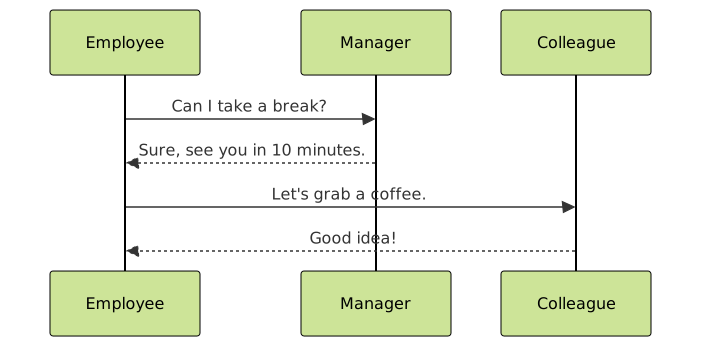
- “Let’s take a short break.” – Suggesting a pause during work.
- “I’ll get back to you soon.” – Promising to reply later.
- “That sounds great!” – Responding positively to an idea.
- “I need to finish this task before lunch.” – Explaining deadlines.
5. Digital Work Terms
Modern offices rely heavily on technology and remote work tools.
| Term | Meaning | Example |
|---|---|---|
| Login | Enter username and password to access a system. | Please login to your email account. |
| Dashboard | An organized screen showing key information. | The dashboard displays our sales data. |
| Spreadsheet | A file with rows and columns for calculations or data. | We use spreadsheets to track expenses. |
| Meeting link | An online link to join a virtual meeting. | Click the meeting link to join on Zoom. |

Interactive Practice: Match the Words
Try matching the words in Column A with their meaning in Column B. You can copy this exercise to your notebook:
| Column A | Column B |
|---|---|
| 1. Deadline | a. A plan for when things will happen |
| 2. Schedule | b. The final date to finish something |
| 3. Meeting Room | c. A place for discussions |
| 4. Email | d. An electronic message |
Answers: 1-b, 2-a, 3-c, 4-d
Short Conversation Example
Here’s a quick conversation using the above vocabulary:
Sara: Good morning! Did you attend the team meeting?
John: Yes, I did. The manager shared our new project schedule.
Sara: Great! Could you forward me the meeting notes?
John: Sure, I’ll send you an email after lunch.

Tips to Remember Office Vocabulary
- Use flashcards or apps to review daily.
- Practice speaking these words in sentences.
- Watch English office sitcoms or tutorials for context.
- Create word maps like the diagrams above to visualize meaning.
Conclusion
Building your vocabulary for work and office communication is essential for your career growth and everyday efficiency. The more words you learn, the more confident you become in expressing yourself professionally. Keep practicing, stay curious, and soon you’ll master the English needed for success at any workplace!