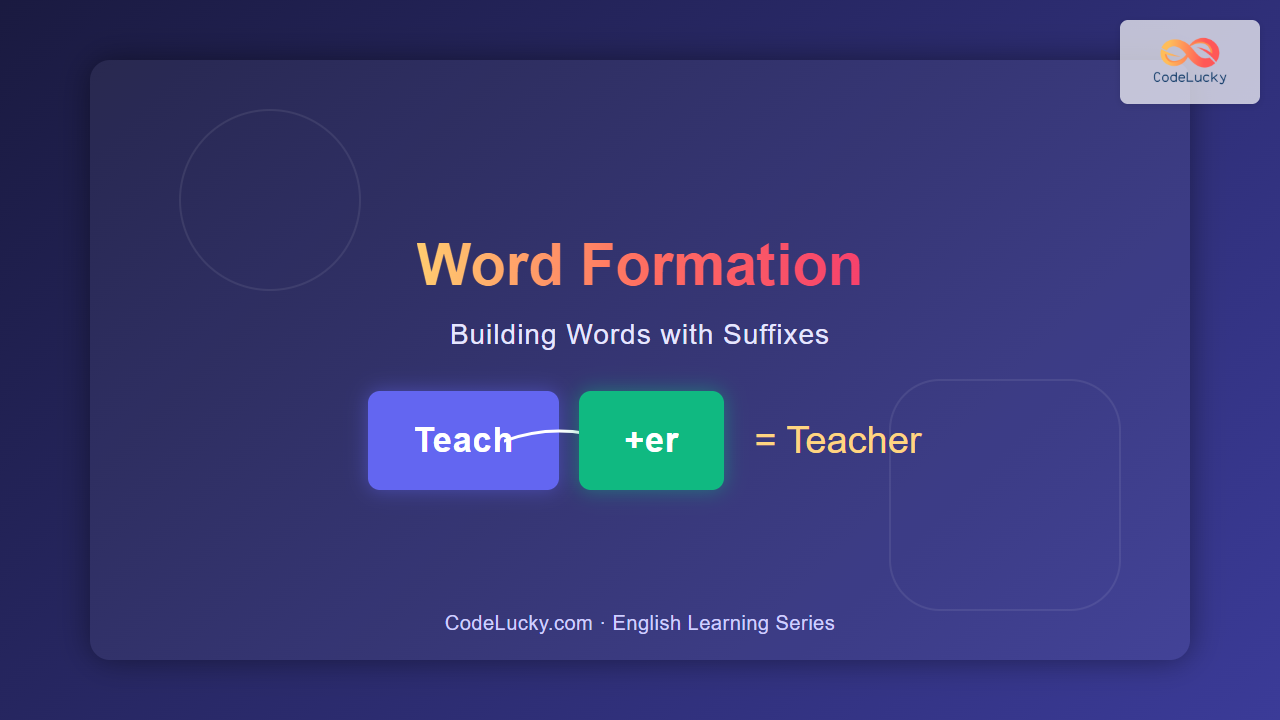
Word Formation is one of the most powerful tools for expanding your English vocabulary naturally. Among various methods, building words with suffixes helps you understand how new words evolve from base forms. This article explores how suffixes change meanings, parts of speech, and tone—supported by examples, visual aids, and interactive challenges for better learning.
What Is a Suffix?
A suffix is a group of letters added at the end of a word to form a new word or alter the word’s grammatical role. Suffixes often change a base word’s meaning or part of speech.
Examples:
- Happy → Happiness (adjective → noun)
- Teach → Teacher (verb → noun)
- Kind → Kindly (adjective → adverb)

In each case above, attaching a suffix creates a related word with a new grammatical function and sometimes a modified meaning.
Common Types of Suffixes
There are four main categories of suffixes based on how they transform the base word:
1. Noun-forming Suffixes
These suffixes turn verbs or adjectives into nouns. Common ones include: -ness, -tion, -er, -ment, -ity.
| Base Word | Suffix | New Word (Noun) | Meaning |
|---|---|---|---|
| Develop | -ment | Development | The process of developing |
| Happy | -ness | Happiness | The state of being happy |
| Create | -ion | Creation | The act of creating |
2. Verb-forming Suffixes
These suffixes create verbs from nouns or adjectives. Common ones are: -ize, -en, -ify.
| Base Word | Suffix | New Verb | Meaning |
|---|---|---|---|
| Modern | -ize | Modernize | To make modern |
| Strength | -en | Strengthen | To make stronger |
| Simple | -ify | Simplify | To make simple |
3. Adjective-forming Suffixes
These change nouns or verbs into adjectives. Common ones: -ful, -less, -ous, -able.
| Base Word | Suffix | New Adjective | Meaning |
|---|---|---|---|
| Care | -ful | Careful | Showing care |
| Hope | -less | Hopeless | Without hope |
| Danger | -ous | Dangerous | Full of danger |
4. Adverb-forming Suffixes
These suffixes convert adjectives into adverbs. Most common: -ly.
| Adjective | Suffix | Adverb | Meaning |
|---|---|---|---|
| Quick | -ly | Quickly | In a quick manner |
| Calm | -ly | Calmly | In a calm manner |

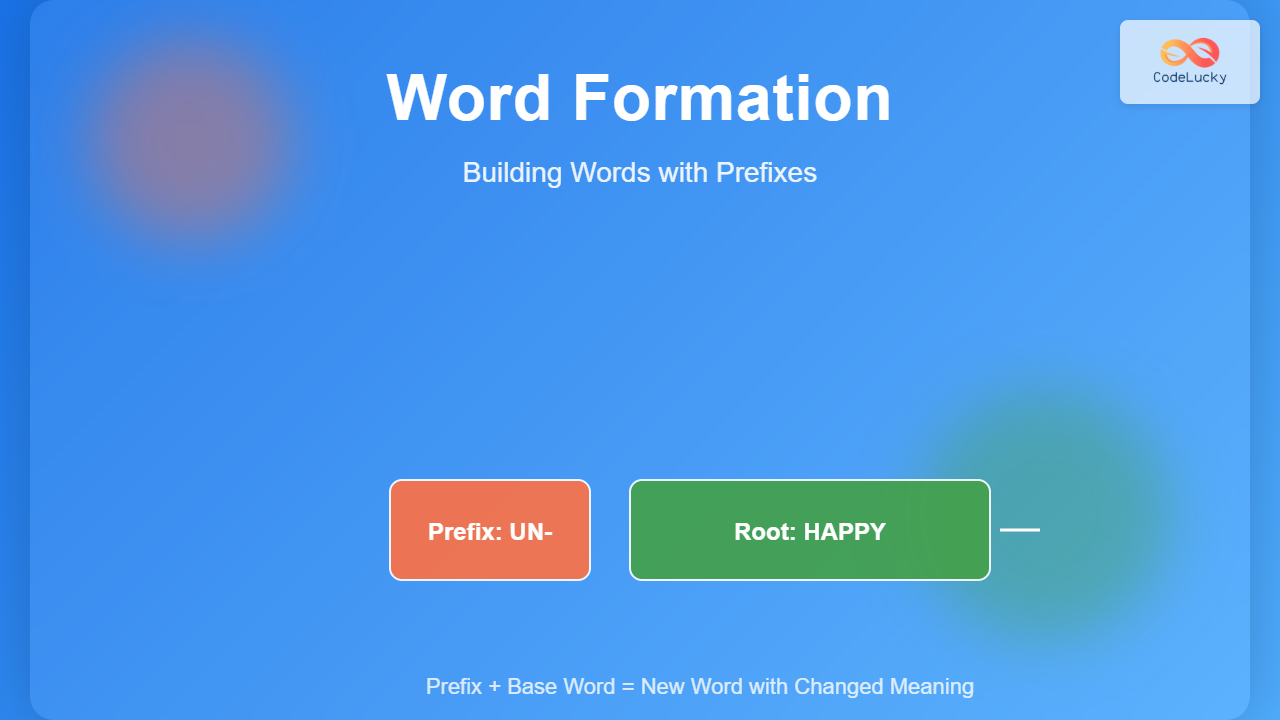
This diagram visually shows how suffixes can change a base word through different parts of speech in a sequence.
How Suffixes Affect Word Meaning
Beyond grammatical shifts, suffixes add emotional tone or nuance. For example, -ish softens or approximates meaning, while -ette indicates something smaller or affectionate.
- Child → Childish (suggests immaturity)
- Kitchen → Kitchenette (smaller kitchen)
- Book → Booklet (small book)
Rules When Adding Suffixes
- If a base word ends in y preceded by a consonant, change y → i before adding suffixes (except for -ing).
e.g., Happy → Happiness - If the base word ends in e, drop it before adding vowel-starting suffixes.
e.g., Create → Creation - Double the final consonant for one-syllable words with consonant-vowel-consonant endings when adding vowel-starting suffixes.
e.g., Run → Running

Interactive Practice: Guess the Suffix
Try completing these interactive examples mentally (or write them down):
- Act → ________ (Hint: person who acts)
- Care → ________ (Hint: without care)
- Beauty → ________ (Hint: adjective form)
- Forgive → ________ (Hint: the act of forgiving)
Answers:
- Actor
- Careless
- Beautiful
- Forgiveness
Why Learning Suffixes Matters
Understanding suffix patterns allows learners to deduce meaning of unfamiliar words. For instance, if you know -able means “capable of,” then readable instantly makes sense even without prior exposure.

Conclusion
Learning word formation with suffixes enhances vocabulary depth, boosts confidence in reading comprehension, and improves writing clarity. Regular practice using suffix-based transformations helps internalize patterns quickly. Remember—suffixes are not random endings; they are meaning carriers that build the structure of English communication.
Next up in the CodeLucky English Learning Series: “Prefix Power — Expanding Vocabulary from the Start of Words.”