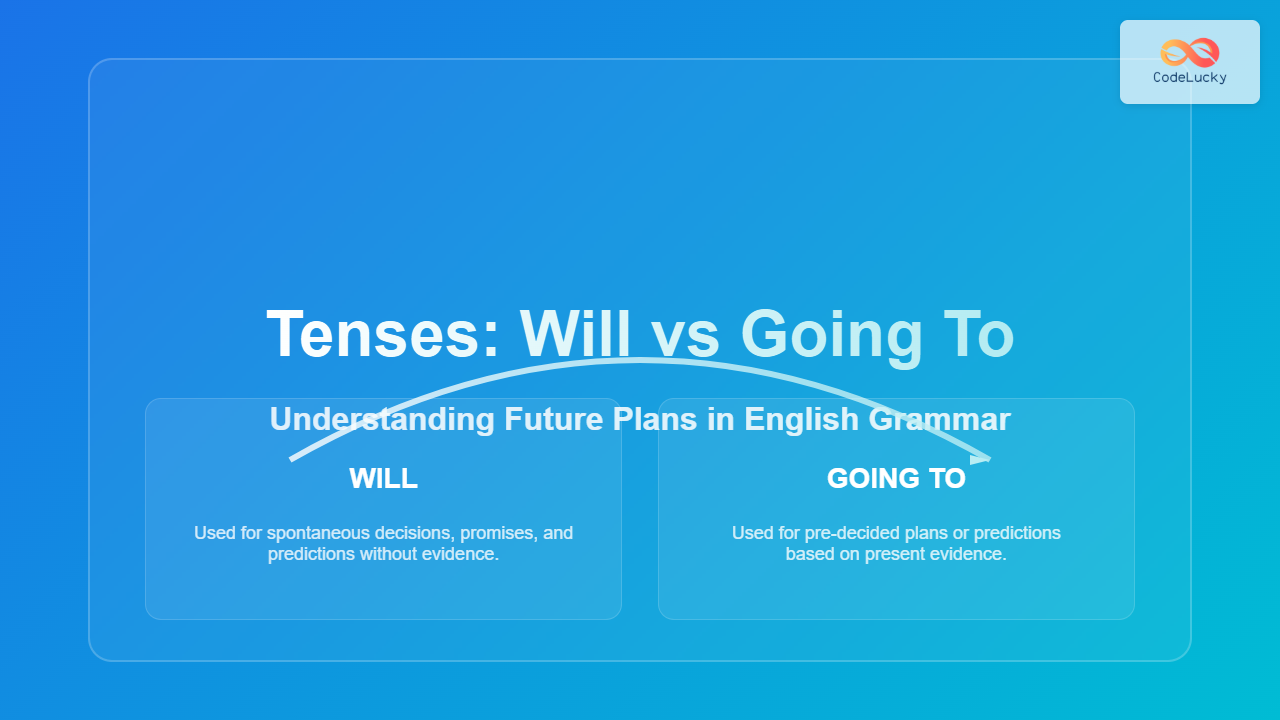
When talking about the future in English, two of the most common ways are using “will” and “going to”. Although both refer to future events, they are used in slightly different situations. Understanding their differences is a key step in mastering English tenses and sounding natural in conversations.
1. The Core Difference Between “Will” and “Going To”
The simplest way to differentiate them is by understanding intention and decision time.

→ “Will” is used when the decision or prediction happens at the moment of speaking.
→ “Going to” is used when the plan or intention was decided before the conversation.
2. Using “Will” – For Spontaneous Decisions & Promises
We use will when we decide something spontaneously, or when making predictions, promises, or offers.
Common Structures
| Affirmative | Negative | Question |
|---|---|---|
| I will call you later. | I will not (won’t) forget this. | Will you help me? |
Examples with Context
- At the moment of decision: “I’m thirsty.” → “I’ll get you some water.”
- Promise: “I’ll always be your friend.”
- Prediction (without evidence): “I think it’ll rain tomorrow.”
Visual Cue: When to Use “Will”

3. Using “Going To” – For Planned Actions or Evidence-Based Predictions
We use be going to when we talk about something already decided or planned, or when we can see evidence that something will happen.
Common Structures
| Affirmative | Negative | Question |
|---|---|---|
| I am going to visit Delhi next week. | I’m not going to tell her. | Are you going to study tonight? |
Examples with Context
- Planned action: “I’m going to buy a new camera.” (Decision made earlier)
- Evidence-based prediction: “Look at those clouds! It’s going to rain.”

4. “Will” vs “Going To” Side-by-Side Comparison
| Situation | Example with “Will” | Example with “Going To” |
|---|---|---|
| Instant decision | It’s cold. I’ll close the window. | – |
| Pre-planned action | – | I’m going to meet my friend after class. |
| Promise | I’ll help you with your project. | – |
| Evidence-based prediction | – | Look! She’s going to fall. |
| General prediction / thought | I think you’ll love this movie. | – |
5. Interactive Practice: Choose the Correct Form
Try filling in the blanks to test your understanding!
- I think it ______ (rain) tomorrow. [will / going to]
- Look at that car! It ______ crash. [will / going to]
- Don’t worry, I ______ help you with your homework. [will / going to]
- We ______ buy a new sofa next month. [will / going to]
Answers: 1. will, 2. is going to, 3. will, 4. are going to
6. The Rule of Decision Timing
An easy rule to remember is this:

This simple decision flow can help learners identify the correct tense quickly in real conversations.
7. Practical Examples in Daily Life
Let’s see how native speakers naturally use both forms in everyday life:
- At a restaurant: “I’ll have the pasta, please.” (Decision made now)
- Weekend plans: “We’re going to visit our grandparents.” (Pre-decided plan)
- On the phone: “Don’t worry, I’ll call you when I arrive.” (Promise)
- Watching weather: “Those dark clouds mean it’s going to rain soon.” (Evidence)
8. Quick Grammar Notes
- Both “will” and “going to” are followed by the base verb.
- In spoken English, contractions like “I’ll” and “gonna” are common, though “gonna” is informal.
- Be careful: “going to” always requires the correct form of ‘be’ (am / is / are).
9. Visual Summary Chart

10. Final Thoughts
Both “will” and “going to” express the future, but choosing the correct one depends on context and timing. Use “will” when reacting or deciding instantly, and “going to” when talking about already planned actions or visible evidence.
Practice making your own sentences! The more examples you create, the more natural your English will sound. Continue your English Learning journey with more interactive grammar lessons here on CodeLucky.com.