Understanding ‘OP’ on Stack Exchange and Online Programming Forums
Within the vibrant programming and technical communities on Stack Exchange, the abbreviation OP is frequently encountered. But what exactly does OP mean, and why does it matter?
This article provides a comprehensive guide to What is an OP when referring to Stack Exchange, explaining the term in detail with concrete examples and helpful visuals. By the end, readers will understand OP’s role in community interactions, how to effectively engage with OPs, and related best practices for participation.
What Does OP Mean on Stack Exchange?
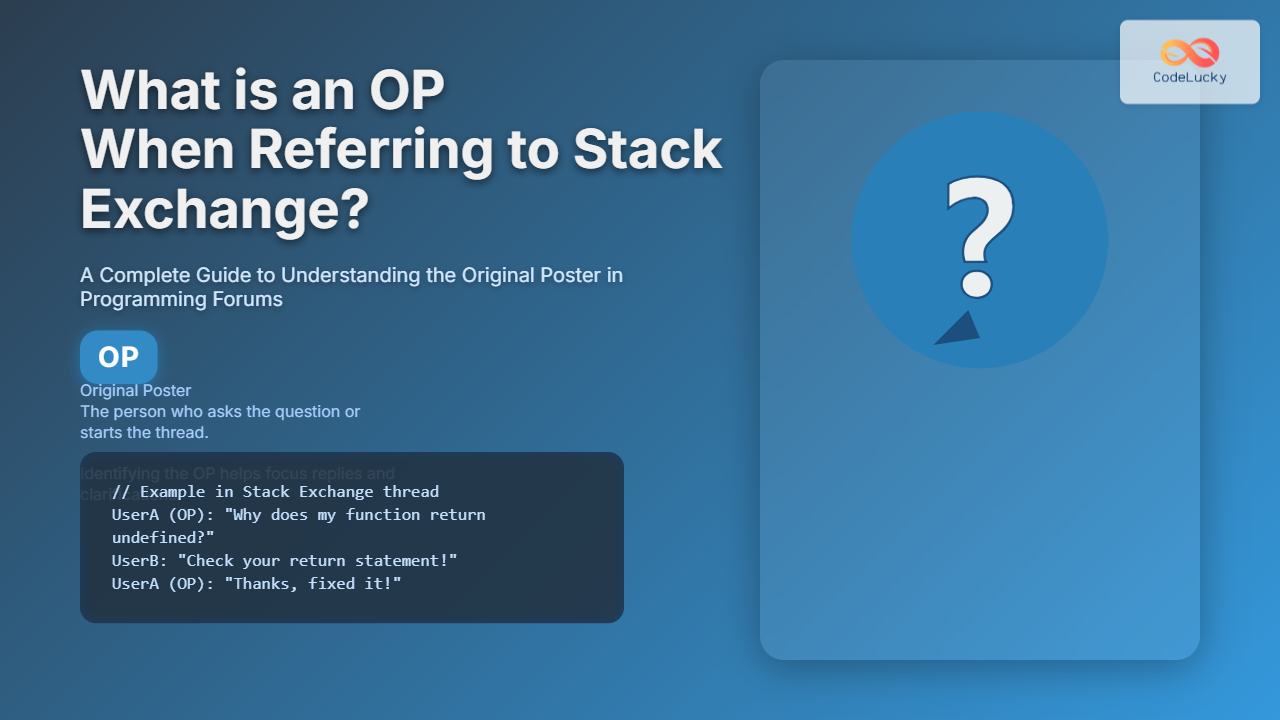
OP stands for Original Poster. It is the person who initiates a new question thread or discussion on Stack Exchange or similar online forums. The OP is essentially the author of the original content that spurs the thread’s existence.
This term usually appears in comments, answers, or discussions as an easy shorthand to refer back to the question asker without repeating their username.
Why Is Identifying the OP Important?
- Contextual clarity: Referring to the OP keeps conversations clear about who’s perspective or issue is being addressed.
- Respectful engagement: Answers and comments tailored to the OP’s problem enhance effectiveness and community harmony.
- Tracking progress: The OP’s feedback in comments or edits often leads to refining questions or solutions.
Example: OP Usage in a Stack Exchange Thread
Consider a simplified Stack Exchange Q&A thread about a programming bug:
UserA (OP): "Why does my JavaScript function return undefined? Here's my code snippet..."
UserB: "Are you missing a return statement in your function?"
UserC: "I agree with UserB, OP, check your return logic carefully."
UserA (OP): "Thanks, UserB and UserC, adding the return statement fixed it!"
Here, UserA is the OP who asked the question. Other users reference OP to address the original poster specially without repeating their username.
Visualizing OP’s Role in a Stack Exchange Thread
The diagram above shows a simple flow where an OP starts a thread, community members respond, and the OP interacts, creating a collaborative troubleshooting process.
Interactive Understanding
Imagine a scenario where you are the OP encountering an error. The community provides inputs; how you respond affects the troubleshooting’s effectiveness. Always remember, expressing gratitude or clarifying your problem helps others help you better.
Common Terms Related to OP
- Answerer: A community member who provides solutions to the OP’s question.
- Commenter: Someone giving clarifications or hints related to the OP’s post.
- Accepted answer: An answer marked by the OP as the best solution.
Tips When Interacting with an OP
- Read the question carefully: Understand the OP’s exact problem before answering.
- Ask for clarification politely: If the question lacks details, request more info rather than guessing.
- Refer respectfully: Use “OP” to keep responses clear and directed to the original poster.
- Encourage feedback: Prompt the OP to confirm if the solution worked or explain new issues encountered.
Summary
The OP or Original Poster is the linchpin of any Stack Exchange thread, being the person who brings the question to the community. Understanding this role enriches interaction quality, helping posts evolve constructively toward solutions. Remembering how to identify and engage with the OP members best practices for thriving in the collaborative programming environment of Stack Exchange.