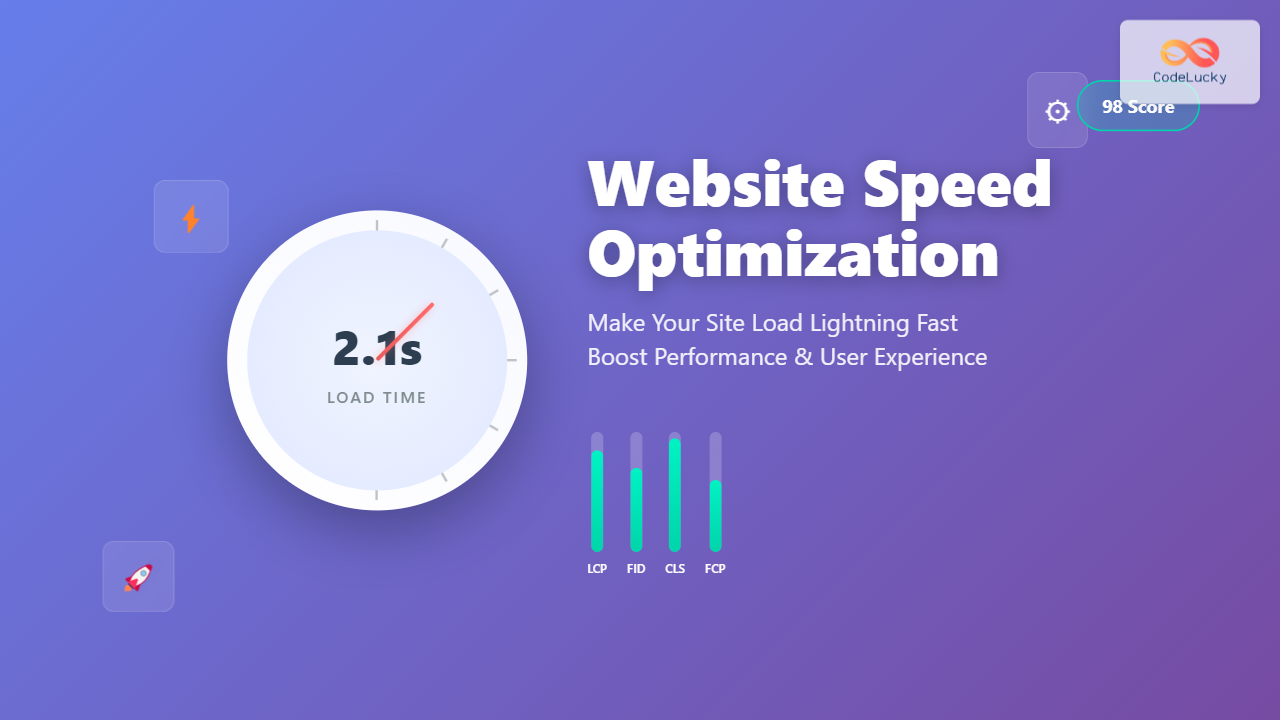
Website speed optimization is crucial for user experience, search engine rankings, and conversion rates. A one-second delay in page load time can reduce conversions by 7% and increase bounce rates significantly. This comprehensive guide will teach you everything you need to know about making your website load faster.
Understanding Website Performance Metrics
Before optimizing your website, you need to understand the key performance metrics that Google and users care about:

- Largest Contentful Paint (LCP): Measures loading performance – should occur within 2.5 seconds
- First Input Delay (FID): Measures interactivity – should be less than 100 milliseconds
- Cumulative Layout Shift (CLS): Measures visual stability – should be less than 0.1
- First Contentful Paint (FCP): Time until first content appears on screen
- Time to Interactive (TTI): When page becomes fully interactive
Image Optimization Techniques
Images typically account for 60-70% of a webpage’s total size. Optimizing them is often the most impactful improvement you can make.
Choose the Right Image Format
| Format | Best For | Compression | Browser Support |
|---|---|---|---|
| WebP | Photos, graphics | 25-35% smaller than JPEG | 95%+ modern browsers |
| AVIF | High-quality photos | 50% smaller than JPEG | 80%+ modern browsers |
| JPEG | Photographs | Good lossy compression | Universal |
| PNG | Logos, simple graphics | Lossless | Universal |
| SVG | Icons, simple graphics | Vector-based | Universal |
Implement Responsive Images
Use the srcset attribute to serve different image sizes based on device capabilities:
<img
  src="image-800w.jpg"
  srcset="image-400w.jpg 400w,
          image-800w.jpg 800w,
          image-1200w.jpg 1200w"
  sizes="(max-width: 400px) 400px,
         (max-width: 800px) 800px,
         1200px"
  alt="Optimized responsive image"
>
Lazy Loading Implementation
Modern browsers support native lazy loading with a simple attribute:
<img src="image.jpg" loading="lazy" alt="Lazy loaded image">For older browsers, implement intersection observer:
const images = document.querySelectorAll('img[data-src]');
const imageObserver = new IntersectionObserver((entries, observer) => {
  entries.forEach(entry => {
    if (entry.isIntersecting) {
      const img = entry.target;
      img.src = img.dataset.src;
      img.classList.remove('lazy');
      imageObserver.unobserve(img);
    }
  });
});

images.forEach(img => imageObserver.observe(img));
CSS Optimization Strategies
Critical CSS Inline
Inline critical CSS for above-the-fold content to eliminate render-blocking resources:
<style>
/* Critical CSS for above-the-fold content */
body { margin: 0; font-family: -apple-system, BlinkMacSystemFont, sans-serif; }
.header { background: #fff; padding: 1rem; box-shadow: 0 2px 4px rgba(0,0,0,0.1); }
.hero { height: 500px; background: linear-gradient(135deg, #667eea 0%, #764ba2 100%); }
</style>

<link rel="preload" href="styles.css" as="style" onload="this.onload=null;this.rel='stylesheet'">
CSS Minification and Compression
Before minification:
.navigation {
    background-color: #ffffff;
    padding: 10px 20px;
    border-bottom: 1px solid #e1e1e1;
    margin-bottom: 0;
}
After minification:
.navigation{background-color:#fff;padding:10px 20px;border-bottom:1px solid #e1e1e1;margin-bottom:0}JavaScript Performance Optimization

Script Loading Strategies
| Attribute | Behavior | Use Case |
|---|---|---|
| None | Blocks HTML parsing | Critical scripts only |
| defer | Loads in parallel, executes after HTML | Scripts that need DOM |
| async | Loads and executes immediately | Independent scripts (analytics) |
<!-- Critical script -->
<script src="critical.js"></script>

<!-- Deferred script -->
<script src="main.js" defer></script>

<!-- Async script -->
<script src="analytics.js" async></script>
Code Splitting and Tree Shaking
Split your JavaScript into smaller chunks that load only when needed:
// Dynamic import for code splitting
const loadChart = async () => {
  const { Chart } = await import('./chart-library.js');
  return new Chart();
};

// Use only when chart is needed
document.getElementById('show-chart').addEventListener('click', async () => {
  const chart = await loadChart();
  chart.render();
});
Server-Side Optimization Techniques
HTTP/2 and HTTP/3
Modern HTTP protocols provide significant performance improvements:
- Multiplexing: Multiple requests over single connection
- Header compression: Reduces overhead
- Server push: Proactively send resources
- Stream prioritization: Critical resources first
Compression Configuration
Enable Gzip or Brotli compression on your server:
# Apache .htaccess
<IfModule mod_deflate.c>
    AddOutputFilterByType DEFLATE text/html text/plain text/xml text/css text/javascript application/javascript application/json
</IfModule>

# Nginx configuration
gzip on;
gzip_types text/html text/css application/javascript application/json;
gzip_min_length 1000;
Caching Strategies

Set appropriate cache headers:
# Cache static assets for 1 year
<FilesMatch "\.(css|js|png|jpg|jpeg|gif|svg|woff|woff2)$">
    ExpiresActive On
    ExpiresDefault "access plus 1 year"
    Header set Cache-Control "public, immutable"
</FilesMatch>

# Cache HTML for 1 hour
<FilesMatch "\.html$">
    ExpiresActive On
    ExpiresDefault "access plus 1 hour"
    Header set Cache-Control "public, must-revalidate"
</FilesMatch>
Content Delivery Network (CDN) Implementation
CDNs distribute your content across global edge servers, reducing latency by serving content from locations closer to users.
CDN Benefits
- Reduced latency: Content served from nearby servers
- Improved availability: Redundancy across multiple servers
- DDoS protection: Distributed infrastructure absorbs attacks
- Bandwidth savings: Offload traffic from origin server
Popular CDN Providers
| Provider | Free Tier | Global POPs | Special Features |
|---|---|---|---|
| Cloudflare | Yes | 250+ | Security, DNS, Workers |
| AWS CloudFront | Limited | 400+ | AWS integration, Edge functions |
| Google Cloud CDN | Limited | 130+ | Google infrastructure, ML optimization |
Database and Backend Optimization
Database Query Optimization
Slow database queries are often the bottleneck in web applications:
-- Bad: No index, scans entire table
SELECT * FROM users WHERE email = '[email protected]';

-- Good: Index on email column
CREATE INDEX idx_users_email ON users(email);
SELECT id, name, email FROM users WHERE email = '[email protected]';
Caching Layers

Monitoring and Testing Tools
Performance Testing Tools
- Google PageSpeed Insights: Comprehensive performance analysis
- GTmetrix: Detailed waterfall charts and recommendations
- WebPageTest: Advanced testing with different locations and devices
- Lighthouse: Built into Chrome DevTools
- Pingdom: Continuous monitoring and alerts
Real User Monitoring (RUM)
Implement RUM to track actual user experience:
// Track Core Web Vitals
import {getLCP, getFID, getCLS} from 'web-vitals';

getLCP(console.log);
getFID(console.log);
getCLS(console.log);

// Custom performance tracking
window.addEventListener('load', () => {
  const perfData = performance.getEntriesByType('navigation')[0];
  console.log('Page load time:', perfData.loadEventEnd - perfData.fetchStart);
});
Advanced Optimization Techniques
Resource Preloading
Guide the browser to load critical resources early:
<!-- Preload critical CSS -->
<link rel="preload" href="critical.css" as="style">

<!-- Preload hero image -->
<link rel="preload" href="hero-image.jpg" as="image">

<!-- Preload JavaScript -->
<link rel="preload" href="main.js" as="script">

<!-- Prefetch next page -->
<link rel="prefetch" href="/next-page.html">
Service Workers for Caching
Implement offline-first caching strategies:
// service-worker.js
const CACHE_NAME = 'site-cache-v1';
const urlsToCache = [
  '/',
  '/styles.css',
  '/script.js',
  '/offline.html'
];

self.addEventListener('install', event => {
  event.waitUntil(
    caches.open(CACHE_NAME)
      .then(cache => cache.addAll(urlsToCache))
  );
});

self.addEventListener('fetch', event => {
  event.respondWith(
    caches.match(event.request)
      .then(response => response || fetch(event.request))
  );
});
Mobile Performance Optimization
Responsive Design Considerations
- Touch-friendly interfaces: Minimum 44px touch targets
- Reduce network requests: Combine CSS and JavaScript files
- Optimize for 3G: Test on slower connections
- Progressive enhancement: Core functionality works without JavaScript
AMP (Accelerated Mobile Pages)
For content-heavy sites, consider AMP for ultra-fast mobile loading:
<!doctype html>
<html ⚡>
<head>
  <meta charset="utf-8">
  <script async src="https://cdn.ampproject.org/v0.js"></script>
  <title>Hello, AMPs</title>
  <link rel="canonical" href="http://example.ampproject.org/article-metadata.html">
  <meta name="viewport" content="width=device-width,minimum-scale=1,initial-scale=1">
  <style amp-boilerplate>...</style>
</head>
<body>
  <h1>Welcome to the mobile web</h1>
</body>
</html>
Performance Budget and Monitoring
Setting Performance Budgets
Establish measurable goals for your optimization efforts:
| Metric | Budget | Threshold |
|---|---|---|
| Total page weight | < 500KB | Critical |
| First Contentful Paint | < 1.5s | Warning at 2s |
| Largest Contentful Paint | < 2.5s | Warning at 3s |
| JavaScript bundle | < 150KB | Critical |
Continuous Monitoring
Set up automated performance monitoring in your CI/CD pipeline:
# GitHub Actions example
name: Performance Audit
on: [push]
jobs:
  audit:
    runs-on: ubuntu-latest
    steps:
      - uses: actions/checkout@v2
      - name: Audit URLs using Lighthouse
        uses: treosh/lighthouse-ci-action@v3
        with:
          urls: |
            https://example.com
            https://example.com/about
          budgetPath: ./budget.json
          uploadArtifacts: true
Common Performance Pitfalls to Avoid
- Over-optimization: Don’t optimize metrics that don’t impact user experience
- Ignoring real users: Lab data doesn’t always reflect real-world performance
- Premature optimization: Measure first, then optimize bottlenecks
- Breaking functionality: Always test optimizations thoroughly
- Neglecting maintenance: Performance degrades over time without monitoring
Conclusion
Website speed optimization is an ongoing process that requires continuous attention and measurement. Start with the biggest impact changes like image optimization and critical CSS, then gradually implement more advanced techniques like service workers and performance budgets.
Remember that every millisecond counts in web performance. A fast website not only improves user experience but also boosts search engine rankings, increases conversion rates, and reduces server costs. Implement these techniques systematically, measure the results, and keep optimizing based on real user data.
The investment in website speed optimization pays dividends in user satisfaction, SEO performance, and business metrics. Start implementing these strategies today and watch your website performance soar.