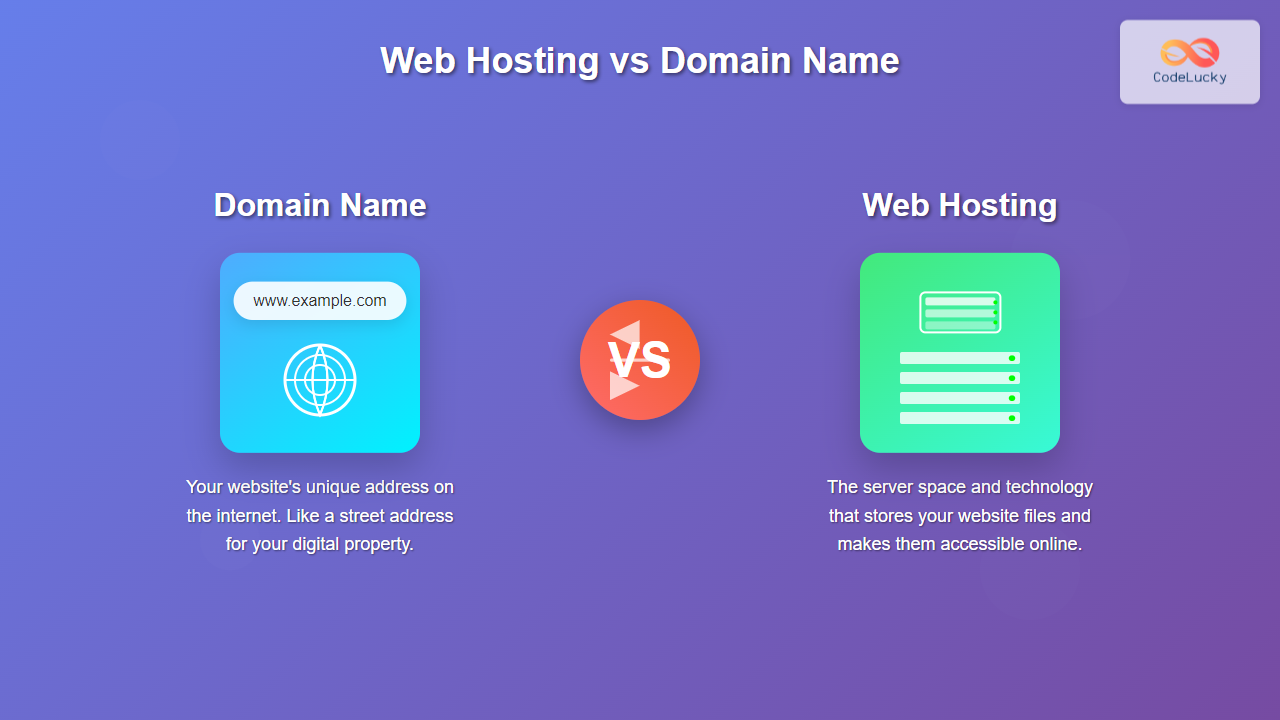
When starting your journey into website development, two terms you’ll encounter frequently are web hosting and domain name. While these concepts are closely related and work together to make your website accessible on the internet, they serve completely different purposes. Understanding their differences is crucial for anyone looking to establish an online presence.
This comprehensive guide will break down everything you need to know about web hosting versus domain names, how they work together, and what you need to consider when choosing each for your website.
What is a Domain Name?
A domain name is your website’s unique address on the internet. It’s what users type into their browser’s address bar to visit your site. Think of it as your website’s street address in the digital world.
Components of a Domain Name
Every domain name consists of several parts:
- Subdomain: Often “www” but can be customized (e.g., blog.example.com)
- Second-level domain: Your chosen name (e.g., “codelucky”)
- Top-level domain (TLD): The extension (.com, .org, .net, etc.)

How Domain Names Work
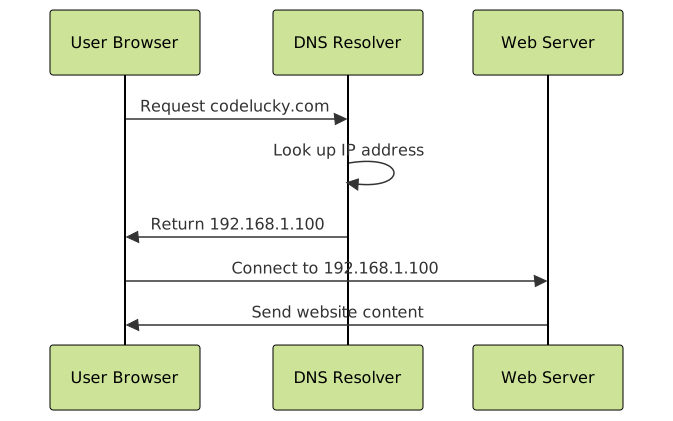
When you type a domain name into your browser, a complex process called Domain Name System (DNS) resolution occurs:
- Your browser contacts a DNS resolver
- The resolver queries DNS servers to find the IP address
- The IP address is returned to your browser
- Your browser connects to the web server at that IP address
- The website content is delivered to your browser
What is Web Hosting?
Web hosting is a service that provides the technology and infrastructure needed to store your website’s files and make them accessible on the internet. When you purchase web hosting, you’re essentially renting space on a server where your website’s files, databases, and content are stored.
Types of Web Hosting
There are several types of web hosting services available:
Shared Hosting
Multiple websites share resources on a single server. This is the most affordable option but offers limited resources and performance.
VPS Hosting
Virtual Private Server hosting provides dedicated resources within a shared physical server, offering better performance and control.
Dedicated Hosting
You have an entire physical server dedicated to your website, providing maximum performance and control.
Cloud Hosting
Your website is hosted across multiple servers, offering high reliability and scalability.

Key Differences Between Web Hosting and Domain Names
| Aspect | Domain Name | Web Hosting |
|---|---|---|
| Purpose | Website address/identifier | Storage space and server resources |
| Function | Points visitors to your website | Stores and serves your website files |
| Analogy | Street address of a house | The actual house and land |
| Cost | $10-50 per year typically | $3-500+ per month depending on type |
| Renewal | Annual registration required | Monthly/annual hosting fees |
| Portability | Can be transferred between registrars | Files can be migrated between hosts |
How Domain Names and Web Hosting Work Together
While domain names and web hosting are separate services, they must work together to create a functioning website. Here’s how the relationship works:

DNS Configuration
To connect your domain name to your web hosting service, you need to configure DNS records:
- A Record: Points your domain to your hosting server’s IP address
- CNAME Record: Creates aliases for your domain (like www.yourdomain.com)
- MX Record: Handles email routing for your domain
- NS Records: Specifies which name servers are authoritative for your domain
Choosing the Right Domain Name
Selecting an effective domain name is crucial for your website’s success. Consider these factors:
Best Practices for Domain Selection
- Keep it short and memorable: Shorter domains are easier to remember and type
- Use relevant keywords: Include keywords related to your business or niche
- Avoid hyphens and numbers: These can be confusing and hard to remember
- Choose the right TLD: .com is most popular, but consider industry-specific extensions
- Make it brandable: Choose something that represents your brand well
Domain Registration Process
- Check domain availability using registrar tools
- Choose a reputable domain registrar
- Complete the registration process
- Configure DNS settings
- Set up domain privacy protection (recommended)
Selecting the Right Web Hosting Service
Choosing the appropriate web hosting service depends on several factors:
Key Hosting Considerations
- Traffic expectations: How many visitors do you expect?
- Storage requirements: How much space do you need for files and databases?
- Technical requirements: What programming languages and databases do you need?
- Budget constraints: What can you afford monthly/annually?
- Support needs: Do you need 24/7 technical support?
- Scalability: Will your hosting needs grow over time?
Performance Factors
When evaluating hosting providers, consider these performance metrics:
- Uptime guarantee: Look for 99.9% or higher uptime promises
- Page load speeds: Server response times affect user experience and SEO
- Bandwidth limits: Ensure adequate data transfer allowances
- Storage type: SSD storage is faster than traditional HDD
- Server locations: Choose servers close to your target audience
Common Misconceptions and Clarifications
Myth 1: “You must buy hosting and domain from the same provider”
Reality: You can purchase your domain name from one registrar and hosting from a different provider. Many people do this to get the best deals or services from specialized companies.
Myth 2: “Free hosting is just as good as paid hosting”
Reality: Free hosting typically comes with significant limitations including ads, limited storage, poor performance, and unreliable uptime.
Myth 3: “More expensive hosting is always better”
Reality: The best hosting solution depends on your specific needs. A small blog doesn’t need enterprise-level hosting, while a high-traffic e-commerce site requires robust resources.
Setting Up Your First Website: Step-by-Step
Here’s a practical walkthrough of setting up a website using both domain and hosting services:
Step 1: Plan Your Website
- Define your website’s purpose and target audience
- Choose your website platform (WordPress, HTML/CSS, etc.)
- Plan your content structure and design
Step 2: Register Your Domain
- Brainstorm and check domain name availability
- Select a reliable domain registrar
- Complete the registration process
- Enable domain privacy protection
Step 3: Choose and Purchase Hosting
- Evaluate your hosting needs
- Research and compare hosting providers
- Select an appropriate hosting plan
- Complete the hosting setup process
Step 4: Connect Domain to Hosting
- Access your domain registrar’s DNS management
- Update nameservers to point to your hosting provider
- Configure A records and other DNS settings
- Wait for DNS propagation (can take 24-48 hours)
Step 5: Upload Your Website
- Access your hosting control panel
- Upload website files via FTP or file manager
- Set up databases if needed
- Test your website functionality

Cost Considerations and Budgeting
Domain Name Costs
Domain registration costs vary by TLD and registrar:
- .com domains: $10-15 per year typically
- .org/.net domains: $12-20 per year
- Premium domains: Can cost hundreds or thousands
- Country-specific TLDs: Varies widely by country
Web Hosting Costs
Hosting costs depend on the type and features you need:
- Shared hosting: $3-10 per month
- VPS hosting: $20-80 per month
- Dedicated hosting: $100-500+ per month
- Cloud hosting: $10-100+ per month (usage-based)
Additional Costs to Consider
- SSL certificates (often included with hosting)
- Email hosting services
- Website backup services
- Content Delivery Network (CDN) services
- Premium support plans
Maintenance and Management
Domain Management Tasks
- Renewal reminders: Set up automatic renewal to avoid losing your domain
- Contact information updates: Keep registrant information current
- DNS management: Update records as needed for services
- Transfer procedures: Know how to transfer domains if needed
Hosting Management Tasks
- Regular backups: Protect your website data
- Security updates: Keep software and plugins updated
- Performance monitoring: Track website speed and uptime
- Resource monitoring: Watch bandwidth and storage usage
Troubleshooting Common Issues
Domain-Related Problems
- DNS propagation delays: Changes can take up to 48 hours
- Domain not resolving: Check DNS configuration and nameservers
- Email not working: Verify MX record settings
- Subdomain issues: Ensure proper CNAME or A record setup
Hosting-Related Problems
- Website loading slowly: Check server resources and optimization
- Frequent downtime: Monitor hosting provider’s status and performance
- Storage limitations: Regular cleanup and potential plan upgrades
- Database connection errors: Verify database credentials and server status
Future Considerations and Scalability
As your website grows, you may need to make changes to both your domain strategy and hosting setup:
Domain Strategy Evolution
- Additional domains: Protect your brand with related domain names
- Subdomain structure: Organize content with strategic subdomains
- International domains: Consider country-specific domains for global reach
- Domain redirects: Manage traffic flow between multiple domains
Hosting Scalability Planning
- Traffic growth: Monitor and plan for increased visitor numbers
- Resource upgrades: Scale server resources as needed
- Geographic expansion: Consider CDN or multiple server locations
- Backup and disaster recovery: Implement robust backup strategies
Understanding the distinction between web hosting and domain names is fundamental to successfully establishing and maintaining an online presence. While they serve different purposes, both are essential components that work together to make your website accessible to visitors around the world.
Your domain name serves as your website’s unique identifier and address, while web hosting provides the infrastructure and storage space needed to serve your website’s content. By carefully selecting both services based on your specific needs, budget, and long-term goals, you’ll create a solid foundation for your online success.
Remember that both domain names and web hosting services can be changed or upgraded as your website grows, so don’t let the fear of making the “wrong” choice prevent you from getting started. The most important step is to begin building your online presence with reliable, reputable providers who can support your journey as you learn and grow.