Weather is one of the most common topics in daily English conversations. Whether you’re greeting someone, making small talk, or describing your day, knowing weather vocabulary and expressions helps you sound natural and fluent. This article covers daily words, phrases, idioms, and examples that will make you confident in using weather-related language in different contexts.
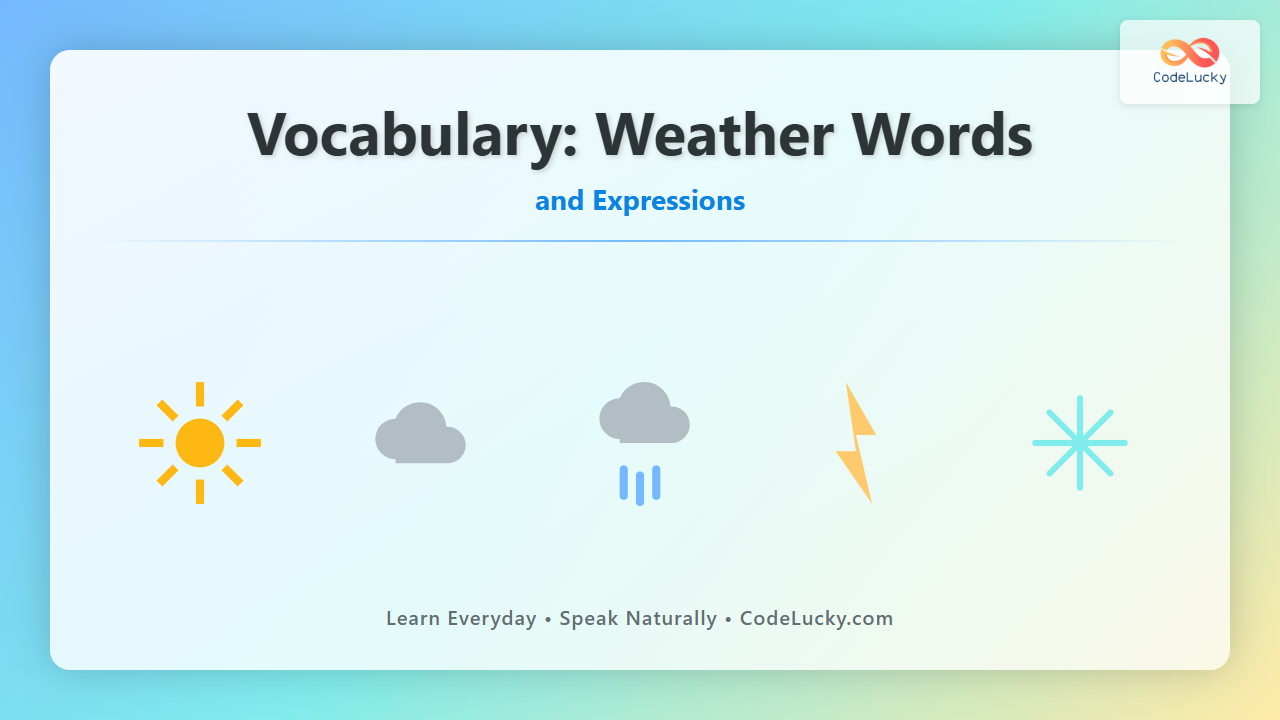
1. Common Weather Vocabulary
Let’s begin with the basic weather words you’ll often hear in conversations, forecasts, and media.
| Word | Meaning | Example Sentence |
|---|---|---|
| Sunny | Bright with sunlight | It’s a sunny morning; perfect for a picnic. |
| Cloudy | Covered with clouds | It was cloudy all day, but it didn’t rain. |
| Windy | Full of wind | It’s too windy to fly a kite today. |
| Rainy | Frequent rainfall | Delhi’s rainy season starts in July. |
| Stormy | Characterized by storms | Last night was stormy with thunder and lightning. |
| Snowy | Covered with snow | They built a snowman on a snowy afternoon. |
2. Describing the Weather: Useful Phrases
When you describe the weather, use expressions that make your language vivid and natural.
- It’s a bit chilly today. (slightly cold)
- The sky is overcast. (completely covered by clouds)
- It’s pouring outside. (raining heavily)
- The sun is blazing. (extremely hot and bright)
- There’s a light breeze. (gentle wind)
- The temperature is dropping fast. (getting colder)
These phrases can be used in daily contexts or even in formal communication such as weather reports.
3. Weather Idioms and Expressions
Native speakers often use idioms when talking about weather. These idioms don’t always have literal meanings but add richness to your speech.
- Under the weather – Feeling sick or unwell.
Example: I’m feeling a bit under the weather today, so I’ll stay home. - A storm in a teacup – Making a big deal out of a small issue.
Example: Their argument was just a storm in a teacup. - Every cloud has a silver lining – There’s a positive side to every bad situation.
Example: Losing that job turned out well—every cloud has a silver lining. - Come rain or shine – No matter the circumstances.
Example: I’ll be there come rain or shine. - It’s raining cats and dogs – Raining very heavily.
Example: We canceled the trip because it was raining cats and dogs.
4. How to Talk About Temperature
Temperature is an essential part of weather conversations. Use degrees and comparative expressions naturally.
Examples:
- It’s 25°C today — quite pleasant.
- It’s below freezing in the mountains.
- Yesterday was hotter than today.
- The weather is getting colder as winter approaches.

The above chart shows temperature-related adjectives you can use to make your descriptions more expressive.
5. Weather Forecast Vocabulary
When you listen to or read a weather report, you’ll hear specific words describing conditions and expectations.
- Forecast – A prediction of future weather.
- Humidity – The amount of moisture in the air.
- Precipitation – Any form of water (rain, snow, sleet) falling from the sky.
- Visibility – How far you can see clearly.
- Barometric pressure – Used to measure air pressure and predict weather changes.
Example of a short English weather forecast:
“Tomorrow’s forecast is mostly sunny with light winds and a high of 28°C.”

6. Interactive Practice: Describe the Weather Around You
Try this short exercise.
- Look outside your window.
- Write three sentences using today’s weather conditions.
- Use at least one idiom or descriptive adjective from the lists above.
Example:
“The sky is overcast, and a light drizzle has started. It feels chilly, and I wish I had an umbrella. Still, I’m heading out come rain or shine.”

7. Talking About Seasons and Climate
Weather vocabulary changes slightly when you describe seasons or climates. Learning common adjectives for each helps you sound authentic.
| Season | Common Weather | Descriptive Words |
|---|---|---|
| Spring | Mild and pleasant | Breezy, fresh, blooming, clear |
| Summer | Hot and sunny | Blazing, humid, sticky, bright |
| Autumn (Fall) | Cool and windy | Crisp, golden, breezy, refreshing |
| Winter | Cold and sometimes snowy | Freezing, frosty, dry, gloomy |

8. Weather Small Talk Examples
English speakers often use weather as a polite way to start a conversation. Here are some simple dialogues:
A: It’s really sunny today!
B: Yes, finally a day without rain!
A: Looks like a storm is coming.
B: I know! The wind’s getting stronger.
9. Quick Grammar Tip: Discussing Weather with “It”
In English, weather expressions almost always use “It” as the subject:
- It is raining.
- It was sunny yesterday.
- It’s getting colder now.
Never say “He rains” or “She snows” — weather is impersonal, and “It” is always correct.
10. Wrapping Up: Speak Like a Natural
Mastering weather vocabulary will improve not only your speaking skills but also your listening comprehension. Weather-related expressions appear in news, stories, casual talk, and even idioms about emotions and situations. Practice them daily and use them to describe real conditions around you.
Example Challenge: Describe today’s weather in five sentences — one with an adjective, one with a phrase, one with a forecast term, one with an idiom, and one that compares it to yesterday.
By practicing consistently, you’ll soon sound as fluent as a native English speaker when talking about the weather.