Vocabulary: Synonyms and Antonyms for Beginners is a perfect starting point if you want to improve your English communication skills. Knowing how to use the right words makes your language richer, more precise, and more natural. Whether you’re speaking, writing essays, or preparing for an exam, mastering synonyms and antonyms gives you a sharper command of English.
What Are Synonyms?
Synonyms are words with the same or nearly the same meanings. They help you avoid repetition and make your sentences more engaging. For example:
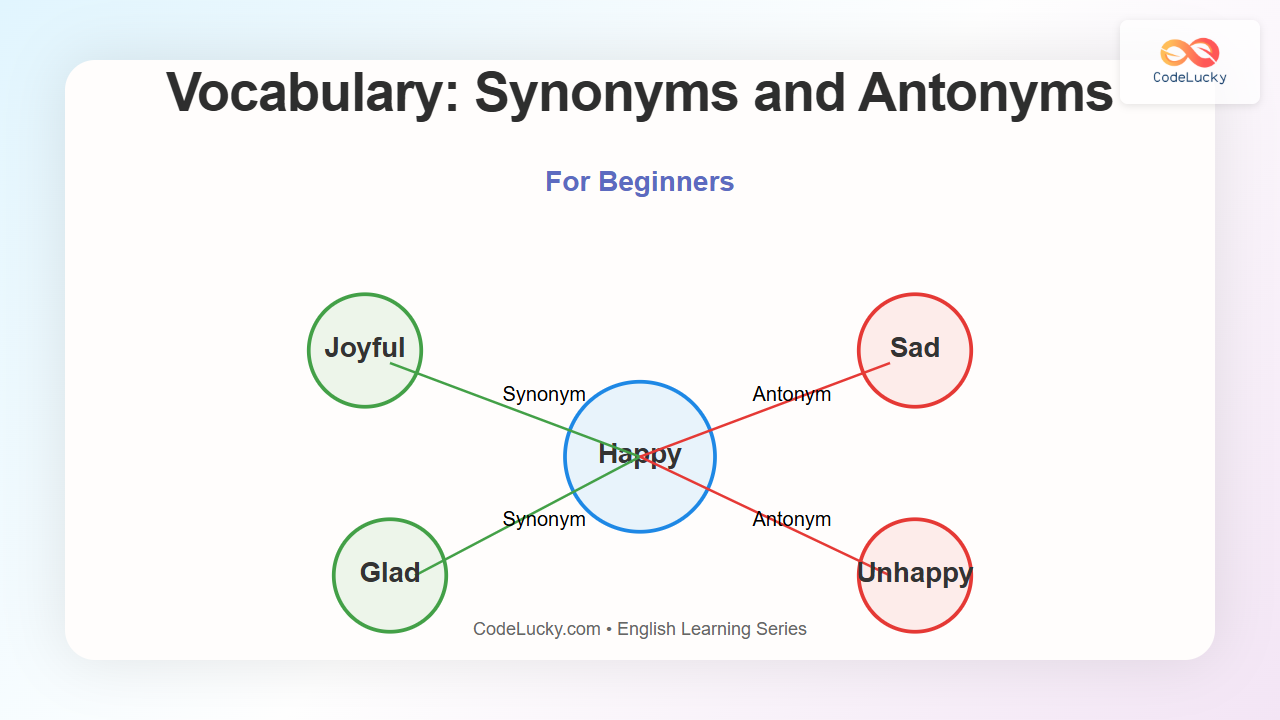
- Happy → glad, joyful, delighted
- Big → large, huge, enormous
- Fast → quick, speedy, rapid
Try to notice the slight differences in tone or intensity between synonyms. For instance, “enormous” feels stronger than “big.”

Tips to Learn Synonyms Easily
- Group words by meaning clusters (e.g., “happy” family: joyful, cheerful, blissful).
- Use flashcards or a mobile app to practice daily.
- Write one short paragraph using different synonyms for a single word.
What Are Antonyms?
Antonyms are words that have opposite meanings. They help convey contrast and make your expressions more precise. For example:
- Hot ↔ cold
- Start ↔ stop
- Old ↔ young
- Accept ↔ reject
Understanding antonyms also helps you think critically about ideas. For example, learning the opposite of a new word reinforces the meaning of both.

Practical Uses of Synonyms and Antonyms
Using synonyms and antonyms effectively can:
- Make your writing more expressive and varied.
- Help you understand reading passages better.
- Improve your performance in competitive exams like IELTS, TOEFL, or SSC.

Interactive Exercise: Choose the Correct Word
Try this quick activity right in your head (or jot it down):
- I am feeling _____ today. (Hint: synonym of happy)
- The room is too _____ for comfort. (Hint: antonym of cold)
- He spoke in a very _____ tone. (Hint: synonym of rude)
Answers: joyful, hot, impolite
Common Synonym and Antonym Pairs for Beginners
| Base Word | Synonym(s) | Antonym(s) |
|---|---|---|
| Beautiful | Pretty, lovely | Ugly |
| Easy | Simple, effortless | Difficult |
| Brave | Courageous, bold | Cowardly |
| Clean | Tidy, neat | Dirty |
| Strong | Powerful, sturdy | Weak |
Visual Connection Between Synonyms and Antonyms

Why Synonyms and Antonyms Matter in Real Life
Imagine describing a product, story, or emotion. If you use the same words repeatedly—like “nice,” “good,” or “bad”—your expression loses strength. Synonyms give variety (“excellent,” “outstanding,” “terrible”), while antonyms add contrast (“bright vs. dull”). Together, they form the foundation of expressive communication.
Final Thoughts
Building your English vocabulary through synonyms and antonyms is not about memorizing lists—it’s about understanding relationships between words. Practice a few pairs daily, write sentences with them, and soon your English will sound more fluent and natural.
Quick Challenge
Pick one base word like “happy.” Write three synonyms and three antonyms. Then use each in a sentence. You’ll notice how your language becomes more dynamic!
Keep expanding your vocabulary—word by word, you’ll strengthen your English foundation.