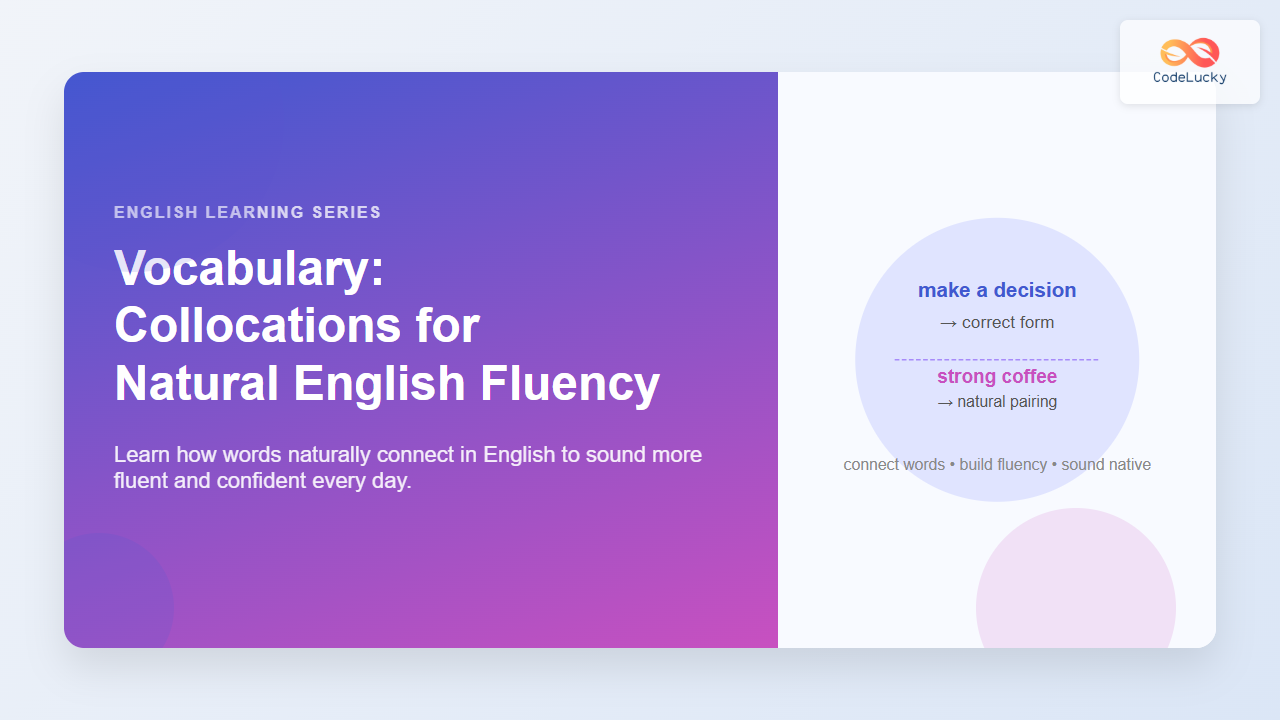
Collocations are natural combinations of words that frequently appear together in English. They make your speech and writing sound effortless, fluent, and native-like. For instance, native speakers say “make a mistake” instead of “do a mistake.”
In this article from CodeLucky.com’s English Learning Series, you’ll explore what collocations are, how they work, and how to practice them effectively. You’ll see categorized examples, visual diagrams, and interactive tips to strengthen your understanding.
What Are Collocations?
A collocation is a pair or group of words that are often used together in a way that sounds natural to native speakers. Using incorrect word combinations might still be grammatically correct, but they sound awkward. Compare:
- ❌ He did a big mistake.
- ✅ He made a big mistake.
Both sentences are understandable, but only the second is natural. Collocations form the “rhythms” of fluent English.

Types of English Collocations
1. Verb + Noun
These are extremely common and help describe actions naturally.
- Make a decision (not “do a decision”)
- Catch a cold (not “get a cold” in all contexts)
- Pay attention
- Save time
Example: “You need to make a decision quickly.”
2. Adjective + Noun
These express emotion, value, or quality naturally.
- Strong coffee
- Heavy rain (not “strong rain”)
- Fast train
- Deep sleep
Example: “It was such heavy rain that the match was canceled.”
3. Noun + Noun
These create fixed expressions often used in professional or technical contexts.
- Traffic jam
- Data analysis
- Company policy
- Job interview
4. Adverb + Adjective
Used for emphasizing quality or emotion.
- Deeply disappointed
- Completely satisfied
- Totally different
- Highly successful
5. Verb + Adverb
These enhance natural description of actions.
- Apologize sincerely
- Wait patiently
- Work hard
- Speak softly
Why Collocations Matter for Fluency
Native speakers don’t build sentences word-by-word—they recall natural word combinations. Mastering collocations helps with:
- Fluency: You sound smooth and natural.
- Accuracy: Avoid awkward word choices.
- Listening & Reading: Recognize patterns used by others.
- Writing: Make essays and reports sound more professional.

Practical Tips to Learn Collocations
1. Learn in Context
Instead of memorizing words individually, store collocations as phrases. For example, remember “take a break” instead of just “break.”
2. Keep a Collocation Notebook
Divide your notebook by parts of speech — verbs, adjectives, etc. Write new combinations as you notice them.
3. Use Interactive Practice
Try these types of exercises:
- Match the pairs: Match words like take → photos, make → effort.
- Sentence challenge: Complete the sentence “He ___ a terrible decision.”
- Collocation bingo: Listen to dialogues and tick off collocations.

Common Mistakes and How to Avoid Them
- Don’t translate collocations from your native language.
- Rely on context examples from reliable English sources.
- Practice speaking aloud to internalize sound patterns.
- Use spaced repetition to remember collocations efficiently.

Collocation Quiz (Try It Yourself)
Choose the correct collocation:
- He decided to __ a break.
a) make b) take - That’s a very __ problem.
a) big b) heavy - I was __ disappointed with her behavior.
a) deeply b) strongly
Answers: (1) take, (2) big, (3) deeply
Final Thoughts
Fluency isn’t about knowing thousands of words—it’s about knowing which words fit together. Start collecting collocations today, repeat them in daily usage, and you’ll soon speak English like a native. The key lies in natural word partnerships that convey meaning effortlessly.
Stay tuned for more lessons from CodeLucky.com’s English Learning Series—your guide to mastering real English, one topic at a time.