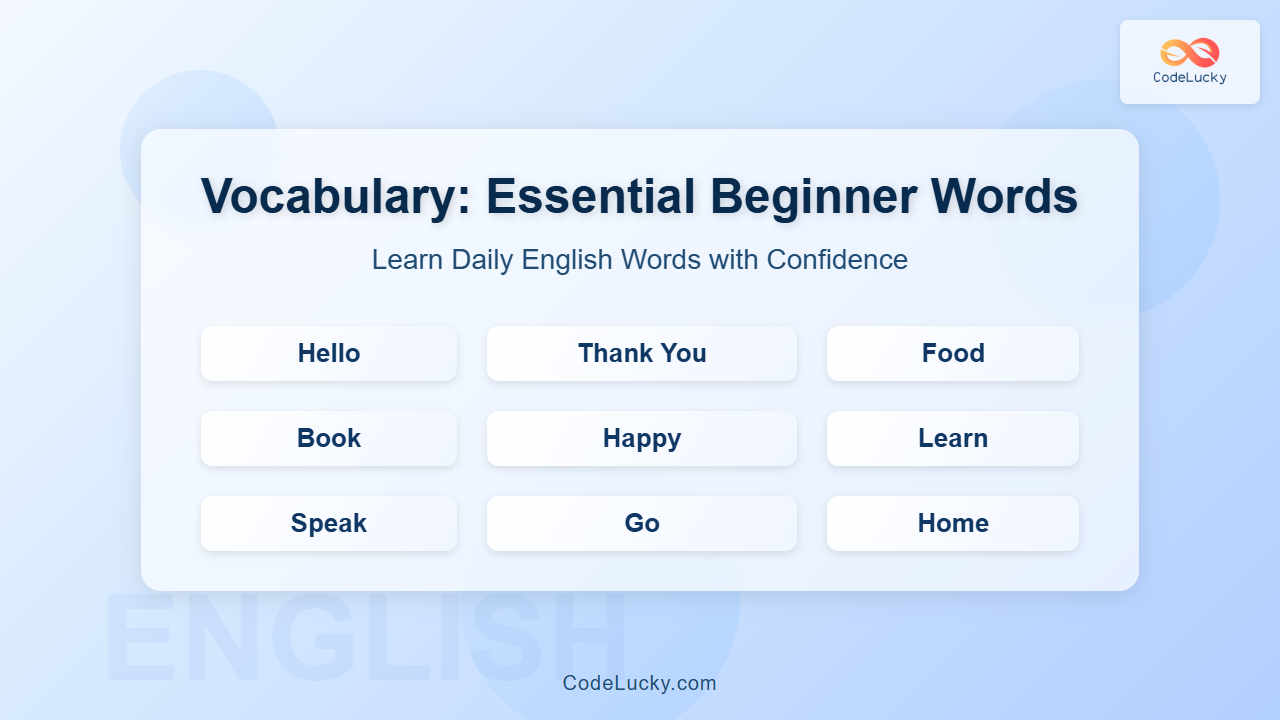
Vocabulary: Essential Beginner Words for Daily Use is your first step toward speaking and understanding English with confidence. Whether you’re a student, traveler, or professional, learning the most commonly used words makes communication smoother and daily life easier. This guide by CodeLucky.com breaks down essential words into easy categories with simple examples, clear meanings, and visual explanations.
Why Start with Basic Vocabulary?
Basic vocabulary builds the foundation of any language. Even a small set of words—used correctly—can help you express hundreds of ideas. For English beginners, focusing on high-frequency words is the fastest path to fluency.

1. Common Greeting and Politeness Words
Using polite words helps you connect positively with people. Here are essential greetings and responses:
| Word | Meaning | Example Sentence |
|---|---|---|
| Hello | A common greeting | Hello! How are you today? |
| Goodbye | Used when leaving | Goodbye! See you tomorrow. |
| Please | Used to make a request polite | Please pass the water. |
| Thank you | To show gratitude | Thank you for your help! |
| Sorry | Used to apologize | Sorry, I’m late to class. |
Pro Tip: Practice daily conversations with a friend or language partner. Repeat these words naturally to use them confidently.
2. Everyday Action Words (Verbs)
Action words describe what we do every day. Mastering these words helps you form simple, correct sentences.
| Verb | Meaning | Example |
|---|---|---|
| Eat | To take food | I eat breakfast at 8 AM. |
| Go | To move from one place to another | They go to school by bus. |
| Come | To move toward someone | Please come here. |
| Speak | To talk with someone | She speaks English well. |
| Do | To perform an action | We do our homework every day. |

3. Common Nouns for Daily Life
Nouns represent people, places, or things. These are words you’ll hear and use everywhere:
- Book – I read a book every night.
- Chair – Please sit on the chair.
- Phone – My phone is on the table.
- Car – He drives his car to work.
- House – Their house is near the park.
Remember: nouns are often combined with “a” or “the,” like “a chair” or “the table.”
4. Useful Adjectives to Describe Things
Adjectives describe qualities or states of nouns. Knowing a few helps you express emotions and ideas more clearly.
| Adjective | Meaning | Example |
|---|---|---|
| Big | Large in size | This is a big room. |
| Small | Little in size | That’s a small dog. |
| Hot | With high temperature | The tea is hot. |
| Cold | With low temperature | The water is cold. |
| Happy | Feeling joy | I am happy today. |

5. Basic Question Words
Questions are vital for learning and conversations. These words help you ask and understand information easily.
- What – What is this?
- Where – Where do you live?
- When – When will you come?
- Who – Who is your teacher?
- Why – Why are you late?
- How – How are you today?

6. Simple Prepositions for Everyday Use
Prepositions show the relationship between words—especially in describing positions or directions.
| Preposition | Meaning | Example |
|---|---|---|
| In | Inside something | The pen is in the bag. |
| On | Placed above and touching | The book is on the table. |
| Under | Below something | The cat is under the chair. |
| Near | Close to | The school is near my house. |
| Between | In the middle of | The park is between two buildings. |
Interactive Vocabulary Practice
Try matching each word to its meaning. This helps strengthen memory through active recall.
- Happy – ____
- Chair – ____
- Run – ____
- Cold – ____
- Book – ____
Write your answers in a notebook, then create a sentence for each word. Practice daily to build long-term memory.
7. How to Practice and Memorize New Words
Memorization becomes easier when you connect words to situations or visuals. Here’s a simple learning pattern:

Example:
- Word: “Cold”
- Meaning: With low temperature
- Sentence: The weather is cold today.
- Practice: When you feel the cold weather, repeat the word.
Final Tips for Beginners
- Start with 5–10 new words daily.
- Use flashcards or digital word lists.
- Speak words aloud to improve pronunciation.
- Review weekly to retain vocabulary longer.
- Watch simple English videos to see words in real use.
By mastering these essential English words, you’ll soon find yourself speaking more confidently and understanding more of the language around you. Keep learning, keep practicing, and visit CodeLucky.com for more lessons in this English Learning Series!