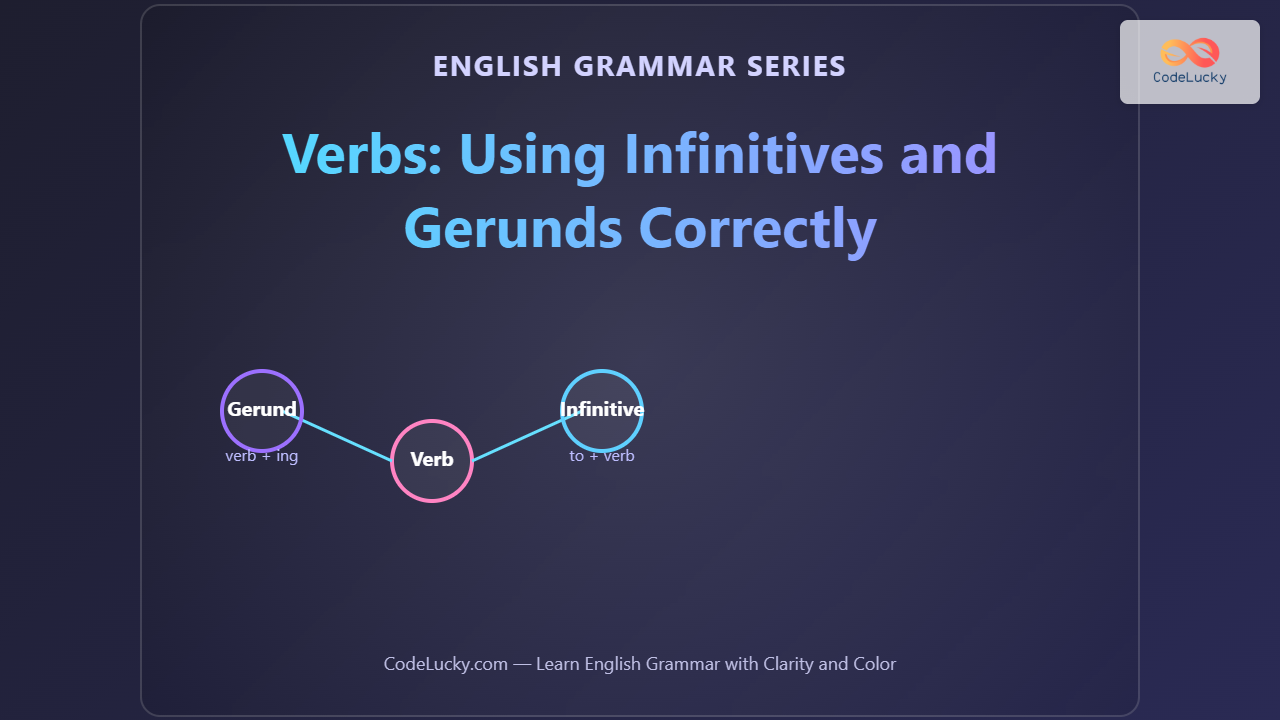
Mastering verbs with infinitives and gerunds is essential for speaking and writing English naturally. Understanding when to use to + verb (infinitives) or verb + -ing (gerunds) will help you express actions, preferences, and intentions with precision. This guide provides clear rules, examples, and visual charts to help learners of all levels grasp this tricky topic confidently.
What Are Infinitives and Gerunds?
An infinitive is the base form of a verb preceded by to, such as to eat, to learn, or to play.
A gerund is the -ing form of a verb used as a noun, for example: eating, learning, or playing.
Both infinitives and gerunds can function as subjects, objects, or complements of verbs in sentences. Choosing which one to use often depends on the main verb or function in the sentence.
Example Comparison
| Role | Gerund | Infinitive |
|---|---|---|
| Subject | Reading helps you relax. | To read helps you relax. |
| Object | I enjoy reading novels. | I want to read novels. |
| Complement | Her passion is teaching. | Her goal is to teach. |
When to Use a Gerund
Gerunds are used:
- After certain verbs such as enjoy, avoid, consider, finish, keep.
- As the subject of a sentence.
- After prepositions.
- After phrasal verbs.
Examples
- I enjoy reading science fiction.
- Swimming keeps you healthy.
- He’s interested in learning Japanese.
- She gave up smoking years ago.

When to Use an Infinitive
Infinitives are often used to express purpose, plans, or preference. They are also used after certain verbs and adjectives.
- After verbs such as want, decide, hope, plan, learn.
- After adjectives (e.g., happy to see you).
- To express reason or intention (I called to ask about…).
- After question words like what, how, where (e.g., I don’t know what to say).
Examples
- They want to learn Spanish.
- She’s happy to help.
- He came here to study.
- I don’t know how to solve this problem.

Verbs Followed by Gerunds or Infinitives (with No Change in Meaning)
Some verbs can take both forms without changing meaning:
| Verb | Gerund Example | Infinitive Example |
|---|---|---|
| begin | It began raining. | It began to rain. |
| continue | She continued working. | She continued to work. |
| like | I like swimming. | I like to swim. |
Verbs Followed by Gerunds or Infinitives (with Change in Meaning)
Other verbs change meaning depending on which form follows them. Here are some key examples:
| Verb | With Gerund | With Infinitive |
|---|---|---|
| remember | Means the past: I remember meeting him. | Means the future: Remember to meet him. |
| stop | Means quit doing something: He stopped smoking. | Means pause another action: He stopped to smoke. |
| try | Means an experiment: Try restarting your phone. | Means an effort: Try to restart your phone. |

Gerund vs Infinitive Quick Guide
Here’s a visual summary to keep rules top of mind:

Interactive Practice
Try filling in the blanks mentally or aloud. Check which form fits — gerund or infinitive.
- She avoided ______ (talk) about the issue.
- I plan ______ (travel) next month.
- He stopped ______ (work) because he was tired.
- They enjoy ______ (play) chess together.
- Did you remember ______ (lock) the door?
Answers: talking, to travel, working, playing, to lock
Pro Tip: Watch for Prepositions
Whenever a verb or expression includes a preposition, use a gerund afterward. This is a common mistake among English learners.
- I’m looking forward to meeting you. ✅
- He’s good at running. ✅
- She’s interested in learning. ✅

Summary Table
| Category | Use Gerund | Use Infinitive |
|---|---|---|
| Common verbs | enjoy, avoid, keep | want, decide, hope |
| Function | After prepositions or as subject | To express purpose or after adjectives |
| Special verbs | stop, remember (past) | stop, remember (future) |
Conclusion
Choosing between gerunds and infinitives is one of the most subtle parts of English grammar, but with practice, you’ll master it naturally. Keep a list of verbs that use one or both forms, and pay attention to how native speakers use them in context. Over time, your ear will guide you instinctively to pick the right form.
Keep practicing, keep noticing patterns, and English grammar will become second nature!