The PowerShell pipeline is one of the most powerful features that distinguishes it from traditional command-line shells. Unlike Unix/Linux shells that pass text between commands, PowerShell passes objects, enabling sophisticated data manipulation and automation workflows. This article explores how the pipeline works, how objects flow between cmdlets, and how to leverage this mechanism effectively.
What is the PowerShell Pipeline?
The pipeline is a mechanism that allows you to pass the output of one cmdlet directly as input to another cmdlet using the pipe operator (|). This creates a chain of commands where data flows seamlessly from left to right.
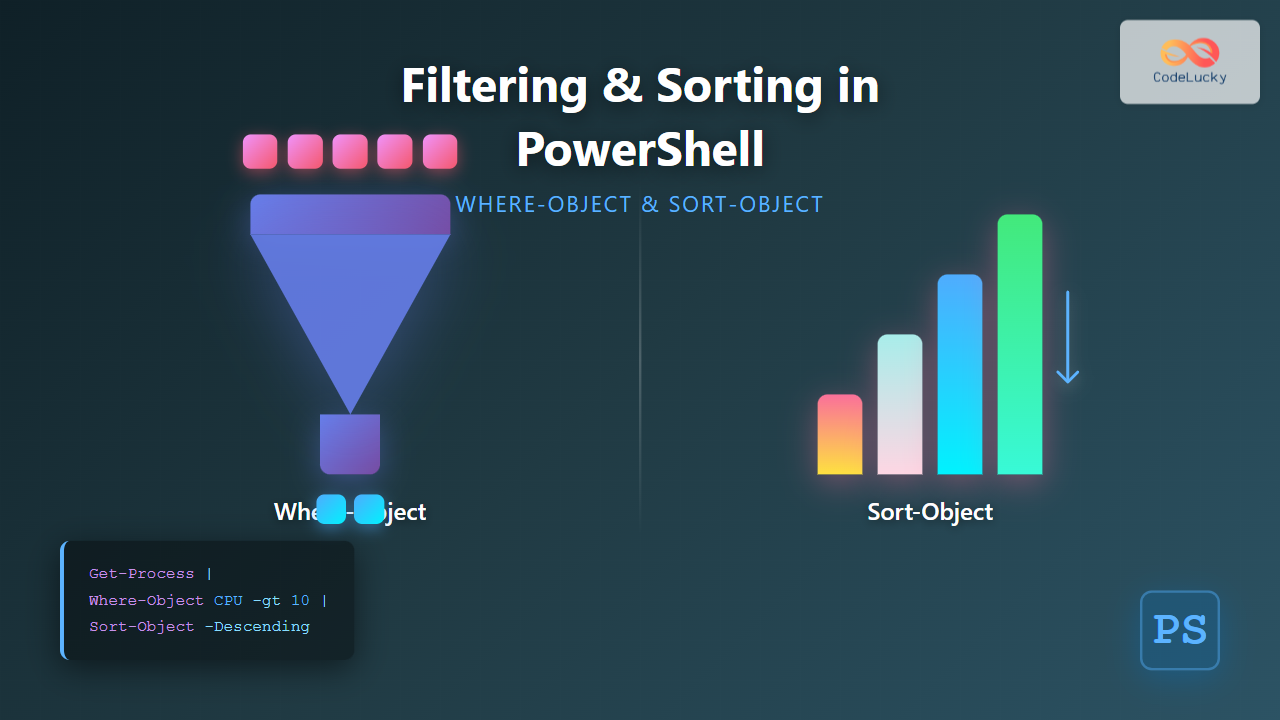
Get-Process | Where-Object CPU -gt 100 | Sort-Object CPU -DescendingIn this example, Get-Process retrieves process objects, which are filtered by Where-Object, and then sorted by Sort-Object. Each cmdlet receives complete objects with all their properties and methods, not just text.
Object-Based vs. Text-Based Pipelines
Understanding the difference between PowerShell’s object-based pipeline and traditional text-based pipelines is crucial:

In traditional shells, commands output text that must be parsed:
# Traditional shell (bash)
ps aux | grep chrome | awk '{print $2}'
In PowerShell, you work with structured objects:
# PowerShell
Get-Process chrome | Select-Object Id
The PowerShell approach provides direct access to properties without text parsing, reducing errors and complexity.
How Pipeline Parameter Binding Works
When you pipe objects between cmdlets, PowerShell uses parameter binding to determine how to pass data. There are two primary binding methods:
ByValue Binding
PowerShell attempts to bind the entire object to a parameter that accepts that object type. The receiving cmdlet looks for a parameter that accepts the incoming object’s type.
# Get-Process outputs Process objects
# Stop-Process accepts Process objects via pipeline
Get-Process notepad | Stop-Process -WhatIf
Output:
What if: Performing the operation "Stop-Process" on target "notepad (12345)".Here, Stop-Process has a parameter that accepts Process objects by value, so the binding happens automatically.
ByPropertyName Binding
If ByValue binding fails, PowerShell attempts to match object properties to parameter names. The property names from the incoming object must match parameter names in the receiving cmdlet.
# Create custom objects with specific properties
$services = @(
    [PSCustomObject]@{ Name = "Spooler"; DisplayName = "Print Spooler" }
    [PSCustomObject]@{ Name = "wuauserv"; DisplayName = "Windows Update" }
)

# The Name property matches the -Name parameter of Get-Service
$services | Get-Service
Output:
Status   Name               DisplayName
------   ----               -----------
Running  Spooler            Print Spooler
Stopped  wuauserv           Windows Update
Inspecting Pipeline Objects
To understand what objects are flowing through the pipeline, use Get-Member:
Get-Process | Get-MemberOutput (partial):
   TypeName: System.Diagnostics.Process

Name                       MemberType     Definition
----                       ----------     ----------
Handles                    AliasProperty  Handles = Handlecount
Name                       AliasProperty  Name = ProcessName
CPU                        Property       double CPU {get;}
Id                         Property       int Id {get;}
ProcessName                Property       string ProcessName {get;}
StartTime                  Property       datetime StartTime {get;}
This reveals that Get-Process outputs System.Diagnostics.Process objects with properties like CPU, Id, and ProcessName.
Filtering Objects in the Pipeline
The Where-Object cmdlet filters objects based on conditions:
# Filter processes using more than 100MB of memory
Get-Process | Where-Object { $_.WorkingSet -gt 100MB }
The $_ variable represents the current object in the pipeline. You can also use simplified syntax:
# Simplified syntax
Get-Process | Where-Object WorkingSet -gt 100MB
Example Output:
Handles  NPM(K)    PM(K)      WS(K)     CPU(s)     Id ProcessName
-------  ------    -----      -----     ------     -- -----------
   1234      89   234567     345678      45.32   5432 chrome
    987      67   123456     234567      23.45   6789 firefox
Selecting and Transforming Properties
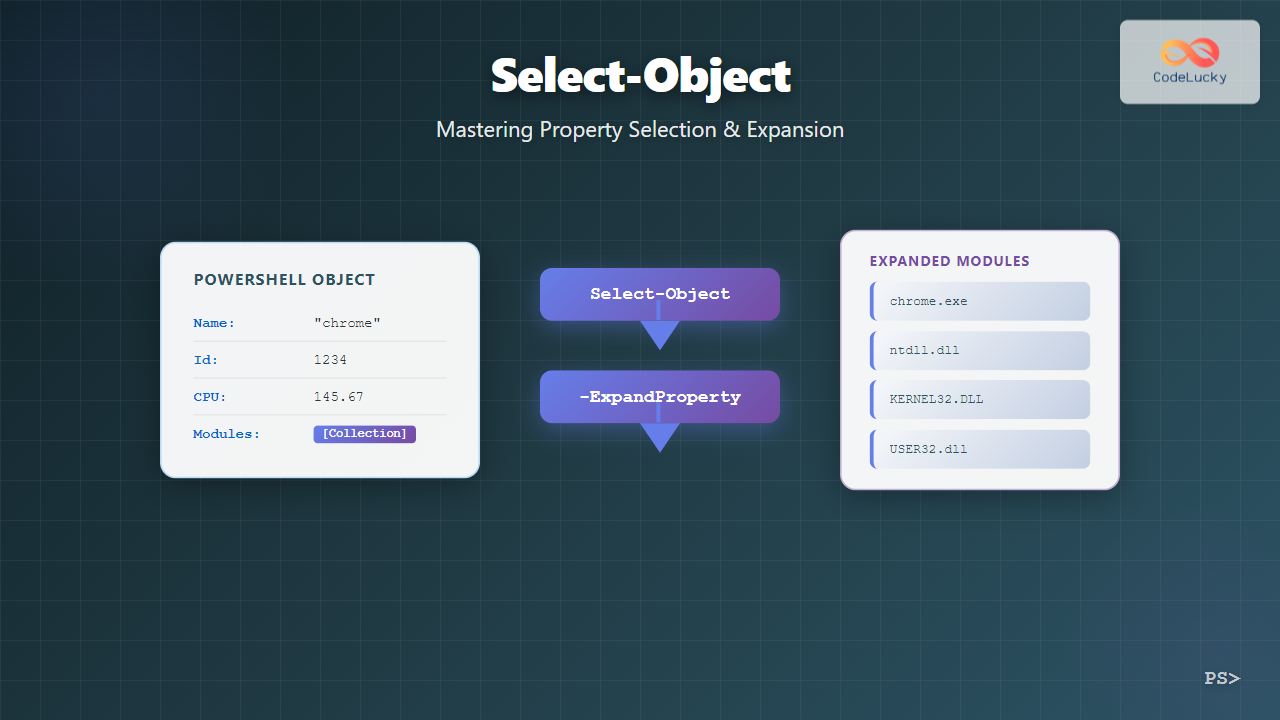
Use Select-Object to choose specific properties or create calculated properties:
# Select specific properties
Get-Process | Select-Object Name, Id, CPU | Select-Object -First 5
Output:
Name                       Id        CPU
----                       --        ---
ApplicationFrameHost     4567      2.34
chrome                   5432     45.32
csrss                     456      1.23
dwm                       789      8.90
explorer                 1234     12.45
Creating Calculated Properties
# Convert memory to MB and add a calculated property
Get-Process | Select-Object Name,
    @{Name='MemoryMB'; Expression={[math]::Round($_.WorkingSet / 1MB, 2)}},
    @{Name='Status'; Expression={
        if ($_.Responding) { 'Running' } else { 'Not Responding' }
    }} | Select-Object -First 5
Output:
Name                     MemoryMB Status
----                     -------- ------
ApplicationFrameHost        45.23 Running
chrome                     234.56 Running
csrss                       12.34 Running
dwm                         67.89 Running
explorer                   123.45 Running
Sorting and Grouping Pipeline Data
Organize pipeline data using Sort-Object and Group-Object:
# Sort by CPU usage in descending order
Get-Process | Sort-Object CPU -Descending | Select-Object -First 5 Name, CPU
Output:
Name                          CPU
----                          ---
chrome                      45.32
firefox                     23.45
explorer                    12.45
dwm                          8.90
System                       5.67
Grouping Objects
# Group processes by company
Get-Process | Group-Object Company | Select-Object Count, Name
Output:
Count Name
----- ----
   23 Microsoft Corporation
   12 Google LLC
    8 Mozilla Corporation
   45
    5 Adobe Inc.
The ForEach-Object Cmdlet
ForEach-Object performs operations on each object in the pipeline:
# Get file sizes and calculate total
Get-ChildItem -Path C:\Temp -File |
    ForEach-Object {
        [PSCustomObject]@{
            Name = $_.Name
            SizeKB = [math]::Round($_.Length / 1KB, 2)
            Type = $_.Extension
        }
    }
Output:
Name           SizeKB Type
----           ------ ----
document.pdf   234.56 .pdf
image.jpg       45.23 .jpg
data.csv       123.45 .csv
script.ps1       5.67 .ps1
Advanced Pipeline Techniques
Pipeline Variable $_
The $_ automatic variable represents the current pipeline object:
# Multiple operations on pipeline objects
Get-Service | Where-Object {
    $_.Status -eq 'Running' -and $_.StartType -eq 'Automatic'
} | ForEach-Object {
    "Service: $($_.Name) - Display: $($_.DisplayName)"
}
Output:
Service: AudioSrv - Display: Windows Audio
Service: BITS - Display: Background Intelligent Transfer Service
Service: Dhcp - Display: DHCP Client
Service: EventLog - Display: Windows Event Log
Chaining Multiple Cmdlets
# Complex pipeline chain
Get-Process |
    Where-Object { $_.WorkingSet -gt 50MB } |
    Sort-Object WorkingSet -Descending |
    Select-Object -First 10 Name,
        @{Name='MemoryMB'; Expression={[math]::Round($_.WorkingSet / 1MB, 2)}} |
    ForEach-Object {
        [PSCustomObject]@{
            Process = $_.Name
            Memory = "$($_.MemoryMB) MB"
            Category = if ($_.MemoryMB -gt 200) { 'High' }
                      elseif ($_.MemoryMB -gt 100) { 'Medium' }
                      else { 'Low' }
        }
    }
Output:
Process              Memory      Category
-------              ------      --------
chrome               345.67 MB   High
firefox              234.56 MB   High
Code                 189.45 MB   Medium
explorer             156.78 MB   Medium
Teams                134.23 MB   Medium
Pipeline Performance Considerations
The pipeline processes objects one at a time (streaming), which is memory-efficient for large datasets:
# Efficient: Processes one file at a time
Get-ChildItem -Path C:\LargeFolder -Recurse -File |
    Where-Object Length -gt 100MB |
    Select-Object Name, Length

# Less efficient: Loads all objects into memory first
$files = Get-ChildItem -Path C:\LargeFolder -Recurse -File
$largeFiles = $files | Where-Object Length -gt 100MB
Common Pipeline Patterns
Filter, Transform, Output Pattern
# Filter -> Transform -> Output
Get-Service |
    Where-Object Status -eq 'Running' |
    Select-Object Name, DisplayName, StartType |
    Export-Csv -Path 'C:\Temp\running-services.csv' -NoTypeInformation
Collect, Process, Group Pattern
# Collect -> Process -> Group
Get-EventLog -LogName System -Newest 100 |
    Where-Object EntryType -eq 'Error' |
    Group-Object Source |
    Sort-Object Count -Descending |
    Select-Object Count, Name
Output:
Count Name
----- ----
   23 DCOM
   15 Service Control Manager
   12 Disk
    8 DistributedCOM
    5 EventLog
Aggregate and Calculate Pattern
# Calculate total memory used by all Chrome processes
Get-Process chrome |
    Measure-Object -Property WorkingSet -Sum |
    ForEach-Object {
        [PSCustomObject]@{
            ProcessCount = $_.Count
            TotalMemoryMB = [math]::Round($_.Sum / 1MB, 2)
            AverageMemoryMB = [math]::Round(($_.Sum / $_.Count) / 1MB, 2)
        }
    }
Output:
ProcessCount TotalMemoryMB AverageMemoryMB
------------ ------------- ---------------
          12        1234.56          102.88
Debugging Pipeline Issues
When pipelines don’t work as expected, use these debugging techniques:
1. Inspect Objects at Each Stage
# Add Get-Member to see object types
Get-Process | Get-Member | Select-Object -First 10

# Use Select-Object to view specific properties
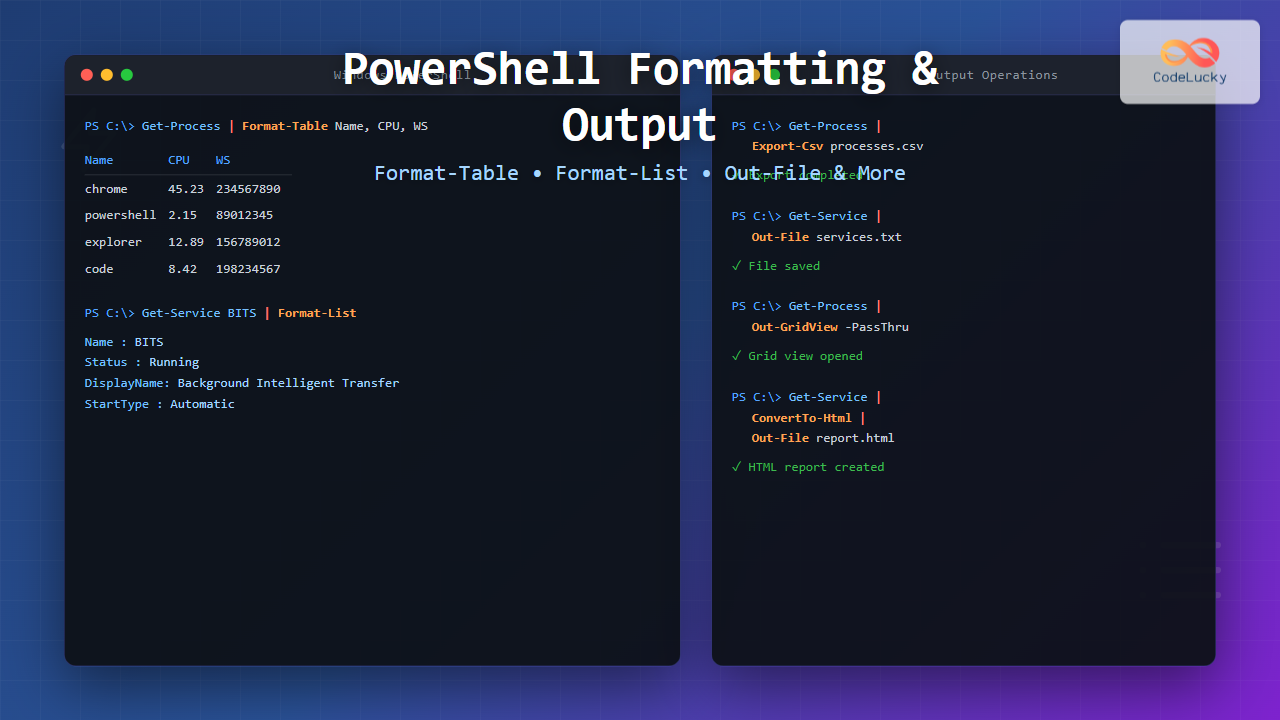
Get-Process | Select-Object Name, Id, CPU | Format-Table
2. Use Tee-Object to Branch Pipeline
# Save intermediate results while continuing pipeline
Get-Process |
    Tee-Object -FilePath 'C:\Temp\all-processes.txt' |
    Where-Object CPU -gt 10 |
    Tee-Object -FilePath 'C:\Temp\high-cpu-processes.txt' |
    Sort-Object CPU -Descending
3. Check Parameter Binding
# Use Trace-Command to see how parameters bind
Trace-Command -Name ParameterBinding -Expression {
    Get-Process chrome | Stop-Process -WhatIf
} -PSHost
Real-World Pipeline Examples
System Administration Task
# Find and stop processes consuming high memory
Get-Process |
    Where-Object { $_.WorkingSet -gt 500MB -and $_.Name -ne 'System' } |
    Select-Object Name, Id,
        @{Name='MemoryGB'; Expression={[math]::Round($_.WorkingSet / 1GB, 2)}} |
    ForEach-Object {
        Write-Host "High memory process found: $($_.Name) (PID: $($_.Id), Memory: $($_.MemoryGB) GB)"
        # Stop-Process -Id $_.Id -Force -WhatIf
    }
File Management Task
# Find large, old files for cleanup
Get-ChildItem -Path C:\Temp -Recurse -File |
    Where-Object {
        $_.Length -gt 10MB -and
        $_.LastWriteTime -lt (Get-Date).AddDays(-30)
    } |
    Select-Object FullName,
        @{Name='SizeMB'; Expression={[math]::Round($_.Length / 1MB, 2)}},
        @{Name='DaysOld'; Expression={((Get-Date) - $_.LastWriteTime).Days}} |
    Sort-Object SizeMB -Descending |
    Format-Table -AutoSize
Report Generation Task
# Generate service status report
Get-Service |
    Select-Object Name, DisplayName, Status, StartType |
    Group-Object Status |
    ForEach-Object {
        [PSCustomObject]@{
            Status = $_.Name
            Count = $_.Count
            Services = ($_.Group.Name -join ', ')
        }
    } |
    Export-Csv -Path 'C:\Reports\service-status.csv' -NoTypeInformation
Best Practices for Pipeline Usage
- Keep pipelines readable: Break long pipelines across multiple lines using backticks or wrap in parentheses
- Filter early: Use
Where-Objectas early as possible to reduce objects flowing through the pipeline - Understand object types: Use
Get-Memberto know what properties and methods are available - Use appropriate cmdlets: Choose cmdlets designed for pipeline input when available
- Handle errors: Add error handling with
-ErrorActionor try-catch blocks for production scripts - Consider performance: For large datasets, streaming through the pipeline is more efficient than storing in variables
Conclusion
The PowerShell pipeline is a fundamental concept that enables efficient, readable, and powerful scripts. By understanding how objects flow between cmdlets, how parameter binding works, and how to leverage filtering, transformation, and aggregation cmdlets, you can create sophisticated automation solutions. Practice these patterns with real-world scenarios to master pipeline techniques and unlock PowerShell’s full potential.
Remember that the pipeline processes objects, not text, which gives you direct access to properties and methods without parsing. This object-oriented approach makes PowerShell scripts more reliable, maintainable, and powerful than traditional text-based shells.