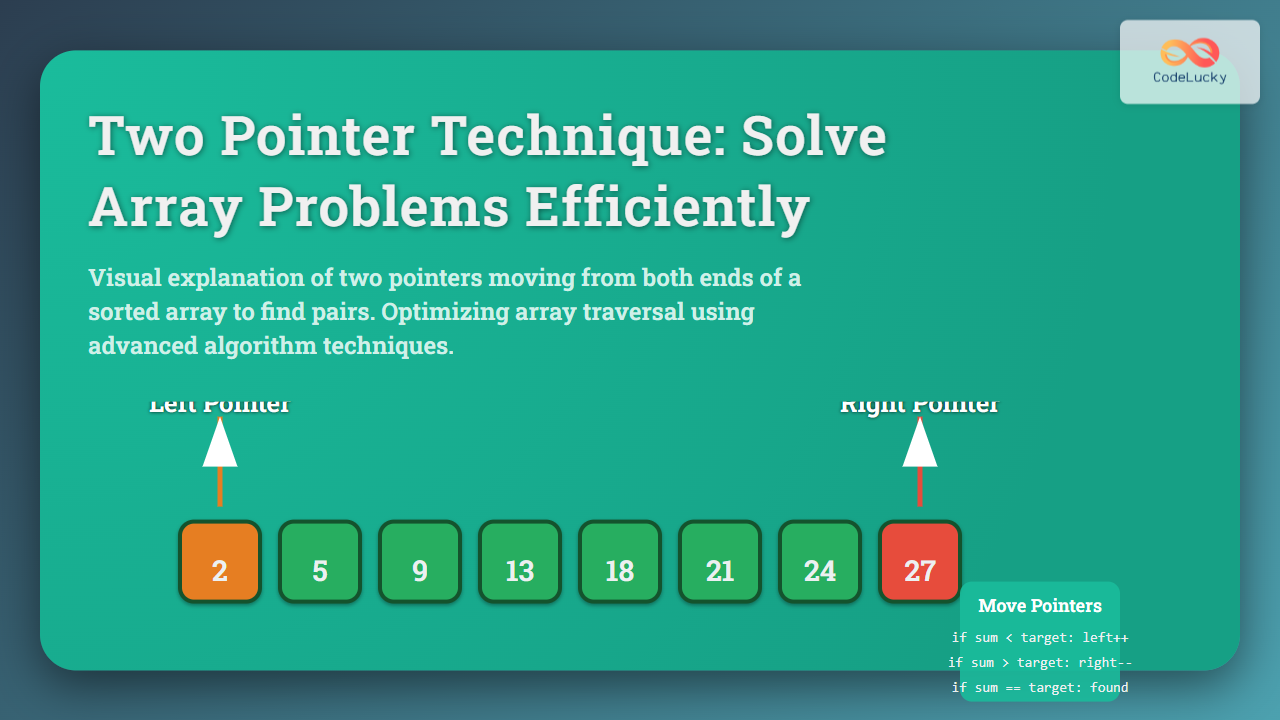
The Two Pointer Technique is one of the most efficient strategies in computer algorithms, especially when dealing with problems involving arrays and strings. Instead of brute force approaches that check all possible pairs or subarrays, the two pointer approach smartly uses left and right indices (or moving pointers) to reduce redundant computations, solving problems in O(n) or O(n log n) time instead of O(n²).
In this article, we will explore:
- What the Two Pointer Technique is
- Types of pointer movements (opposite direction, same direction)
- Step-by-step examples of array problems solved with two pointers
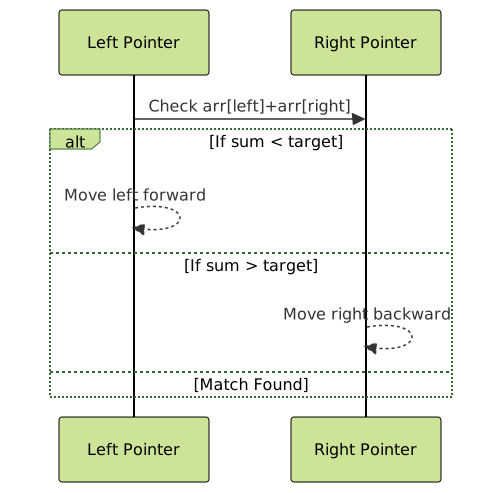
- Visual diagrams to understand the pointer movement
- Python code implementations you can try instantly
What is the Two Pointer Technique?
It is a common method where two indices traverse a data structure, usually an array or string, simultaneously. By carefully deciding how these pointers move, we can avoid unnecessary looping and reduce complexity.
There are two common variations:
- Opposite Direction Pointers: One pointer starts from the left, and the other starts from the right. Typically used for problems like pair sums or checking palindromes.
- Same Direction Pointers: Both pointers move in the same direction, often used for problems like sliding window, subarray sums, and string matching.

Example 1: Pair Sum Problem
Problem: Given a sorted array and a target sum, find if there exists a pair whose sum equals the target.
def pair_sum(arr, target):
    left, right = 0, len(arr) - 1
    while left < right:
        current_sum = arr[left] + arr[right]
        if current_sum == target:
            return (arr[left], arr[right])
        elif current_sum < target:
            left += 1
        else:
            right -= 1
    return None

# Example usage
print(pair_sum([1, 2, 3, 4, 6, 8, 9], 10))
Output:
(2, 8)
Example 2: Removing Duplicates in a Sorted Array
Problem: Given a sorted array, remove duplicates in place such that each element appears only once and return the new length.
def remove_duplicates(nums):
    if not nums:
        return 0
    left = 0
    for right in range(1, len(nums)):
        if nums[right] != nums[left]:
            left += 1
            nums[left] = nums[right]
    return left + 1

nums = [1,1,2,2,3,3,4,5,5]
length = remove_duplicates(nums)
print(nums[:length])
Output:
[1, 2, 3, 4, 5]

Example 3: Valid Palindrome Check
Problem: Determine if a given string is a palindrome using the two pointer technique.
def is_palindrome(s):
    left, right = 0, len(s) - 1
    while left < right:
        if not s[left].isalnum():
            left += 1
        elif not s[right].isalnum():
            right -= 1
        elif s[left].lower() != s[right].lower():
            return False
        else:
            left += 1
            right -= 1
    return True

print(is_palindrome("A man, a plan, a canal: Panama"))
Output:
True

Example 4: Container With Most Water
Problem: Find two lines that form a container with the most water.
def max_area(height):
    left, right = 0, len(height) - 1
    max_area_val = 0
    while left < right:
        area = (right - left) * min(height[left], height[right])
        max_area_val = max(max_area_val, area)
        if height[left] < height[right]:
            left += 1
        else:
            right -= 1
    return max_area_val

print(max_area([1,8,6,2,5,4,8,3,7]))
Output:
49
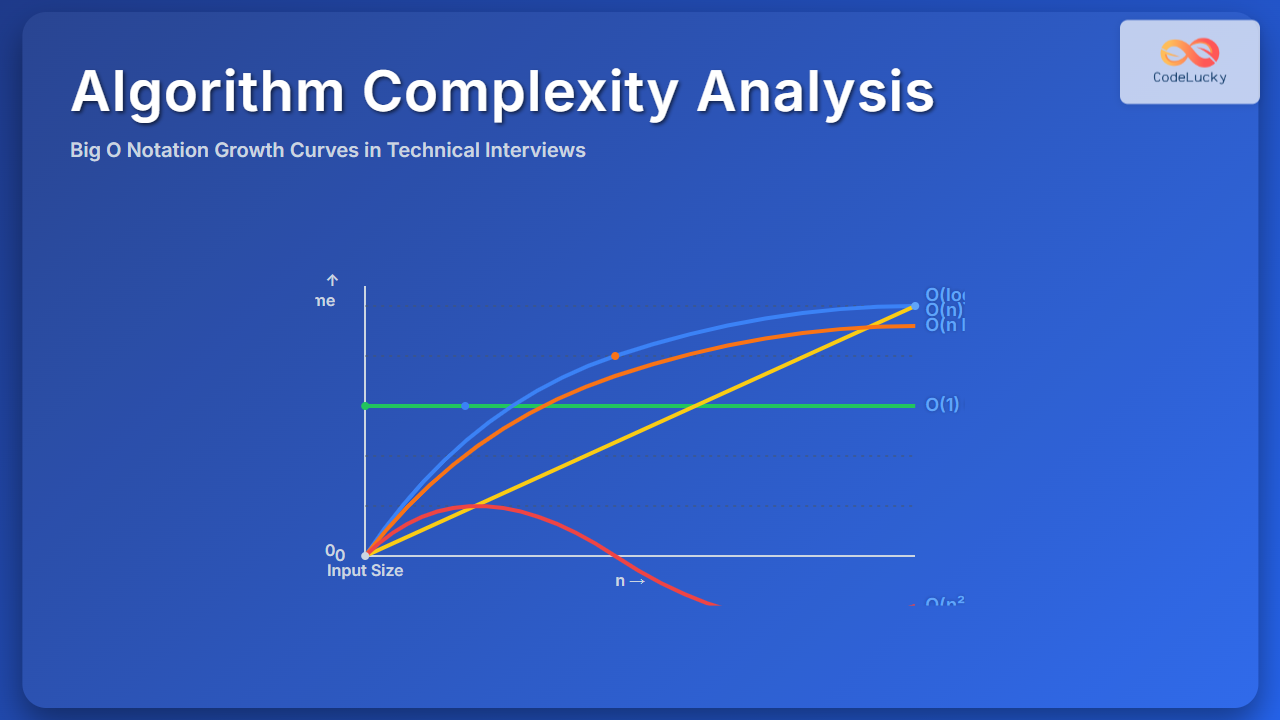
Complexity Analysis
- Time Complexity: Most two pointer solutions run in
O(n). - Space Complexity: Usually
O(1), since only constant space for pointers is used.
When to Use the Two Pointer Technique?
- When dealing with sorted arrays to find pairs or triplets.
- For palindrome or subsequence verification in strings.
- When optimizing two-sum like problems.
- Efficient sliding window problems like minimum subarray length.
Conclusion
The Two Pointer Technique is a powerful optimization pattern in algorithm design. It simplifies many classical problems, making them efficient and elegant. Whether checking palindromes, finding pairs in arrays, or computing maximum water container space, this method helps reduce time complexity drastically.
Try experimenting with variations of the examples above, especially combining this with sliding window and binary search concepts. You’ll quickly find that this approach is one of the most practical tools in your problem-solving toolkit.