The Trie algorithm, also known as the prefix tree, is a highly efficient data structure designed for storing and retrieving strings, especially when dealing with large collections of words such as dictionaries, search engines, and autocomplete systems. Unlike hash tables or balanced trees, a Trie explicitly encodes common prefixes of strings to save both time and space.
In this article, we will explore what a Trie is, how it works, its advantages, real-world applications, and provide step-by-step examples with diagrams and code snippets.
What is a Trie (Prefix Tree)?
A Trie is a tree-based data structure where each node represents a single character of a string. The root represents an empty string, and paths from the root to a terminal node form complete words. Unlike other data structures that store strings as whole units, a Trie breaks them down into prefixes, enabling fast searches and retrievals.

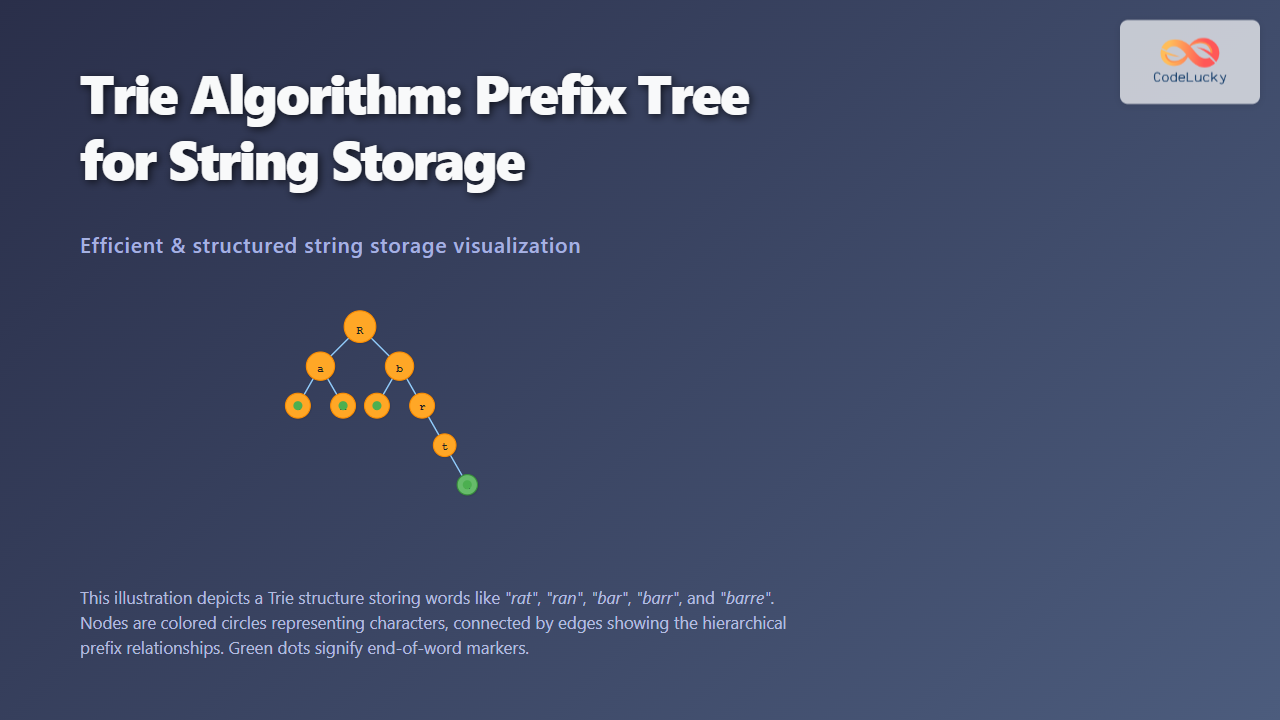
In this visual, we can store words like app, apple, and and. The Trie reuses common prefixes (ap and a), preventing duplication and saving space.
Key Properties of a Trie
- Each edge represents a character in a string.
- Each node may have multiple children (26 for lowercase English letters, or more for Unicode).
- Words are identified by marking the “end of word” in the Trie.
- Insert, search, and prefix search operations can be performed efficiently in
O(L), whereLis the length of the word.
Trie Algorithm Operations
1. Insertion
To insert a word into a Trie, we iterate through each character and create nodes as needed. At the last character, we mark the node as the end of a word.
class TrieNode:
    def __init__(self):
        self.children = {}
        self.is_end_of_word = False

class Trie:
    def __init__(self):
        self.root = TrieNode()

    def insert(self, word):
        current = self.root
        for ch in word:
            if ch not in current.children:
                current.children[ch] = TrieNode()
            current = current.children[ch]
        current.is_end_of_word = True
2. Search
Searching in a Trie involves following the path of characters. If at any point a character is missing, the word doesn’t exist.
    def search(self, word):
        current = self.root
        for ch in word:
            if ch not in current.children:
                return False
            current = current.children[ch]
        return current.is_end_of_word
3. Prefix Search
Tries excel at prefix searches, which makes them perfect for autocomplete systems.
    def starts_with(self, prefix):
        current = self.root
        for ch in prefix:
            if ch not in current.children:
                return False
            current = current.children[ch]
        return True
Visual Example of Autocomplete
If we insert the words cat, car, cart, and care, the Trie structure will look like this:

Now, when searching for prefix ca, we can instantly retrieve suggestions like cat, car, cart, and care.
Complexity Analysis
- Insertion: \(O(L)\), where \(L\) is the length of the word.
- Search: \(O(L)\).
- Prefix Search: \(O(L)\).
- Space Complexity: \(O(N \times \Sigma)\), where \(N\) is the total number of strings and \(\Sigma\) is the alphabet size.
Advantages of Trie
- Efficient for prefix-based queries and dictionary-like lookups.
- Avoids collisions like in hash tables.
- Very predictable time complexity \(O(L)\).
- Ideal for autocompletion and spell-checkers.
Disadvantages of Trie
- Can consume a lot of memory if the dataset is sparse.
- Implementation is more complex than arrays or hash maps.
Real-World Applications of Trie
- Autocomplete in search engines and IDEs.
- Spell checkers where prefixes need to be matched quickly.
- IP routing in networking where longest prefix matches are essential.
- Word games like Scrabble or crossword solvers.
Interactive Example: Trie Autocomplete
Try inserting words and searching prefixes using this JavaScript implementation:
Conclusion
The Trie algorithm (prefix tree) is a cornerstone data structure for string-related problems. By breaking down words into prefixes and sharing common paths, Tries offer unmatched efficiency at handling dictionary operations, autocomplete, spell-check, and more. While the downside includes higher space usage, the performance benefits for search-intensive applications make it a critical tool in modern computing.