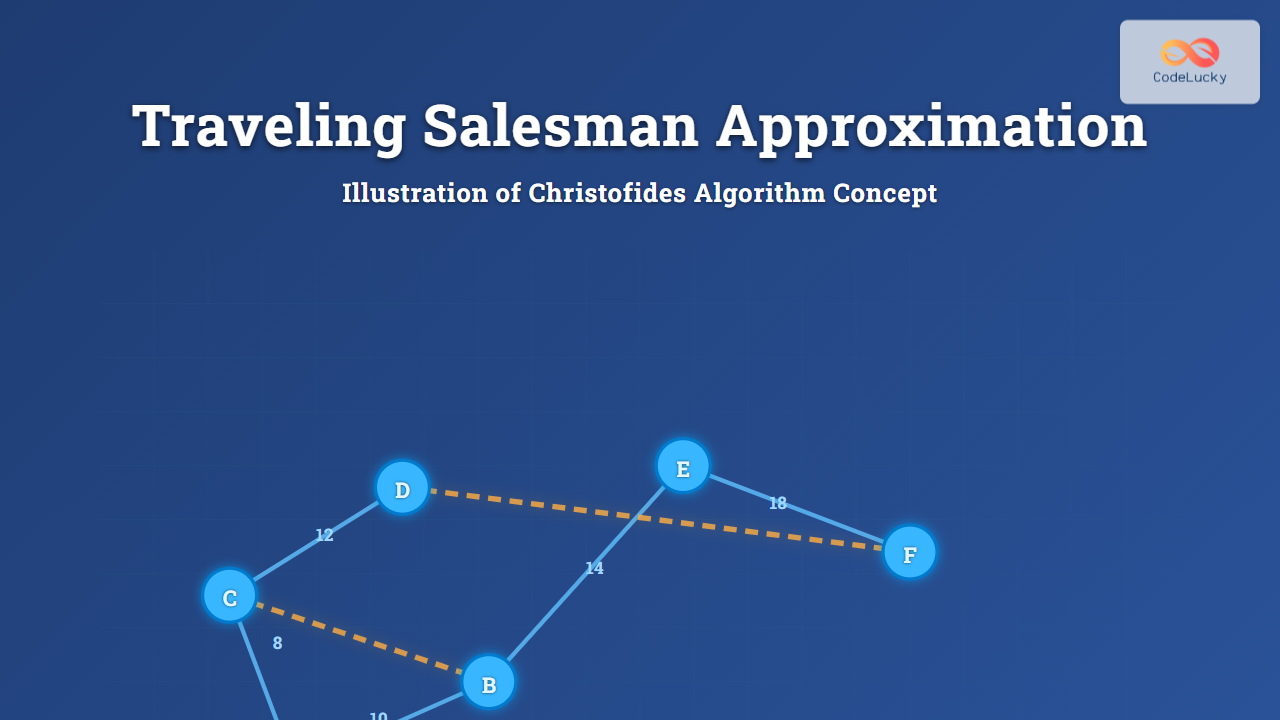
The Traveling Salesman Problem (TSP) is a classic optimization challenge in computer science and operations research where the goal is to find the shortest possible route that visits each city exactly once and returns to the origin city. Since finding the exact solution is NP-hard, approximation algorithms play a crucial role for larger instances. Among these, the Christofides algorithm stands out as a landmark approximation method, guaranteeing a solution within 1.5 times the optimal.
Understanding the Traveling Salesman Problem (TSP)
The TSP can be formally described on a weighted graph \( G = (V, E) \) where vertices \( V \) represent cities and edges \( E \) represent paths with associated costs (or distances). The objective is to find the minimum-cost Hamiltonian circuit that visits each vertex exactly once.
Due to its computational complexity, exact solutions are only feasible for small datasets. Approximation algorithms, such as Christofides, provide efficient near-optimal solutions when the graph satisfies the metric condition (triangle inequality holds).
What Is Christofides Algorithm?
The Christofides algorithm, proposed by Nicos Christofides in 1976, is a polynomial-time approximation algorithm for metric TSP that produces a route no longer than 1.5 times the optimal tour length.
This guarantee is significant because it is the best-known approximation ratio for metric TSP to date. The algorithm combines concepts from minimum spanning trees, perfect matching, and Eulerian circuits.
Step-by-Step Procedure of Christofides Algorithm
- Compute a Minimum Spanning Tree (MST) of the graph \(G\). This spans all vertices with minimal total edge weight.
- Find vertices with odd degree in the MST. An MST can have an even or odd number of vertices with an odd degree; list them as set \(O\).
- Compute a Minimum Weight Perfect Matching (MWPM) on the induced subgraph formed by vertices in \(O\). This pairs odd-degree vertices to make their degrees even when added to the MST.
- Combine MST and the MWPM edges to form a connected multigraph with even-degree vertices, ensuring the existence of an Eulerian circuit.
- Find an Eulerian Circuit in this combined graph.
- Convert the Eulerian circuit to a Hamiltonian circuit by shortcutting repeated vertices (due to the triangle inequality, this shortcut does not increase the cost).

Example Illustrating Christofides Algorithm
Consider a set of 6 cities with pairwise distances respecting the triangle inequality:
| City | A | B | C | D | E | F |
|---|---|---|---|---|---|---|
| A | 0 | 10 | 15 | 20 | 10 | 25 |
| B | 10 | 0 | 35 | 25 | 15 | 30 |
| C | 15 | 35 | 0 | 30 | 20 | 5 |
| D | 20 | 25 | 30 | 0 | 15 | 10 |
| E | 10 | 15 | 20 | 15 | 0 | 35 |
| F | 25 | 30 | 5 | 10 | 35 | 0 |
Step 1: Compute MST (using Prim’s or Kruskal’s algorithm)

MST edges and weights: A-B(10), A-E(10), E-D(15), D-F(10), F-C(5).
Step 2: Identify odd degree vertices in MST:
- Odd degree vertices: B, C, D (each connected to only one or three edges).
Step 3: Find MWPM among odd vertices B, C, D:
- Matching pairs: (B-D) with weight 25, (C-D) with weight 30, (B-C) with weight 35.
- Choose minimum matching pair (B-D) with 25 to keep total minimal.
Step 4: Add matching edge B-D to MST to create even degrees:

Vertices now all have even degree.
Step 5: Find Eulerian Circuit (a path traversing every edge exactly once):
Possible Route: A → B → D → E → A → E → D → F → C → F → C (then shortcut repeated vertices).
Step 6: Shortcut repeated nodes into Hamiltonian Circuit:
Final Approximate tour: A → B → D → F → C → E → A.
Interactive Visualization Suggestion
To better understand the algorithm, an interactive visualization showing MST construction, odd vertex highlighting, matching edges addition, and final tour construction enhances comprehension significantly. Interactive tools can be built with JavaScript libraries like D3.js or Vis.js.
Why Christofides Algorithm Matters
- It guarantees a tour no longer than 1.5 times the optimal, the best theoretical bound known for metric TSP approximation.
- It combines classical graph theory algorithms in a clever way — MST, perfect matching, Eulerian circuits.
- The polynomial-time complexity and strong bound make it practical for moderately sized problems.
- It’s a cornerstone in the study of approximation algorithms and combinatorial optimization.
Limitations and Extensions
The algorithm is limited to metric TSP (triangle inequality must hold). For non-metric graphs, approximation bounds do not apply.
Research continues into improving approximations beyond 1.5, though no better polynomial-time approximation algorithms have been found yet.
Summary
The Christofides algorithm elegantly solves the metric Traveling Salesman Problem with a reliable approximation ratio of 1.5. By integrating MST, minimum weight perfect matching, and Eulerian circuits, it builds an efficient and effective solution. Its combination of theoretical significance and practical usefulness cements its role in computer science optimization literature.
For readers and developers aiming to implement or visualize this algorithm, focus on graph data structures, MST and matching algorithms, and Eulerian path algorithms. Practical coding examples in Python or C++ can further illustrate the power of Christofides in real-world TSP scenarios.