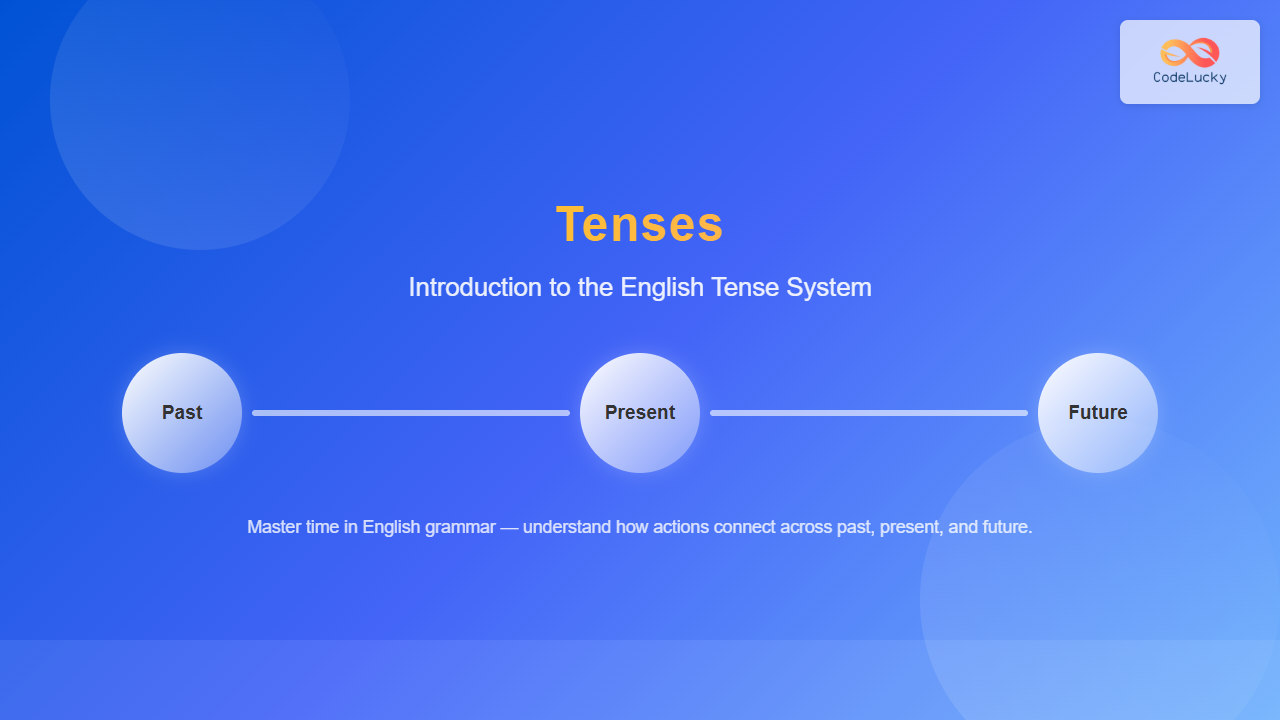
Tenses form the backbone of English grammar. Whether you’re writing an email, telling a story, or giving instructions, the time when an action happens matters. Understanding the English tense system helps express time relationships clearly and accurately — a crucial skill for fluency in any context.
What Are Tenses?
Tenses indicate the time at which an action occurs — in the past, present, or future. They also communicate the state or completion of an action. In English grammar, there are three main tenses, each having four sub-types:
- Present Tense – Describes actions happening now.
- Past Tense – Describes actions that already happened.
- Future Tense – Describes actions that will happen in the future.

1. Present Tense
The present tense describes actions happening right now, routines, habits, or universal truths. It has four forms:
a) Simple Present
Structure: Subject + base verb (add ‘s’ or ‘es’ for singular subjects)
Example: She runs every morning.
b) Present Continuous
Structure: Subject + is/am/are + verb(+ing)
Example: They are studying English now.
c) Present Perfect
Structure: Subject + has/have + past participle
Example: I have finished my work.
d) Present Perfect Continuous
Structure: Subject + has/have + been + verb(+ing)
Example: He has been reading for two hours.

2. Past Tense
The past tense expresses actions or situations that happened earlier. It includes four types as well:
a) Simple Past
Structure: Subject + past form of verb
Example: She wrote a letter yesterday.
b) Past Continuous
Structure: Subject + was/were + verb(+ing)
Example: They were playing when it rained.
c) Past Perfect
Structure: Subject + had + past participle
Example: I had completed the task before the meeting.
d) Past Perfect Continuous
Structure: Subject + had been + verb(+ing)
Example: She had been studying for hours before the test.

3. Future Tense
The future tense describes actions that will happen later. These are plans, predictions, or intentions.
a) Simple Future
Structure: Subject + will/shall + base verb
Example: We will travel tomorrow.
b) Future Continuous
Structure: Subject + will be + verb(+ing)
Example: I will be waiting for you.
c) Future Perfect
Structure: Subject + will have + past participle
Example: She will have left before you arrive.
d) Future Perfect Continuous
Structure: Subject + will have been + verb(+ing)
Example: By next year, I will have been working here for a decade.

How to Choose the Right Tense
Choosing the correct tense depends on when an action happens and whether it’s complete or ongoing. Here’s a quick reference:
| Time | Type | Example |
|---|---|---|
| Now | Present Continuous | I am reading. |
| Completed before now | Past Perfect | I had eaten. |
| Future plan | Simple Future | I will call you. |
Interactive Practice Tip
To master tenses, try visual timelines or drag-and-drop quizzes that link actions to time frames. For example, align sentences like “He will go,” “He is going,” and “He went” along a timeline to compare their temporal meaning. Such interactivity strengthens pattern recognition in language learners.

Conclusion
Understanding English tenses transforms your language skill from basic to expressive. Use them deliberately to shape time, meaning, and clarity in your sentences. Regular practice, visual aids, and real-life examples are the keys to mastering this essential system.
Next Step: In the next lesson, we’ll dive into Simple Present Tense with daily use cases and common mistakes to avoid.