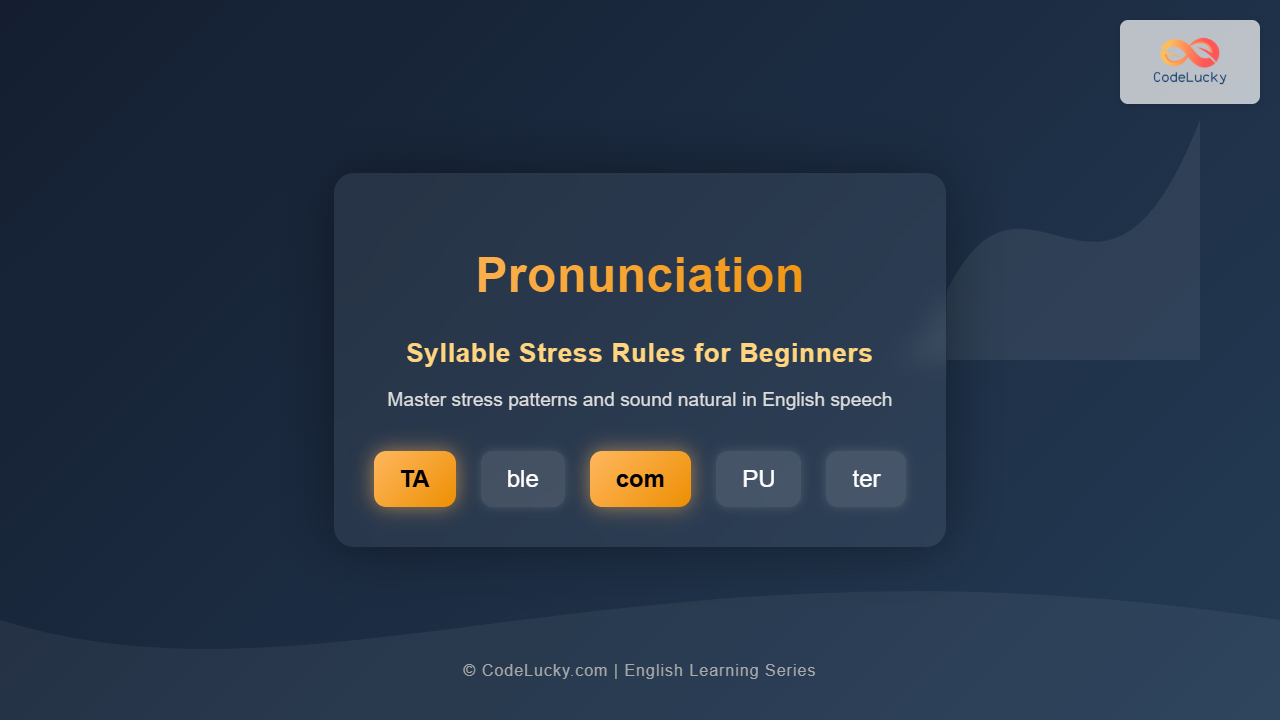
Pronunciation: Syllable Stress Rules for Beginners is one of the most essential topics for learners who want to sound natural in English. Stress means emphasizing one syllable more than the others in a word — by saying it louder, longer, or with a higher pitch. Understanding syllable stress not only helps you communicate clearly but also improves your listening skills.
What Is Syllable Stress?
Every English word with more than one syllable has a pattern of stress. For example:
- TAble → stress on the first syllable
- comPUTer → stress on the second syllable
- phoTOgraph, phoTOgrapher, phoTOgraphy → stress changes depending on the word form
Native speakers automatically apply these patterns, but learners need to understand how stress works to pronounce words correctly.
Why Stress Matters in English
Changing stress can change meaning, grammar, or even cause confusion. Consider these examples:
- CONtract (noun) vs. conTRACT (verb)
- REcord (noun) vs. reCORD (verb)
In both examples, stress placement determines whether the word is a noun or a verb — a crucial distinction in spoken English.
Syllable Stress Basics
Here are foundational rules to identify where stress usually falls:
- Most two-syllable nouns and adjectives are stressed on the first syllable.
Example: TAble, WINdow, HAppy - Most two-syllable verbs and prepositions are stressed on the second syllable.
Example: to reLAX, to beGIN, withIN - For compounds (two joined words), the first word is usually stressed.
Example: POSTman, GREENhouse

Rules for Longer Words
As words get longer, stress patterns become predictable based on suffixes or prefixes:
| Suffix / Prefix | Typical Stress Position | Example |
|---|---|---|
| -tion / -sion | Stress before suffix | inforMAtion, deciSION |
| -ic | Stress before suffix | geoGRAPHic, phoNETic |
| -ity / -ety | Stress three syllables before end | reSPONsibility, soCIety |
| -ee | Stress on the suffix | employEE, traiNEE |
| re-, un-, dis- | Base word decides stress | UNknown, disCOVER |
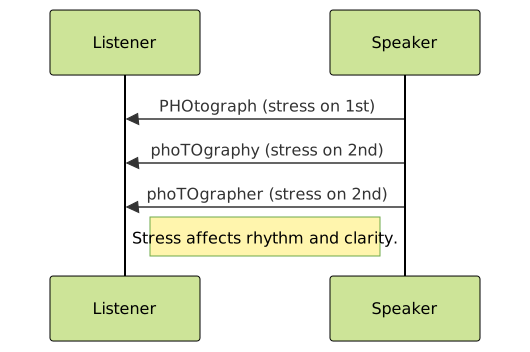
Visualizing Syllable Stress with Rhythmic Marks
You can use symbols to mark stress visually:
- ˈ before a syllable = primary stress
- ˌ = secondary stress
Examples in dictionary form:
- computer → /kəmˈpjuːtə/
- photography → /fəˈtɒɡrəfi/
- responsibility → /rɪˌspɒnsəˈbɪləti/

How to Practice Syllable Stress
- Clap method: Clap for each syllable and emphasize the stressed one. Example: com-PU-ter (clap softly-hard-soft).
- Mirror practice: Watch your mouth movement for stressed syllables — your lips and jaw open wider.
- Record & listen: Compare your stress with a native speaker from a dictionary audio sample.
- Sentence rhythm practice: Try saying: “We DEVelop good PROjects to TEAch LEarners.”

Common Stress Mistakes
- Putting equal stress on all syllables — sounds robotic.
- Missing contrast between stressed and unstressed syllables.
- Ignoring suffix rules — e.g., saying “phoTOgraphy” instead of correct “phoTOgraphy.”
Quick Recap: Syllable Stress Patterns

Practice Challenge
Try identifying stress in these words. Click the syllable (if used interactively) or underline while practicing.
- eduCAtion
- ecoNOMic
- TEAcher
- beGINner
- HAPpiness
Once you get the rhythm, say each word naturally — notice how English feels musical when stressed correctly!
Conclusion
Mastering stress patterns is about rhythm, awareness, and practice. Over time, you’ll feel the natural beat of English speech. Remember, English is stress-timed — some syllables get more prominence, while others become lighter. With the rules and visual examples above, you can start speaking more clearly and confidently today!
Continue your learning journey on CodeLucky.com — where English pronunciation becomes clear, visual, and fun.